• HOME
  • NEWS
  • EXPLORE
    • CAREER
      • Companies
      • Jobs
    • EVENTS
    • iGEM
      • News
      • Team
    • PHOTOS
    • VIDEO
    • WIKI
  • BLOG
  • COMMUNITY
    • FACEBOOK
    • INSTAGRAM
    • TWITTER
Thursday, July 9, 2026
BIOENGINEER.ORG
No Result
View All Result
  • Login
  • HOME
  • NEWS
  • EXPLORE
    • CAREER
      • Companies
      • Jobs
        • Lecturer
        • PhD Studentship
        • Postdoc
        • Research Assistant
    • EVENTS
    • iGEM
      • News
      • Team
    • PHOTOS
    • VIDEO
    • WIKI
  • BLOG
  • COMMUNITY
    • FACEBOOK
    • INSTAGRAM
    • TWITTER
  • HOME
  • NEWS
  • EXPLORE
    • CAREER
      • Companies
      • Jobs
        • Lecturer
        • PhD Studentship
        • Postdoc
        • Research Assistant
    • EVENTS
    • iGEM
      • News
      • Team
    • PHOTOS
    • VIDEO
    • WIKI
  • BLOG
  • COMMUNITY
    • FACEBOOK
    • INSTAGRAM
    • TWITTER
No Result
View All Result
Bioengineer.org
No Result
View All Result
Home NEWS Science News Science

Development of a displacement sensor to measure gravity of smallest source mass ever

Bioengineer by Bioengineer
May 19, 2019
in Science
Reading Time: 2 mins read
0
IMAGE
Share on FacebookShare on TwitterShare on LinkedinShare on RedditShare on Telegram

IMAGE

Credit: Nobuyuki Matsumoto, Tohoku University

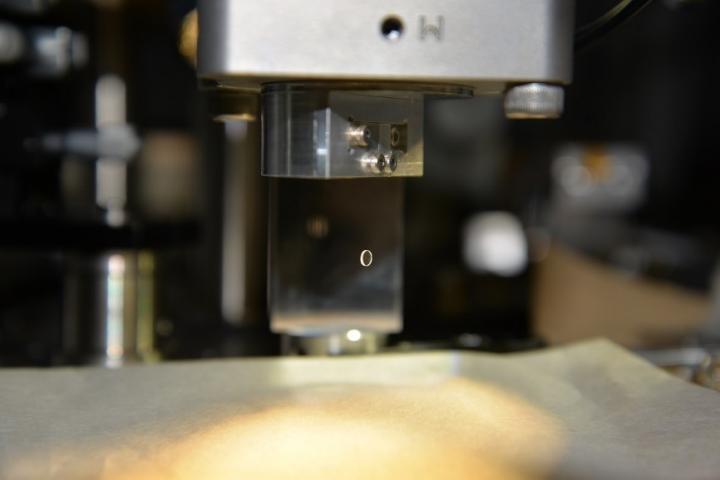
One of the most unknown phenomena in modern physics is gravity. Its measurement and laws remain somewhat of an enigma. Researchers at Tohoku University have revealed important information about a new aspect of the nature of gravity by probing the smallest mass-scale.

Professor Nobuyuki Matsumoto has led a team of researchers to develop a gravity sensor based on monitoring the displacement of a suspended mirror, which allows for measuring the gravity of the smallest mass ever.

The research team was interested in whether the nature of gravity is classical or quantum. “Within the past hundred years, our understanding of nature has deepened based on quantum theory and general relativity. In order to keep moving forward with this progress, it is necessary to understand more about the nature of gravity,” said Matsumoto.

Until now the smallest mass for which humans have measured a gravitational field is about 100g, which is surprisingly larger than the mass scale of a common pencil (~10g). Because the gravitational force is much weaker than other forces, such as the electromagnetic force, it is difficult to measure gravity generated by small masses.

Matsumoto stated that “the system was made based on the technology developed for gravitational wave detectors, e.g. laser stabilization, a vibration isolation stage , high vacuum and noise hunting. Unlike gravitational wave detectors, we used a triangular optical cavity, not a linear optical cavity in order to decrease the noise level of the displacement sensor and maintain stable operation of the sensor. Our system’s noise level, due to the Brownian motion of the suspended mirror, is one of the smallest in the world.”

Development of such a gravity sensor will pave the way for a new class of experiments where gravitational coupling between small masses in quantum regimes can be achieved.

###

Media Contact
Nobuyuki Matsumoto
[email protected]

Original Source

https://www.tohoku.ac.jp/en/press/sensor_to_measure_gravity_generated.html

Related Journal Article

http://dx.doi.org/10.1103/PhysRevLett.122.071101

Tags: Technology/Engineering/Computer Science
Share14Tweet8Share2ShareShareShare2

Related Posts

Five or more hours of smartphone usage per day may increase obesity

July 25, 2019
IMAGE

NASA’s terra satellite finds tropical storm 07W’s strength on the side

July 25, 2019

NASA finds one burst of energy in weakening Depression Dalila

July 25, 2019

Researcher’s innovative flood mapping helps water and emergency management officials

July 25, 2019
Please login to join discussion

POPULAR NEWS

  • Detection of EDCs in Breast Milk and Infant Urine Up to Six Months Highlights Early Exposure Risks

    77 shares
    Share 31 Tweet 19
  • New Drug Candidate Developed at McMaster Shows Potential for Treating Brain Cancer

    58 shares
    Share 23 Tweet 15
  • KTU Researchers Explore Ultrasound’s Role in Enhancing Blood Flow Beyond Diagnostics

    53 shares
    Share 21 Tweet 13
  • 高齢者の骨粗鬆症治療の持続性比較

    51 shares
    Share 20 Tweet 13

About

We bring you the latest biotechnology news from best research centers and universities around the world. Check our website.

Follow us

Recent News

Cement Production Linked to Microplastic Pollution in Groundwater, Study Finds

Olaparib Benefits HR-Deficient TNBC and Platinum-Sensitive Ovarian Cancers

Scientists Quantify Substances Extracted by Cupping Therapy from Skin

Subscribe to Blog via Email

Enter your email address to subscribe to this blog and receive notifications of new posts by email.

Join 83 other subscribers
  • Contact Us

Bioengineer.org © Copyright 2023 All Rights Reserved.

Welcome Back!

Login to your account below

Forgotten Password?

Retrieve your password

Please enter your username or email address to reset your password.

Log In
No Result
View All Result
  • Homepages
    • Home Page 1
    • Home Page 2
  • News
  • National
  • Business
  • Health
  • Lifestyle
  • Science

Bioengineer.org © Copyright 2023 All Rights Reserved.