• HOME
  • NEWS
  • EXPLORE
    • CAREER
      • Companies
      • Jobs
    • EVENTS
    • iGEM
      • News
      • Team
    • PHOTOS
    • VIDEO
    • WIKI
  • BLOG
  • COMMUNITY
    • FACEBOOK
    • INSTAGRAM
    • TWITTER
Friday, June 26, 2026
BIOENGINEER.ORG
No Result
View All Result
  • Login
  • HOME
  • NEWS
  • EXPLORE
    • CAREER
      • Companies
      • Jobs
        • Lecturer
        • PhD Studentship
        • Postdoc
        • Research Assistant
    • EVENTS
    • iGEM
      • News
      • Team
    • PHOTOS
    • VIDEO
    • WIKI
  • BLOG
  • COMMUNITY
    • FACEBOOK
    • INSTAGRAM
    • TWITTER
  • HOME
  • NEWS
  • EXPLORE
    • CAREER
      • Companies
      • Jobs
        • Lecturer
        • PhD Studentship
        • Postdoc
        • Research Assistant
    • EVENTS
    • iGEM
      • News
      • Team
    • PHOTOS
    • VIDEO
    • WIKI
  • BLOG
  • COMMUNITY
    • FACEBOOK
    • INSTAGRAM
    • TWITTER
No Result
View All Result
Bioengineer.org
No Result
View All Result
Home NEWS Science News Chemistry

Scientists develop ultrasensitive organic phototransistors based on novel hybrid-layered architecture

Bioengineer by Bioengineer
May 15, 2019
in Chemistry
Reading Time: 2 mins read
0
IMAGE
Share on FacebookShare on TwitterShare on LinkedinShare on RedditShare on Telegram

IMAGE

Credit: LI Jia

Organic phototransistors (OPTs) are widely used in environmental/health monitoring, quantum communication, chemical/biomedical sensing, remote control, surveillance and image sensors since they are lightweight, low cost, highly efficient and environmentally friendly.

The interfacial charge effect is very crucial for high-sensitivity OPTs. Conventional layered and hybrid OPTs suffer from tradeoffs in balancing the separation, transport, and recombination of photogenerated charges.

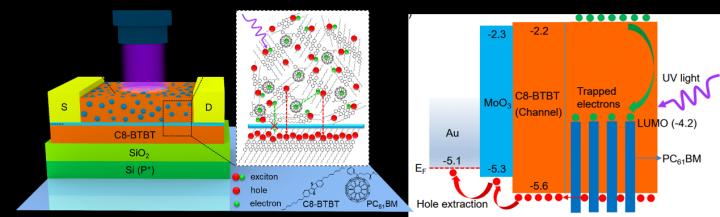
Prof. LI Jia and GAO Yuanhong from the Shenzhen Institutes of Advanced Technology (SIAT) of the Chinese Academy of Sciences and their collaborators developed a novel hybrid-layered architecture to improve the overall photodetection performance of organic phototransistors by simultaneously taking advantages of the charge-trapping effect and efficient carrier transport. Their findings were published in Advanced Materials.

The structure of the novel hybrid-layered phototransistor (HL-OPT) consists of a high mobility organic semiconductor channel layer for fast carrier transport, an organic bulk heterojunction (BHJ) photoactive layer, and an ultrathin inorganic interlayer sandwiched in between.

Excitons generated in the photoactive layer dissociated into electrons and holes at the donor/acceptor BHJ. The generated electrons were readily trapped by the acceptors nearby and holes were injected into the channel layer to increase carrier concentration.

An inorganic interlayer was chosen to further enhance hole injection and block electrons, subsequently suppressing electron-hole recombination. As a result, by combining the virtues of the charge-trapping effect and fast carrier transport, significant enhancement in the overall photodetection performance was achieved from the HL-OPT.

To evaluate potential applications of the high-performance HL-OPT, the researchers fabricated the devices on flexible substrates and confirmed their excellent flexibility. Meanwhile, the devices were also integrated into a one-dimensional array and demonstrated the reliability of the HL-OPT in photosensitive imaging systems. “These successful trials make the HL-OPT particularly appealing for applications in flexible and wearable optoelectronic devices,” said Prof. LI.

This work provides new insights into the design and optimization of high-performance photodetectors, spanning the ultraviolet and near infrared ranges, and suggests fundamental topics pertaining to electronic and photonic properties of the devices.

“Another exciting point is that this organic photodetector can be potentially fabricated by using printing techniques, which would further reduce the processing cost,” said LI. “I hope this work can provide the market with a promising solution for photodetectors by combining both high performance and low cost.”

###

Media Contact
Zhang Xiaomin
[email protected]

Original Source

http://english.cas.cn/

Related Journal Article

http://dx.doi.org/10.1002/adma.201900763

Tags: Atomic/Molecular/Particle PhysicsChemistry/Physics/Materials SciencesMaterialsParticle Physics
Share12Tweet8Share2ShareShareShare2

Related Posts

AI and Physics Collaborate to Design Advanced Hydrogen Storage Materials

June 25, 2026

International Team Including Dresden Scientists Develops Novel Designer Proteins for Advanced Study of Living Tissue

June 25, 2026

New Study Uncovers Key Factors Driving Water Chemistry in Nanoscale Environments

June 25, 2026

Plasma Technology Extends Catalyst Lifespan in Hydrogen Production

June 24, 2026
Please login to join discussion

POPULAR NEWS

  • Saying Goodbye to PGY-6: Pediatric Fellowship Realities

    103 shares
    Share 41 Tweet 26
  • Multi-Hospital Study Reveals Long Covid Burden Is Twice as High as Current Estimates

    92 shares
    Share 36 Tweet 23
  • Detection of EDCs in Breast Milk and Infant Urine Up to Six Months Highlights Early Exposure Risks

    77 shares
    Share 31 Tweet 19
  • New Drug Candidate Developed at McMaster Shows Potential for Treating Brain Cancer

    58 shares
    Share 23 Tweet 15

About

We bring you the latest biotechnology news from best research centers and universities around the world. Check our website.

Follow us

Recent News

Tracking Lanthanide-Labeled Microplastics in Plants

POSTECH Researchers Slash Cost of Reconstituted Cell-Free Systems by 95%

AI and Physics Collaborate to Design Advanced Hydrogen Storage Materials

Subscribe to Blog via Email

Success! An email was just sent to confirm your subscription. Please find the email now and click 'Confirm' to start subscribing.

Join 82 other subscribers
  • Contact Us

Bioengineer.org © Copyright 2023 All Rights Reserved.

Welcome Back!

Login to your account below

Forgotten Password?

Retrieve your password

Please enter your username or email address to reset your password.

Log In
No Result
View All Result
  • Homepages
    • Home Page 1
    • Home Page 2
  • News
  • National
  • Business
  • Health
  • Lifestyle
  • Science

Bioengineer.org © Copyright 2023 All Rights Reserved.