Credit: ©Science China Press
Recently, multi-component materials have become one of the most promising materials in the engineering and biomedical applications. Compared with traditional alloys, the composition design of multi-component materials is more complicated, and lots of alloys with different compositions need to be prepared and tested. In addition, the relationship between the mixing entropy and performance of multi-component materials are nonlinear, thereby the structure and performance cannot be effectively predicted by mixing entropy values, which makes it more difficult to design the alloys efficiently. In this case, high-throughput technology is effective way to solve this issue. A recent study reported that high-throughput screening of the composition and Young’s modulus of Ti-Zr-Nb alloy was successfully achieved by co-sputtering technology with the aid of a physical mask.
The research paper, entitled “High-throughput screening for biomedical applications in a Ti-Zr-Nb alloy system through masking co-sputtering”, is published in SCIENCE CHINA Physics, Mechanics & Astronomy in Issue 9 of 2019, with Prof. Yong Zhang from Beijing University of Science and Technology as the corresponding author.
To develop the new alloys with special properties, e.g., excellent mechanical properties, or biomedical properties, is usually a time-consuming process. The conventional “trial and error” method cannot meet the requirements. On the other hand, owing to the limitations of research methods, only few specific compositions can be obtained from a set of experiments using conventional methods.
Taking biomedical materials as an example, the obtained low Young’s modulus value is generally a relatively low value in a small composition region, rather than the lowest value of a global system. Therefore, the conventional “trial and error” method inevitably causes incompleteness and contingency in research results.
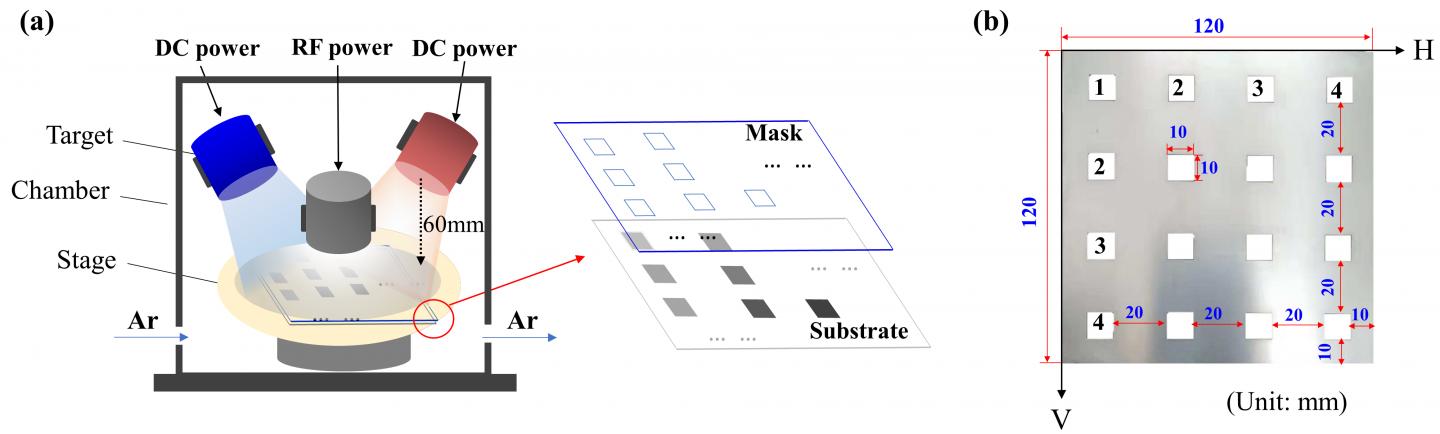
High-throughput technology is an effective way to obtain a composition with desirable properties in a larger composition region while improving efficiency. On the basis of multi-target co-sputtering, an auxiliary physical mask was used to facilitate the preparation of compositional gradient materials and 16 independent specimens were obtained in this work.
Particularly, the Young’s modulus of the Ti-Zr-Nb alloys were tested by nanoindentation. The tested Young’s modulus values were fitted to 3D surface maps and contour maps, as shown in Figure 2. Significantly, a low Young’s modulus region is evident in Figure 2(a). To determine whether a lower modulus composition existed in the blank areas between the specimens with lower Young’s moduli, further optimization of the composition was conducted. Based on the screening results, the formation, structure and mechanical properties of bulk alloys can be further discussed in detail.
It should be noted that the application of the physical mask is necessary to prevent component diffusion between the sample units. In general, the composition of the materials obtained by the multi-target co-sputtering could be continuously changed, which means that the process of component diffusion is inevitable. To ensure the composition difference of the specimens, a separate mask has been used in this work.
This work not only offers novel multi-component alloys with prominent properties for practical applications, but also shed new light on development of high-throughput preparation technology in general.
###
This work was supported by the National Natural Science Foundation of China (NSFC, Grant No. 51671020).
See the article:
Xue-Hui Yan, Jiang Ma, and Yong Zhang, High-throughput screening for biomedical applications in a Ti-Zr-Nb alloy system through masking co-sputtering, Sci. China-Phys. Mech. Astron. 62, 996111 (2019), https:/
http://engine.
Media Contact
Zhang Yong
[email protected]
Related Journal Article
http://dx.