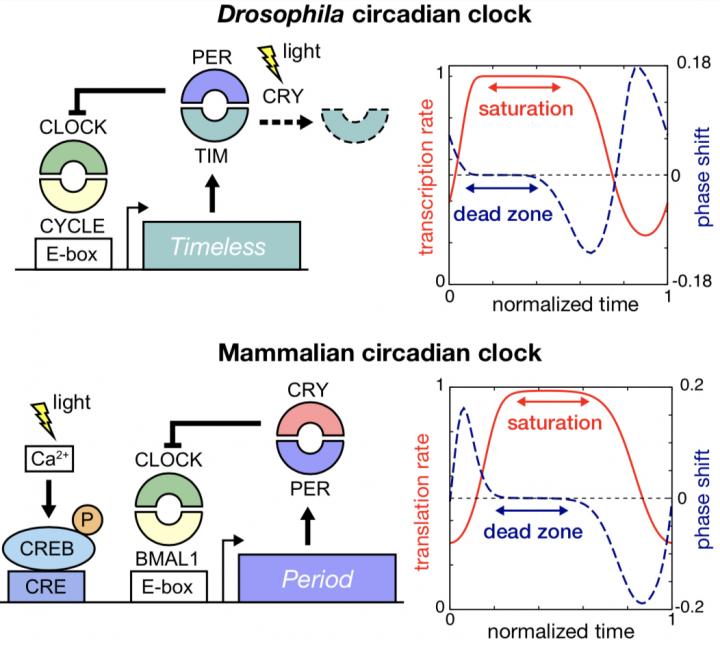
Credit: Kanazawa University
[Background]
Most organisms on Earth have circadian clocks. In mammals, the circadian pacemaker is located in the suprachiasmatic nucleus (SCN) of the brain. The SCN consists of about 20,000 neurons, and oscillatory gene expression with an approximate 24-hour period can be observed independently in each. These cell-autonomous oscillations of gene expression are controlled by delayed negative feedback regulation of circadian clock genes, and function as a circadian clock to regulate the behavioral and physiological rhythms of organisms.
One of the important properties of circadian clocks is the response to light signals, which enables organisms to become entrained to the 24-hour light-dark cycle on Earth. It has been shown that circadian clocks respond to light signals during the night, whereas they do not respond to such signals during the daytime. This holds true even when an organism is kept in complete darkness; a short light pulse does not change the time of the circadian clock when body time of the individual is at daytime. The time period in which the circadian clock is insensitive to light signals is referred to as the “dead zone”. Previous studies have indicated that the presence of a dead zone improves the robustness of the clock. However, the mechanism underlying its generation is unclear.
[Results]
Researchers from Kanazawa University used mathematical modeling and computer simulations to elucidate the mechanism underlying dead-zone generation. Different species have different light-response mechanisms. For example, in the circadian clock system of the fruit fly Drosophila, light signals induce degradation of the circadian repressor protein TIMELESS. In contrast, in mammals, light signals are perceived by the eyes and induce expression of the circadian clock gene Period within the SCN. These differences led researchers from Kanazawa University to question whether the mechanisms for dead-zone generation in these two species are common or distinct.
To address this question, the researchers utilized a mathematical model called the Goodwin Model. This model was used to describe a negative feedback loop in the circadian clock system by considering the concentrations of mRNA and protein as variables. Numerical simulations demonstrated that saturation of transcription of Timeless mRNA induces the generation of a daytime dead zone in the Drosophila circadian clock. In the mammalian circadian clock, saturation of translation, rather than transcription, of PERIOD protein generates a dead zone. Computer simulations demonstrated that saturation of these reactions nullifies the effect of light signals only during the daytime. Thus, saturation of the synthesis of a repressor protein in the negative feedback loop that regulates circadian oscillation may be a conserved mechanism for generating daytime dead zones among different species.
[Significance and future prospects]
The dead zone is considered to be important for robust entrainment of circadian clocks to light-dark cycles. The present study shows that, in principle, even single neurons can realize a dead
zone. This finding suggests that the fundamental properties of circadian clocks are determined at the single-cell level.
Entrainment of the circadian clock to light-dark cycles is fundamental to human health. For example, a mismatch between clock time within the body and the time in a local place can cause jet-lag. Thus, studying the response of the circadian clock to light signals is essential in order to understand one of the most common biological clocks on Earth, which may have medical utility.
###
Media Contact
Tomoya Sato
[email protected]
Original Source
https:/
Related Journal Article
http://dx.