The ultra-high efficiency material called a tandem perovskite solar cell is being developed to help solve the world energy crisis.
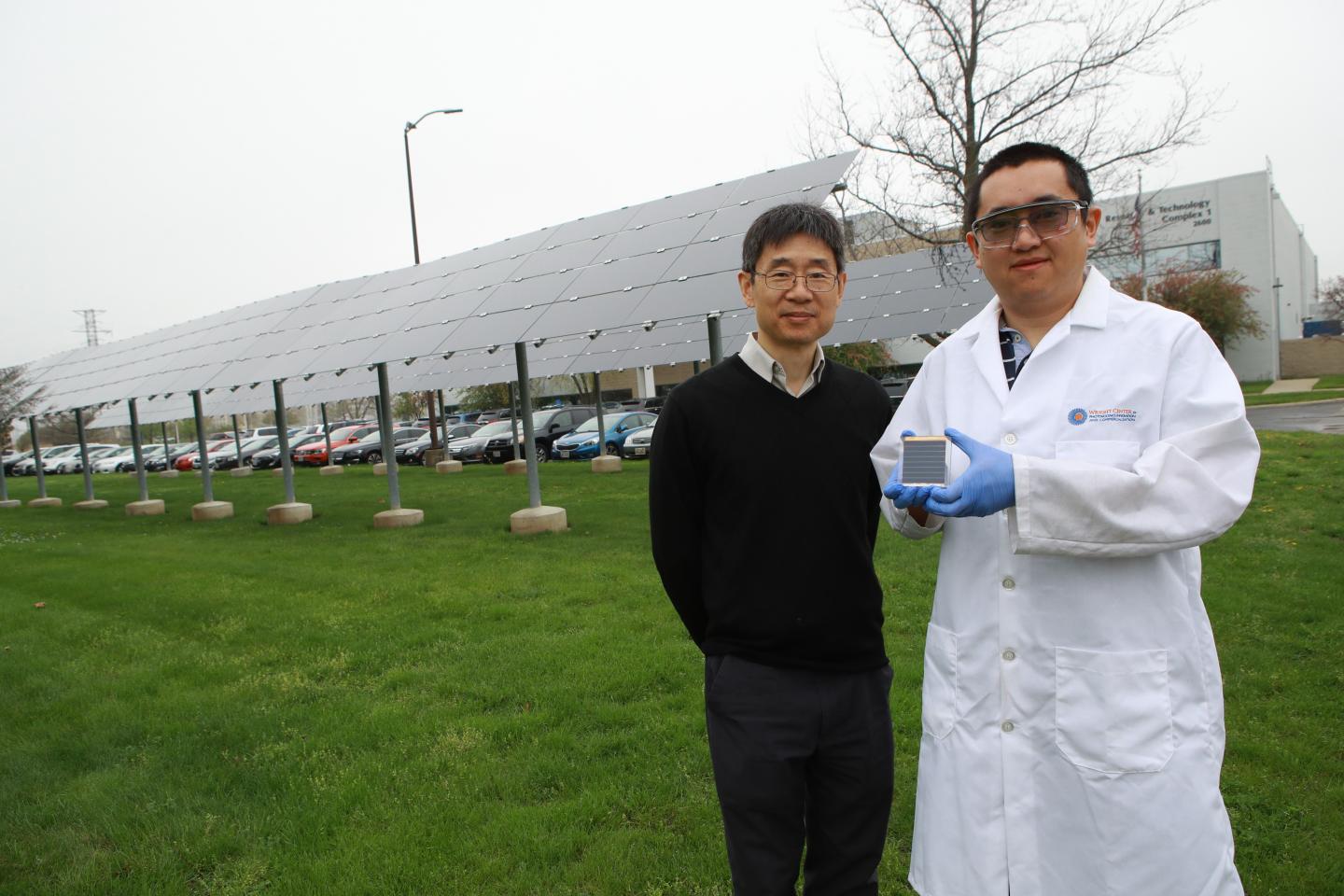
Credit: Daniel Miller, The University of Toledo
The most affordable, efficient way to harness the cleanest, most abundant renewable energy source in the world is one step closer to reality.
The University of Toledo physicist pushing the performance of solar cells to levels never before reached made a significant breakthrough in the chemical formula and process to make the new material.
Working in collaboration with the U.S. Department of Energy’s National Renewable Energy Lab and the University of Colorado, Dr. Yanfa Yan, UToledo professor of physics, envisions the ultra-high efficiency material called a tandem perovskite solar cell will be ready to debut in full-sized solar panels in the consumer market in the near future.
Perovskites, compound materials with a special crystal structure formed through chemistry, would replace silicon, which – for now – remains the solar-cell material of choice for converting the sun’s light into electrical energy.
“We are producing higher-efficiency, lower-cost solar cells that show great promise to help solve the world energy crisis,” Yan said. “The meaningful work will help protect our planet for our children and future generations. We have a problem consuming most of the fossil energies right now, and our collaborative team is focused on refining our innovative way to clean up the mess.”
The new research paper, which is published in the journal Science, outlines how the photovoltaics team is fine-tuning a mix of lead and tin to advance the technology closer to its maximum efficiency. Efforts have currently brought the efficiency of the new solar cell to about 23 percent. In comparison, silicon solar panels on the market today have around an 18 percent efficiency rating.
Scientists used a chemical compound called guanidinium thiocyanate to dramatically improve the structural and optoelectronic properties of the lead-tin mixed perovskite films.
“Science is the top academic journal in the world, alongside Nature, which published other research by Dr. Yan only five months ago after he discovered a single material that produces white light, which could boost the efficiency and appeal of LED bulbs,” Dr. Sanjay Khare, professor and chair of the UToledo Department of Physics and Astronomy, said. “His significant sustainability work at The University of Toledo can help power the world using clean energy.”
About five years ago Yan’s team at UToledo identified the ideal properties of perovskites and he has since focused his 20 years of experience on producing an all-perovskite tandem solar cell that brings together two different solar cells to increase the total electrical power generated by using two different parts of the sun’s spectrum.
Last month the U.S. Department of Energy awarded Yan a $1.1 million grant to continue his research in collaboration with the National Renewable Energy Lab.
“This is the material we’ve been waiting for for a long time,” Yan said. “The solar industry is watching and waiting. Some have already started investing in this technology.”
Yan is an expert in theory of defect physics and electronic properties in semiconductors, materials synthesis and thin-film solar-cell fabrication.
“Our UToledo research is ongoing to make cheaper and more efficient solar cells that could rival and even outperform the prevailing silicon photovoltaic technology,” said Dr. Zhaoning Song, research assistant professor in the UToledo Department of Physics and Astronomy and co-author on the study. “Our tandem solar cells with two layers of perovskites deliver high power conversion efficiency and have the potential to bring down production costs of solar panels, which is an important advance in photovoltaics.”
While Yan’s team has improved the quality of the materials and the process to manufacture them at a low cost, more progress needs to be made.
“The material cost is low and the fabrication cost is low, but the lifetime of the material is still an unknown,” Song said. “We need to continue to increase efficiency and stability.”
“Also, lead is considered a toxic substance,” Yan said. “I am determined to work with the solar industry to ensure solar panels made of this material can be recycled so they don’t cause harm to the environment.”
###
Media Contact
Christine Billau
[email protected]
Related Journal Article
http://dx.