• HOME
  • NEWS
  • EXPLORE
    • CAREER
      • Companies
      • Jobs
    • EVENTS
    • iGEM
      • News
      • Team
    • PHOTOS
    • VIDEO
    • WIKI
  • BLOG
  • COMMUNITY
    • FACEBOOK
    • INSTAGRAM
    • TWITTER
Tuesday, March 31, 2026
BIOENGINEER.ORG
No Result
View All Result
  • Login
  • HOME
  • NEWS
  • EXPLORE
    • CAREER
      • Companies
      • Jobs
        • Lecturer
        • PhD Studentship
        • Postdoc
        • Research Assistant
    • EVENTS
    • iGEM
      • News
      • Team
    • PHOTOS
    • VIDEO
    • WIKI
  • BLOG
  • COMMUNITY
    • FACEBOOK
    • INSTAGRAM
    • TWITTER
  • HOME
  • NEWS
  • EXPLORE
    • CAREER
      • Companies
      • Jobs
        • Lecturer
        • PhD Studentship
        • Postdoc
        • Research Assistant
    • EVENTS
    • iGEM
      • News
      • Team
    • PHOTOS
    • VIDEO
    • WIKI
  • BLOG
  • COMMUNITY
    • FACEBOOK
    • INSTAGRAM
    • TWITTER
No Result
View All Result
Bioengineer.org
No Result
View All Result
Home NEWS Science News Health

Inhibition of ribosome biogenesis as a novel approach for multi-stage cancer treatment

Bioengineer by Bioengineer
May 8, 2019
in Health
Reading Time: 2 mins read
0
IMAGE
Share on FacebookShare on TwitterShare on LinkedinShare on RedditShare on Telegram

IMAGE

Credit: Vincent et al.

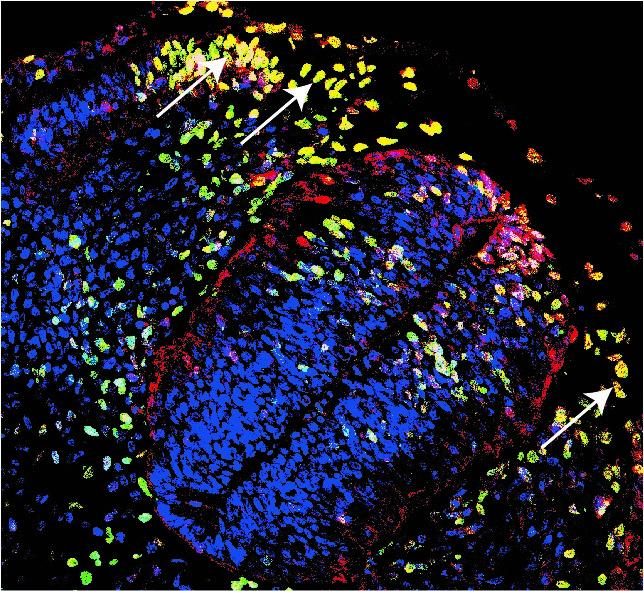
Nearly ninety per cent of all cancer patient deaths are due to metastasis. A study from Uppsala University shows that a process that allows the cells to metastasise is aided by the synthesis of new ribosomes, the cell components in which proteins are produced. The results open the possibility for new treatment strategies for advanced cancers. The study is published in Nature Communications.

As tumours progress towards advanced stages they dedifferentiate, become more aggressive and lose the characteristics of the origin tissue. They also acquire the migratory capacity that allows the tumour to spread or metastasize to distant sites in the body, eventually causing patient death.

For epithelial tumours to metastasis the tumour cells undergo a process known as the epithelial-to-mesenchymal transition (EMT), which allows the cells to develop migratory ability. During EMT, cells also lose their proliferative capacity and become more stem-like. This remarkable transition leads to both increased invasiveness and an ability to evade numerous cancer treatments including hormonal therapies.

In the present study the researchers found that EMT is aided by the synthesis of new ribosomes, which serve to synthesize the proteins required for cell functions. Their study therefore argues that ribosome biogenesis may be more than just a pro-proliferative process.

“Until recently, ribosomes have been considered to play only passive roles during the production of proteins. Our study shows that ribosomes potentially have complex, active roles and suggests that more attention should be given to understanding how ribosomes contribute to cell physiology in health and disease states,” says Theresa Vincent, group leader at the Department of Immunology, Genetics and Pathology at Uppsala University, who has led the study together with Scott C. Blanchard at Weill Cornell Medicine, USA.

The researchers also demonstrated that by inhibiting the formation of new ribosomes, aggressive and hormone insensitive tumours could be partially reverted to a benign and non-metastatic type.

“We used a small molecule called CX-5461 to inhibit ribosome biogenesis in mouse models of human tumours. We found that primary tumours reverted from an invasive type to a non-invasive type as well as potentially regaining sensitivity to hormonal therapy. Importantly, CX-5461 treatment also resulted in a marked reduction of number lung metastases. This suggests that treatment with CX-5461 may enhance hormone therapy responsiveness in patients where this kind of treatment doesn’t work any more. We find this to be a remarkable breakthrough and we are currently pursuing a number of additional validation studies,” says Theresa Vincent.

###

The study was by performed by a multi-institutional group of scientists from Uppsala University, Karolinska Institutet and Lund University in Sweden, together with researchers in USA, Austria, Spain and United Arab Emirates.

Media Contact
Theresa Vincent
[email protected]

Original Source

http://www.uu.se/en/news-media/press-releases/press-release/?id=4694&area=3,8&typ=pm&lang=en

Related Journal Article

http://dx.doi.org/10.1038/s41467-019-10100-8

Tags: cancerCell BiologyMedicine/Health
Share12Tweet8Share2ShareShareShare2

Related Posts

New Index Links Neighborhood Factors to Heart Disease

March 31, 2026

Homoharringtonine Extends Lifespan, Fights Obesity in Mice

March 31, 2026

9 Essential Steps for Lifelong Heart-Healthy Eating

March 31, 2026

Transforming Muscles into Motors Breathes New Life into Static Organs

March 31, 2026
Please login to join discussion

POPULAR NEWS

  • blank

    Revolutionary AI Model Enhances Precision in Detecting Food Contamination

    96 shares
    Share 38 Tweet 24
  • Imagine a Social Media Feed That Challenges Your Views Instead of Reinforcing Them

    1006 shares
    Share 398 Tweet 249
  • Promising Outcomes from First Clinical Trials of Gene Regulation in Epilepsy

    51 shares
    Share 20 Tweet 13
  • Advancements in EV Battery Technology to Surpass Climate Change-Induced Degradation

    45 shares
    Share 18 Tweet 11

About

We bring you the latest biotechnology news from best research centers and universities around the world. Check our website.

Follow us

Recent News

New Index Links Neighborhood Factors to Heart Disease

Homoharringtonine Extends Lifespan, Fights Obesity in Mice

9 Essential Steps for Lifelong Heart-Healthy Eating

Subscribe to Blog via Email

Success! An email was just sent to confirm your subscription. Please find the email now and click 'Confirm' to start subscribing.

Join 78 other subscribers
  • Contact Us

Bioengineer.org © Copyright 2023 All Rights Reserved.

Welcome Back!

Login to your account below

Forgotten Password?

Retrieve your password

Please enter your username or email address to reset your password.

Log In
No Result
View All Result
  • Homepages
    • Home Page 1
    • Home Page 2
  • News
  • National
  • Business
  • Health
  • Lifestyle
  • Science

Bioengineer.org © Copyright 2023 All Rights Reserved.