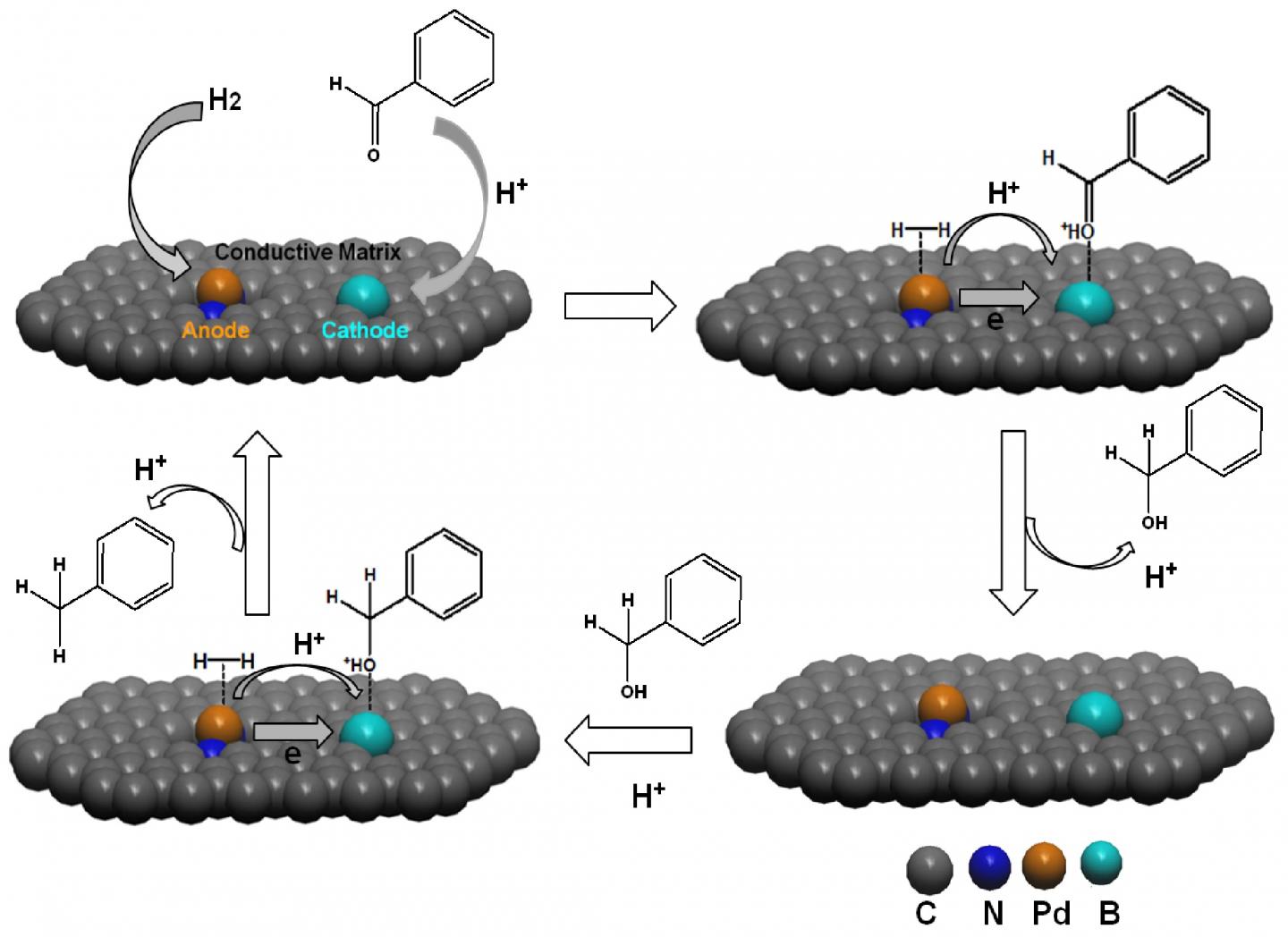
Credit: ©Science China Press
Chemical reactions are involving directional migration of electrons and charged intermediates, depending on the redox potentials of different reactive sites. The chemical energy can be converted into electrical energy when the chemical reactions are occurred in fuel cell devices. However, restricted by the high energy barriers of chemical reactions, numerous chemical reactions have to be performed under harsh conditions or in the presence catalysts by changing the reaction paths, even though the Gibbs free energy is much less than zero. Recently, a new kind of integrated catalyst system, denoted as nanomicrocell catalysts, was developed, which opened a new window for development of highly efficient catalysts by markedly reducing the energy barriers of chemical reactions.
This work was reported in Science Bulletin (2019, 64, 385-390), entitled “Reducing energy barriers of chemical reactions with a nanomicrocell catalyst consisting of integrated active sites in conductive matrices” by Chuan-De Wu et al. from Zhejiang University. Inspired by the natural phenomena, such as steel corrosion, the authors proposed a new kind of integrated catalyst system, denoted as nanomicrocell catalysts, consisting of different redox-active sites with different oxidation-reduction potentials and catalytic properties immobilized on conductive matrices. Similar to traditional fuel cells, the nanomicrocell catalyst system integrates paired anodes and cathodes that are connected by nanosized conductive matrices, which could significantly improve the catalytic efficiency in chemical reactions.
The authors prepared a nanomicrocell catalyst, consisting of boron-and-nitrogen co-doped carbon nanodots (denoted as BNCDs) and immobilized Pd species by coordinating with N atoms, to study the catalytic properties of the proof-of-concept catalyst system. In the nanomicrocell catalyst, BNCDs were used as conductive matrices, immobilized Pd species on N sites as anode and electron-deficient B atoms as cathode. The authors selected catalytic hydrogenation of benzaldehyde as a model reaction to study the roles of different constituent elements in the catalyst system on the catalytic properties. Detailed experimental results showed that the catalytic properties of the nanomicrocell catalyst in hydrogenation of benzaldehyde are highly depending on the selective adsorption and catalytic activation of different reactants by different redox-active electrodes, and transportation efficiency of electrons and charge carriers.
According to the results obtained in this work, the nanomicrocell catalyst system provides a new perspective to illustrate many difficultly understood phenomena in catalytic reactions, and opens up a new window for the designed synthesis of advanced catalysts to improve the catalytic properties by markedly reducing chemical reaction energy barriers. The nanomicrocell catalyst system also provides new way for development of inhibitory catalysts to decelerate chemical reactions in corrosion protection field, and preparation of efficient electrocatalysts and photocatalysts.
###
This work was supported by the National Nature Science Foundation of China (21373180, 21525312 and 21872122).
See the article:
Guo-Peng Zhan, Chuan-De Wu. Reducing energy barriers of chemical reactions with a nanomicrocell catalyst consisting of integrated active sites in conductive matrices. Science Bulletin, 2019, 64(6): 385-390
https:/
Media Contact
WU Chuan-De
[email protected]
Related Journal Article
http://dx.