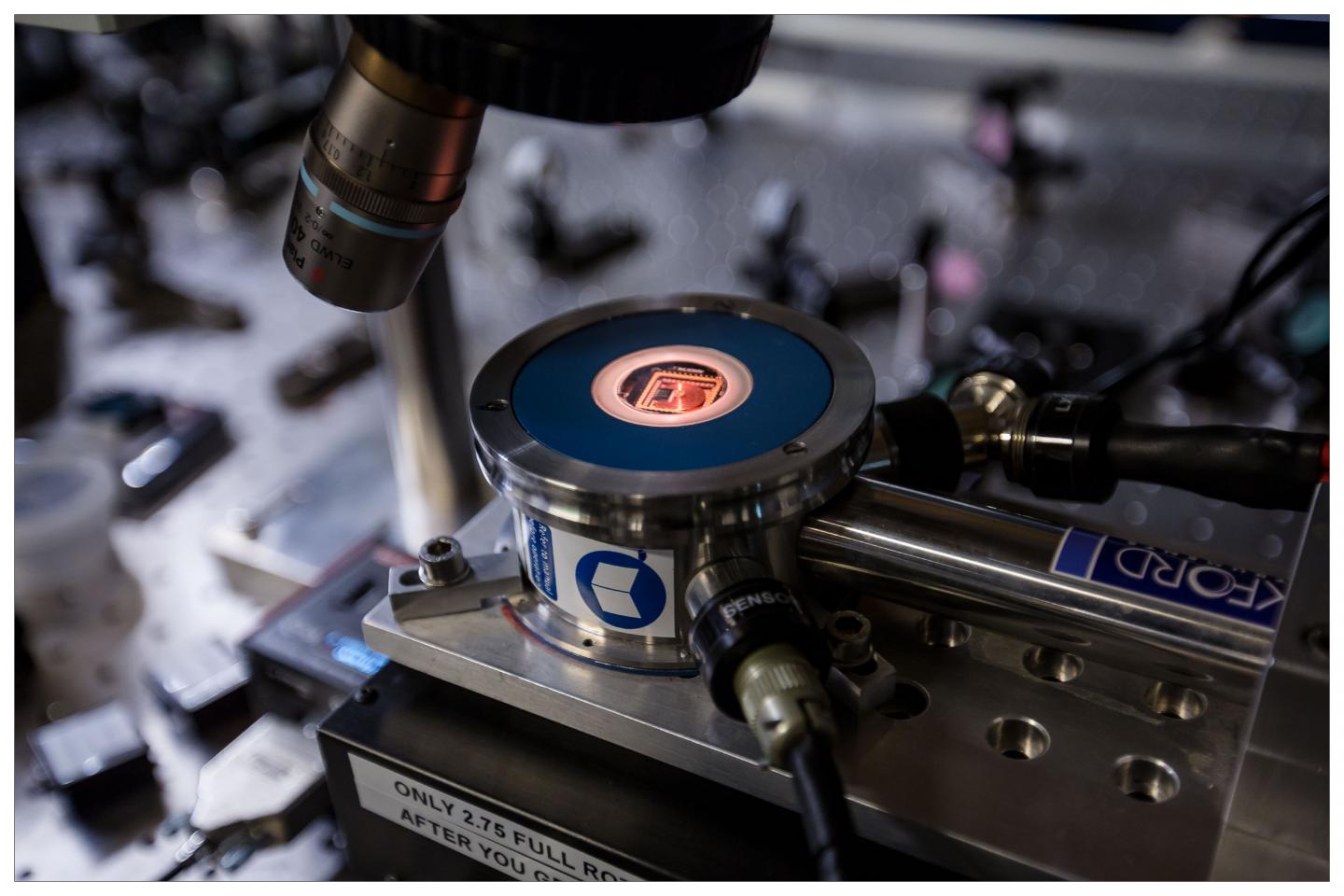
Credit: Ola Jakup
QUANTUM PHYSICS: University of Copenhagen researchers have developed a nanocomponent that emits light particles carrying quantum information. Less than one-tenth the width of a human hair, the miniscule component makes it possible to scale up and could ultimately reach the capabilities required for a quantum computer or quantum internet. The research result puts Denmark at the head of the pack in the quantum race.
Teams around the world are working to develop quantum technologies. The focus of researchers based at the Center for Hybrid Quantum Networks (Hy-Q) at the University of Copenhagen’s Niels Bohr Institute is on developing quantum communication technology based on light circuits, known as nanophotonic circuits. The UCPH researchers have now achieved a major advancement.
“It is a truly major result, despite the component being so tiny,” says Assistant Professor Leonardo Midolo, who has been working towards this breakthrough for the past five years.
The research team has invented a component, called a nanomechanical router, that emits quantum information carried by light particles (photons) and routes them into different directions inside a photonic chip. Photonic chips are like computer microchips – only, they use light instead of electrons. The component merges nano-opto-mechanics and quantum photonics – two areas of research that, until now, have never been combined. Most spectacular of all, is the size of the component, just a tenth that of a human hair. It is this microscopic size that makes it so promising for future applications.
“Bringing the worlds of nanomechanics and quantum photonics together is a way to scale up quantum technology. In quantum physics, it has been a challenge to scale systems. Until now, we have been able to send off individual photons. However, to do more advanced things with quantum physics, we will need to scale systems up, which is what this invention allows for. To build a quantum computer or quantum internet, you don’t just need one photon at a time, you need lots of photons simultaneously that you can connect to each another,” explains Leonardo Midolo.
Achieving ‘quantum supremacy’ is realistic
To exploit quantum mechanical laws to e.g., to build a quantum computer or a quantum internet, many nanomechanical routers must be integrated in the same chip. About 50 photons are required to have enough power for achieving what is known as “quantum supremacy”. According to Midolo, the new nanomechanical router makes doing so a realistic goal:
“We have calculated that our nanomechanical router can already be scaled up to ten photons, and with further enhancements, it should be able to achieve the 50 photons needed to reach ‘quantum supremacy.”
The invention is also a major leap forward in controlling light in a chip. Existing technology allows for only a few routers to be integrated on a single chip due to the large device footprint. Nanomechanical routers, on the contrary, are so small that several thousand can be integrated in the same chip.
“Our component is extremely efficient. It is all about being able to emit as many photons at once, without losing any of them. No other current technique allows for this,” says Leonardo Midolo.
The research is carried out in the Quantum Photonics Group at the Niels Bohr Institute, which is a part of the newly established Center for Hybrid Quantum Networks (Hy-Q)
###
FACTS:
- The research is funded by: Innovationsfonden; Villum Fonden; Danmarks Grundforskningsfond; H2020 European research Concil; Teknologi og Produktion, Det Frie Forskningsråd; Bundesministerium für Bildung und Forschung; Deutsche Forschungsgemeinschaft; Styrelsen for Forskning og Innovation.
- The result is published in Optica.
Media Contact
Leonardo Midolo
[email protected]
Original Source
https:/
Related Journal Article
http://dx.