• HOME
  • NEWS
  • EXPLORE
    • CAREER
      • Companies
      • Jobs
    • EVENTS
    • iGEM
      • News
      • Team
    • PHOTOS
    • VIDEO
    • WIKI
  • BLOG
  • COMMUNITY
    • FACEBOOK
    • INSTAGRAM
    • TWITTER
Friday, December 19, 2025
BIOENGINEER.ORG
No Result
View All Result
  • Login
  • HOME
  • NEWS
  • EXPLORE
    • CAREER
      • Companies
      • Jobs
        • Lecturer
        • PhD Studentship
        • Postdoc
        • Research Assistant
    • EVENTS
    • iGEM
      • News
      • Team
    • PHOTOS
    • VIDEO
    • WIKI
  • BLOG
  • COMMUNITY
    • FACEBOOK
    • INSTAGRAM
    • TWITTER
  • HOME
  • NEWS
  • EXPLORE
    • CAREER
      • Companies
      • Jobs
        • Lecturer
        • PhD Studentship
        • Postdoc
        • Research Assistant
    • EVENTS
    • iGEM
      • News
      • Team
    • PHOTOS
    • VIDEO
    • WIKI
  • BLOG
  • COMMUNITY
    • FACEBOOK
    • INSTAGRAM
    • TWITTER
No Result
View All Result
Bioengineer.org
No Result
View All Result
Home NEWS Science News Chemistry

Scientists improve sensitivity and stretchability of room-temperature liquid metal-based sensor

Bioengineer by Bioengineer
April 17, 2019
in Chemistry
Reading Time: 2 mins read
0
IMAGE
Share on FacebookShare on TwitterShare on LinkedinShare on RedditShare on Telegram

IMAGE

Credit: WANG Lei

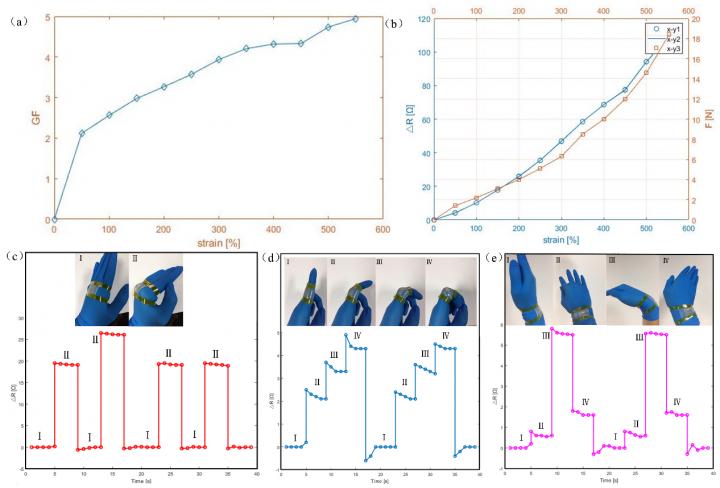
Scientists have developed a room-temperature liquid metal-based super-stretchable sensor, with the advantages of facile fabrication, low cost, great stretchability, high repeatability and a GF (gauge factor) as great as 4.95. The new device potentially takes liquid metal-based sensors to the next stage. The findings were published in Scientific Reports.

The research was conducted by a team led by Prof. WANG Lei at the Shenzhen Institutes of Advanced Technology (SIAT) of the Chinese Academy of Sciences.

Flexible strain sensors have become a key research area in the development of intelligent devices and especially in wearable medical and robotic applications. Such sensors have broad prospects in human-computer interaction systems and electronic skin and human motion behavior monitoring systems.

The important performance parameters for strain sensors include stretchability, sensitivity, stability, reliability and comfort. In order to achieve the best performance, Prof. WANG and his colleagues proposed optimizing the microchannel structures by finite element analysis (FEA). They then designed and fabricated the sensor accordingly.

Experimental results revealed that the sensor could be stretched to 550% of its original length, twisted 270o, and bent 180o. GF reached as high as 4.95 when strain reached 550% and the repeatability error rate was less than 0.1%.

researchers used the sensor to conduct precision detection of joint, finger and wrist motion, achieving excellent performance. Their results showed the great potential for application of the sensor to flexible wearable electronic devices.

###

Media Contact
ZHANG Xiaomin
[email protected]

Related Journal Article

http://dx.doi.org/10.1038/s41598-019-42457-7

Tags: Chemistry/Physics/Materials SciencesMaterials
Share12Tweet7Share2ShareShareShare1

Related Posts

Cutting Electrolyte Reduction Boosts High-Energy Battery Performance

Cutting Electrolyte Reduction Boosts High-Energy Battery Performance

December 19, 2025
Microenvironment Shapes Gold-Catalysed CO2 Electroreduction

Microenvironment Shapes Gold-Catalysed CO2 Electroreduction

December 11, 2025

Photoswitchable Olefins Enable Controlled Polymerization

December 11, 2025

Cation Hydration Entropy Controls Chloride Ion Diffusion

December 10, 2025
Please login to join discussion

POPULAR NEWS

  • Nurses’ Views on Online Learning: Effects on Performance

    Nurses’ Views on Online Learning: Effects on Performance

    70 shares
    Share 28 Tweet 18
  • NSF funds machine-learning research at UNO and UNL to study energy requirements of walking in older adults

    70 shares
    Share 28 Tweet 18
  • Unraveling Levofloxacin’s Impact on Brain Function

    53 shares
    Share 21 Tweet 13
  • MoCK2 Kinase Shapes Mitochondrial Dynamics in Rice Fungal Pathogen

    72 shares
    Share 29 Tweet 18

About

We bring you the latest biotechnology news from best research centers and universities around the world. Check our website.

Follow us

Recent News

Optimizing Polyhydroxybutyrate from Waste Oil: Economic Insights

Connecting Individual and Community Health Insights: A Study

RECQL4 Mutations Impact Helicase Function and Chemotherapy Response

Subscribe to Blog via Email

Success! An email was just sent to confirm your subscription. Please find the email now and click 'Confirm' to start subscribing.

Join 70 other subscribers
  • Contact Us

Bioengineer.org © Copyright 2023 All Rights Reserved.

Welcome Back!

Login to your account below

Forgotten Password?

Retrieve your password

Please enter your username or email address to reset your password.

Log In
No Result
View All Result
  • Homepages
    • Home Page 1
    • Home Page 2
  • News
  • National
  • Business
  • Health
  • Lifestyle
  • Science

Bioengineer.org © Copyright 2023 All Rights Reserved.