

• HOME
  • NEWS
  • EXPLORE
    • CAREER
      • Companies
      • Jobs
    • EVENTS
    • iGEM
      • News
      • Team
    • PHOTOS
    • VIDEO
    • WIKI
  • BLOG
  • COMMUNITY
    • FACEBOOK
    • INSTAGRAM
    • TWITTER
Thursday, January 1, 2026
BIOENGINEER.ORG
No Result
View All Result
  • Login
  • HOME
  • NEWS
  • EXPLORE
    • CAREER
      • Companies
      • Jobs
        • Lecturer
        • PhD Studentship
        • Postdoc
        • Research Assistant
    • EVENTS
    • iGEM
      • News
      • Team
    • PHOTOS
    • VIDEO
    • WIKI
  • BLOG
  • COMMUNITY
    • FACEBOOK
    • INSTAGRAM
    • TWITTER
  • HOME
  • NEWS
  • EXPLORE
    • CAREER
      • Companies
      • Jobs
        • Lecturer
        • PhD Studentship
        • Postdoc
        • Research Assistant
    • EVENTS
    • iGEM
      • News
      • Team
    • PHOTOS
    • VIDEO
    • WIKI
  • BLOG
  • COMMUNITY
    • FACEBOOK
    • INSTAGRAM
    • TWITTER
No Result
View All Result
Bioengineer.org
No Result
View All Result
Home NEWS Science News Science

Alzheimer’s disease found to be a diabetic disorder of the brain

Bioengineer by Bioengineer
November 9, 2016
in Science
Reading Time: 2 mins read
0
Share on FacebookShare on TwitterShare on LinkedinShare on RedditShare on Telegram
IMAGE

Credit: Shigeki Moriguchi

Researchers at Tohoku University have found a promising treatment for Alzheimer's disease, by noticing a similarity in the way insulin signaling works in the brain and in the pancreas of diabetic patients.

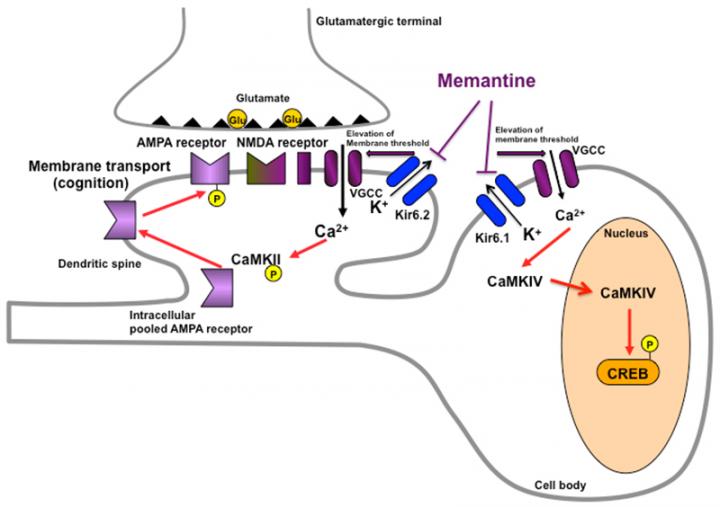
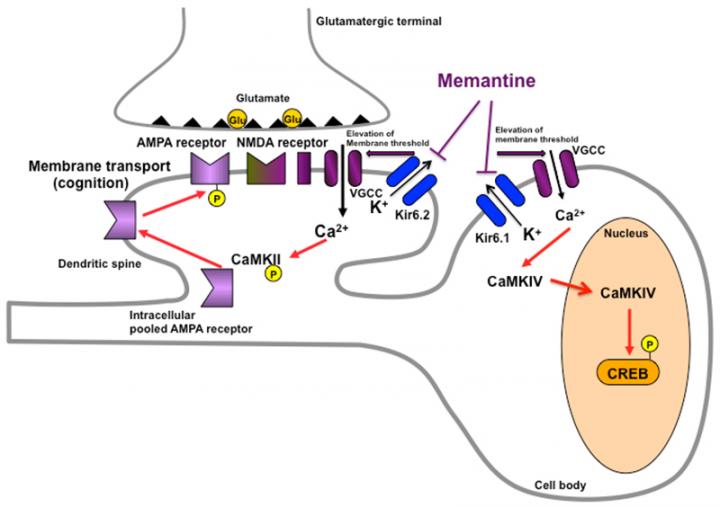
"In the pancreas, the Kir6.2 channel blockade increases the insulin signaling, and insulin signaling decreases the blood glucose levels," says Dr. Shigeki Moriguchi. "In the brain, insulin signaling increases the acquisition of memory through CaM kinase II activation by Kir6.2 channel blockade."

The research group, led by Dr. Moriguchi and Professor Kohji Fukunaga of the Graduate School of Pharmaceutical Sciences, thus concluded that Alzheimer's disease can be described as a diabetic disorder of the brain.

Memantine, a drug widely used to treat Alzheimer's disease, is a well known inhibitor of the N-methyl-D-aspartate (NMDA) receptors that prevent excessive glutamate transmission in the brain. Researchers have now found that memantine also inhibits the ATP-sensitive potassium channel (Kir6.2 channel), improving insulin signal dysfunction in the brain.

In their experiment with mice, the researchers found that memantine treatment improved impaired hippocampal long-term potentiation (LTP) and memory-related behaviors in the mice through the inhibition of KATP channel Kir6.2.

"Since KATP channels Kir6.1 or Kir6.2 are critical components of sulfonylurea receptors (SURs) which is downstream insulin receptor signaling, the KATP channel inhibition by Memantine mediates the anti-diabetic drug action in peripheral tissues," says Dr. Moriguchi. "And this leads to improved cognitive functions and improved memory retention among Alzheimer's patients."

The researchers now hope that results of their study and the parallels drawn with diabetes, will lead to new treatments for Alzheimer's disease, using the inhibition of Kir6.2 channel.

###

Media Contact

Shigeki Moriguchi
[email protected]
@TohokuUniPR

http://www.tohoku.ac.jp/en/

Share12Tweet8Share2ShareShareShare2

Related Posts

Five or more hours of smartphone usage per day may increase obesity

July 25, 2019
IMAGE

NASA’s terra satellite finds tropical storm 07W’s strength on the side

July 25, 2019

NASA finds one burst of energy in weakening Depression Dalila

July 25, 2019

Researcher’s innovative flood mapping helps water and emergency management officials

July 25, 2019
Please login to join discussion

POPULAR NEWS

  • blank

    PTSD, Depression, Anxiety in Childhood Cancer Survivors, Parents

    105 shares
    Share 42 Tweet 26
  • NSF funds machine-learning research at UNO and UNL to study energy requirements of walking in older adults

    71 shares
    Share 28 Tweet 18
  • Exploring Audiology Accessibility in Johannesburg, South Africa

    52 shares
    Share 21 Tweet 13
  • SARS-CoV-2 Subvariants Affect Outcomes in Elderly Hip Fractures

    44 shares
    Share 18 Tweet 11

About

We bring you the latest biotechnology news from best research centers and universities around the world. Check our website.

Follow us

Recent News

Full-Parameter Modulated 3D Vectorial Vortex Arrays

Metabolic Classification of Gliomas Revealed by Multi-Omics

Gender Gaps in Macular Thickness and Cognitive Function

Subscribe to Blog via Email

Enter your email address to subscribe to this blog and receive notifications of new posts by email.

Join 71 other subscribers
  • Contact Us

Bioengineer.org © Copyright 2023 All Rights Reserved.

Welcome Back!

Login to your account below

Forgotten Password?

Retrieve your password

Please enter your username or email address to reset your password.

Log In
No Result
View All Result
  • Homepages
    • Home Page 1
    • Home Page 2
  • News
  • National
  • Business
  • Health
  • Lifestyle
  • Science

Bioengineer.org © Copyright 2023 All Rights Reserved.
