Scientists from TU Dresden find ways to reduce the number of dying neurons and search for therapeutic approaches to treat ALS
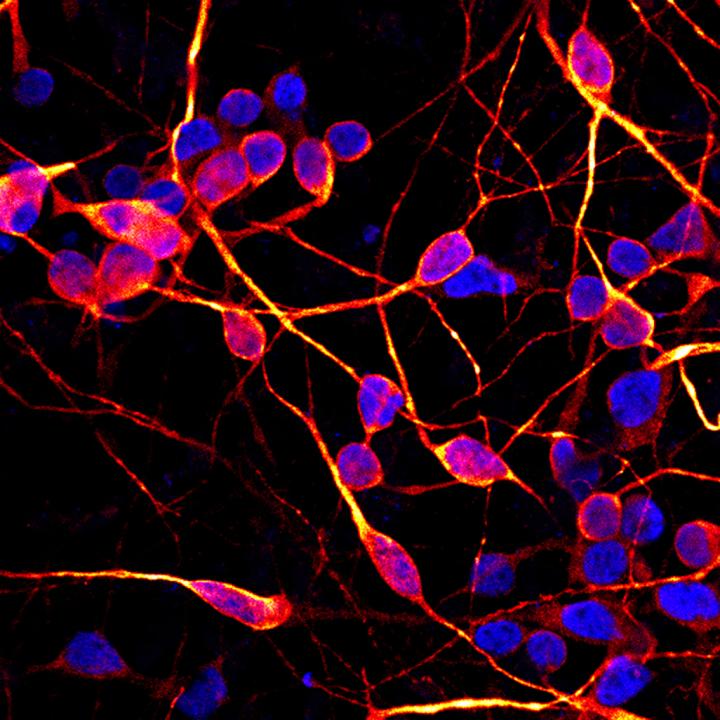
Credit: CRTD
Dresden, 15th April 2019 – Amyotrophic lateral sclerosis (ALS) is an incurable disease of the central nervous system. In most cases, ALS is fatal within a short period following diagnosis. However, people sometimes live with the disease for decades, as did the astrophysicist Steven Hawking. What happens in the body of an ALS patient? Muscle movement is controlled by specialised neurons called motor neurons. During the course of the disease, motor neurons gradually die. As ALS progresses, patients increasingly suffer from muscle weakness and paralysis, which leads to speech, movement and swallowing disorders, and severe restrictions in daily life.
Which processes lead to neuronal death? This is not yet fully understood, but research has shown that changes in the behavior of certain proteins are directly related to ALS. One of these proteins is the RNA-binding protein FUS (Fused in Sarcoma), which plays a crucial role within cells since it regulates genetic messengers and participates in the interaction of different proteins. Mutations in FUS cause FUS to deposit and aggregate in the cytoplasm, causing one of the most aggressive forms of ALS.
Lara Marrone and Jared Sterneckert from the Centre for Regenerative Therapies Dresden (CRTD) at Technische Universität Dresden (TUD), together with collaborating scientists from Germany, Italy, the Netherlands, and the USA, have now discovered that interactions between RNA-binding proteins are more critical to ALS pathogenesis than previously thought. In their recent paper, the research team showed that impaired FUS protein-protein interactions disrupt the balance (homeostasis) of RNA-binding proteins, which significantly contributes to the degeneration of neurons. The scientists also showed that drug-induced protein degradation (autophagy) reduces the pathological processes linked to aberrantly accumulated FUS. Stimulating autophagy rescued these RNA-binding proteins and reduced neuronal death. These improvements were observed in cell culture experiments with reprogrammed stem cells (iPS cells) from patients and validated using as the fruit fly as a model organism.
Lara Marrone, PhD student at the CRTD and lead author of the study, explains: “Mislocalised FUS overwhelms the protein degradation machinery, causing FUS to accumulate within the cytoplasm. This triggers a vicious circle that further hampers the cellular protein quality control systems responsible for the maintenance of protein homeostasis. This is why we speculated that enhancing autophagy could also ameliorate the observed RNA-binding phenotypes”. The Sterneckert group will now investigate the extent to which enhancing autophagy is a possible therapeutic approach for ALS patients. A further goal of their research is to use RNA-binding proteins in patient samples as biomarkers for the disease.
The scientists’ results are being reported in the renowned scientific journal, Acta Neuropathologica. Their research was financed by TUD / CRTD, the German Research Foundation (DFG), the EU Joint Programme – Neurodegenerative Disease Research, the Robert Packard Center for ALS Research, the German Federal Ministry of Education and Research (BMBF), the US National Institute of Health, the Max Planck Society, the European Research Council, the Muscular Dystrophy Association, the German Myopathy Society, the Initiative Therapieforschung ALS e.V., the Petermax-Müller-Stiftung, the Hans and Ilse Breuer Foundation, and the Humboldt Foundation. It was conducted in cooperation with universities and research institutes across Europe (Aachen, Amsterdam, Dresden, Hannover, Milan, Münster) and the US (Pittsburgh, San Francisco). In addition, it was supported by the Center for Molecular and Cellular Bioengineering (CMCB) at TUD.
Jared Sterneckert and his team use induced pluripotent stem cells (iPS cells) to investigate neurodegenerative diseases, such as ALS and Parkinson’s disease. They conduct their studies at the CRTD, where top researchers from more than 30 countries are deciphering the principles of cell and tissue regeneration for disease diagnosis and treatment. The CRTD links the laboratory with the clinic, connects scientists with physicians, and uses expertise in stem cell research, genome editing, and tissue regeneration – all for one goal: curing neurodegenerative diseases such as ALS, Alzheimer’s and Parkinson’s disease, haematological diseases such as leukaemia, metabolic diseases such as diabetes, as well as eye and bone diseases, using novel diagnostic tools and therapies.
###
Publication
Acta Neuropathologica: https:/
Media Contact
Jared Sterneckert, PhD
[email protected]