• HOME
  • NEWS
  • EXPLORE
    • CAREER
      • Companies
      • Jobs
    • EVENTS
    • iGEM
      • News
      • Team
    • PHOTOS
    • VIDEO
    • WIKI
  • BLOG
  • COMMUNITY
    • FACEBOOK
    • INSTAGRAM
    • TWITTER
Saturday, February 7, 2026
BIOENGINEER.ORG
No Result
View All Result
  • Login
  • HOME
  • NEWS
  • EXPLORE
    • CAREER
      • Companies
      • Jobs
        • Lecturer
        • PhD Studentship
        • Postdoc
        • Research Assistant
    • EVENTS
    • iGEM
      • News
      • Team
    • PHOTOS
    • VIDEO
    • WIKI
  • BLOG
  • COMMUNITY
    • FACEBOOK
    • INSTAGRAM
    • TWITTER
  • HOME
  • NEWS
  • EXPLORE
    • CAREER
      • Companies
      • Jobs
        • Lecturer
        • PhD Studentship
        • Postdoc
        • Research Assistant
    • EVENTS
    • iGEM
      • News
      • Team
    • PHOTOS
    • VIDEO
    • WIKI
  • BLOG
  • COMMUNITY
    • FACEBOOK
    • INSTAGRAM
    • TWITTER
No Result
View All Result
Bioengineer.org
No Result
View All Result
Home NEWS Science News Chemistry

Stability improvement under high efficiency — next stage development of perovskite solar cells

Bioengineer by Bioengineer
April 10, 2019
in Chemistry
Reading Time: 3 mins read
0
IMAGE
Share on FacebookShare on TwitterShare on LinkedinShare on RedditShare on Telegram

IMAGE

Credit: ©Science China Press

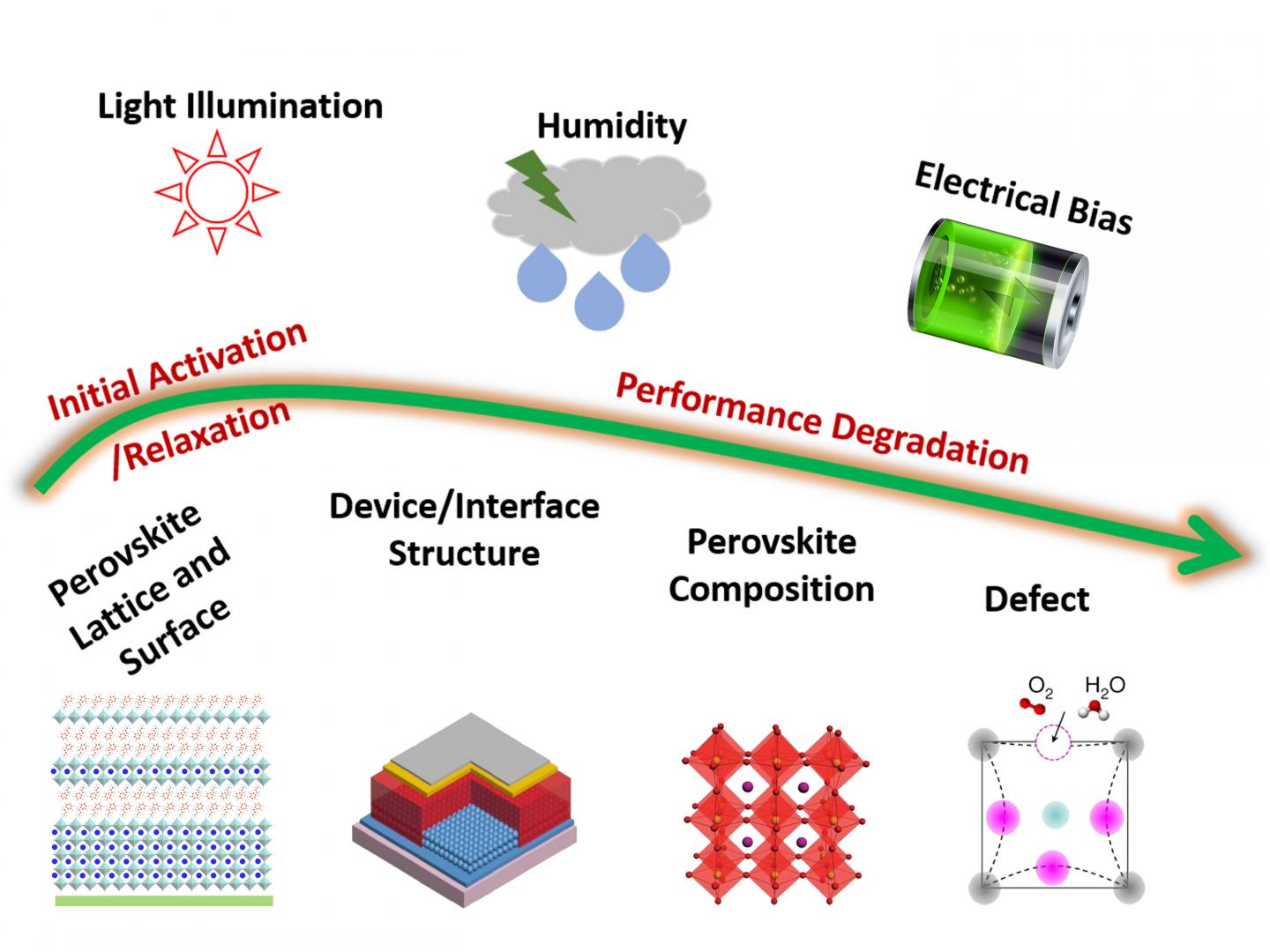
With efficiency of perovskite solar cells (PSCs) overpassing 23%, to realize their commercialization, the biggest challenge now is to boost the stability to the same level as conventional solar cells. Thus, tremendous effort has been directed over the past few years toward improving the stability of these cells. Various methods were used to improve the stability of bulk perovskites, including compositional engineering, interface adjustment, dimensional manipulation, crystal engineering, and grain boundary decoration. Diverse device configurations, carrier transporting layers, and counter electrodes were investigated. To compare the stability of PSCs with clarifying the degradation mechanism, diverse characterization methods were developed. Overall stability of PSCs has become one central topic for the development of PSCs.

Recently, a review article, written by professor Zhijun Ning from Shanghai Technological University, Professor Hongwei Han from Huazhong University of Science and Technology , Professor Qingbo Meng from Institute of Physics, Chinese Academy of Sciences, et al. summarizes the state-of-the-art progress on the improvement of device stability and discusses the directions for future research, hoping to provide an overview of the current status of the research on the stability of PSCs and guidelines for future research.

The authors tell us that although considerable improvement in the stability of PSCs has been realized, particularly using carbon electrodes, the combination of long-term stability and high efficiency still remains unsolved and needs intensive effort to address this challenge.

As for perovskite materials, the exploration of surface terminal groups to prevent the formation of dangling bonds is an important strategy. Considering the large amount of molecules that can be investigated, it is a promising direction to search for new molecules that can better protect the perovskite surface.

In terms of device stability, the use of alternative electrodes, such as carbon paste and oxides, provides another strategy to avoid the abovementioned problems. For this structure, the challenge now might be to improve the efficiency. Strategies, such as improving the conductivity and reducing light loss, can be considered.

For characterizations, Understanding the mechanism via comprehensive and effective characterization is the basis for improving the stability. The mechanism for device degradation is complicated, particularly under electrical field and light illumination. Different methods have been employed to test the stability of PSCs, leading to a lack of reliability or comparability among the reported results; this is another issue. Therefore, commensurable protocols must be developed for evaluating the stability of PSCs. Developing standard test protocols is the first step toward realizing fast and reliable development in this area.

###

See the article: Danni Yu, Yue Hu, Jiangjian Shi, Haoying Tang, Wenhao Zhang, Qingbo Meng, Hongwei Han, Zhijun Ning, He Tian. Stability improvement under high efficiency–next stage development of perovskite solar cells. Sci. China Chem., 2019, 62, https://doi.org/10.1007/s11426-019-9448-3

http://engine.scichina.com/doi/10.1007/s11426-019-9448-3 https://link.springer.com/article/10.1007%2Fs11426-019-9448-3

Media Contact
Zhijun Ning
[email protected]

Related Journal Article

http://dx.doi.org/10.1007/s11426-019-9448-3

Tags: Chemistry/Physics/Materials Sciences
Share12Tweet8Share2ShareShareShare2

Related Posts

blank

Breakthrough in Environmental Cleanup: Scientists Develop Solar-Activated Biochar for Faster Remediation

February 7, 2026
blank

Cutting Costs: Making Hydrogen Fuel Cells More Affordable

February 6, 2026

Scientists Develop Hand-Held “Levitating” Time Crystals

February 6, 2026

Observing a Key Green-Energy Catalyst Dissolve Atom by Atom

February 6, 2026
Please login to join discussion

POPULAR NEWS

  • Robotic Ureteral Reconstruction: A Novel Approach

    Robotic Ureteral Reconstruction: A Novel Approach

    82 shares
    Share 33 Tweet 21
  • Digital Privacy: Health Data Control in Incarceration

    63 shares
    Share 25 Tweet 16
  • Study Reveals Lipid Accumulation in ME/CFS Cells

    57 shares
    Share 23 Tweet 14
  • Breakthrough in RNA Research Accelerates Medical Innovations Timeline

    53 shares
    Share 21 Tweet 13

About

We bring you the latest biotechnology news from best research centers and universities around the world. Check our website.

Follow us

Recent News

Personalized Guide to Understanding and Reducing Chemicals

Inflammasome Protein ASC Drives Pancreatic Cancer Metabolism

Phage-Antibiotic Combo Beats Resistant Peritoneal Infection

Subscribe to Blog via Email

Enter your email address to subscribe to this blog and receive notifications of new posts by email.

Join 73 other subscribers
  • Contact Us

Bioengineer.org © Copyright 2023 All Rights Reserved.

Welcome Back!

Login to your account below

Forgotten Password?

Retrieve your password

Please enter your username or email address to reset your password.

Log In
No Result
View All Result
  • Homepages
    • Home Page 1
    • Home Page 2
  • News
  • National
  • Business
  • Health
  • Lifestyle
  • Science

Bioengineer.org © Copyright 2023 All Rights Reserved.