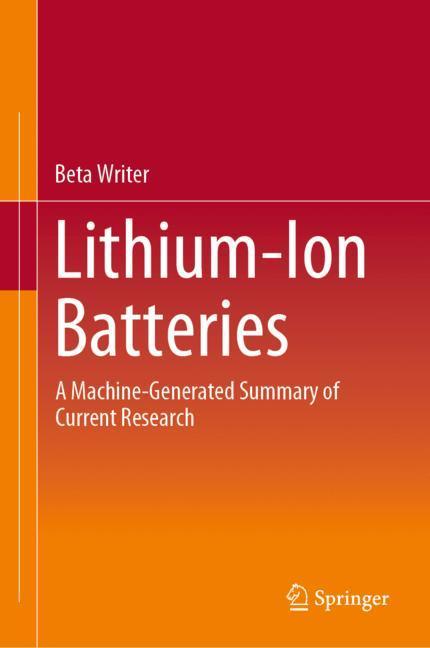
Innovative book prototype provides a compelling machine-generated overview about the latest research on lithium-ion batteries, automatically compiled by an algorithm developed in collaboration with the Applied Computational Linguistics lab
Credit: Springer Nature
Springer Nature published its first machine-generated book in chemistry. The book prototype provides an overview of the latest research in the rapidly growing field of lithium-ion batteries. The content is a cross-corpus auto-summarization of a large number of current research articles in this discipline. Serving as a structured excerpt from a huge set of papers, the innovative pipeline architecture aims at helping researchers to manage the information overload in this discipline efficiently.
In close collaboration between Springer Nature and researchers from Goethe University Frankfurt/Main, a state-of-the-art algorithm, the so-called Beta Writer, was developed to select, consume and process relevant publications in this field from Springer Nature’s content platform SpringerLink. Based on this peer-reviewed and published content, the Beta Writer uses a similarity-based clustering routine to arrange the source documents into coherent chapters and sections. It then creates succinct summaries of the articles. The extracted quotes are referenced by hyperlinks which allow readers to further explore the original source documents. Automatically created introductions, table of contents and references facilitate the orientation within the book.
Niels Peter Thomas, Managing Director Books at Springer Nature, said: “Looking back to a long tradition and expertise in academic book publishing, Springer Nature is aiming at shaping the future of book publishing and reading. New technologies around Natural Language Processing and Artificial Intelligence offer promising opportunities for us to explore the generation of scientific content with the help of algorithms. As a global publisher, it is our responsibility to take potential implications and limitations of machine-generated content into consideration, and to provide a reasonable framework for this new type of content for the future.”
Henning Schoenenberger, Director Product Data & Metadata Management at Springer Nature, added: “We are thrilled to finally publish this new type of research content and make it available for the global research community. While research articles and books written by researchers and authors will continue to play a crucial role in scientific publishing, we foresee many different content types in academic publishing in the future: from yet entirely human-created content creation to a variety of blended man-machine text generation to entirely machine-generated text. This prototype is a first important milestone we reached, and it will hopefully also initiate a public debate on the opportunities, implications, challenges and potential risks of machine-generated content in scholarly publishing.”
In the future, Springer Nature plans to expand this pilot project by developing prototypes for content from other subject areas as well. The published prototype on research about lithium-ion batteries will serve as a solid basis to further refine and improve the underlying technology.
Springer Nature’s first machine-generated book is designed for all interested audiences: researchers, master and PhD students, reviewers, academic writers, librarians and decision makers in science education. It is available as eBook and print book. The eBook is freely available for readers on SpringerLink.
###
Media Contact
Melanie Lehnert-Bechle
[email protected]
Original Source
https:/