• HOME
  • NEWS
  • EXPLORE
    • CAREER
      • Companies
      • Jobs
    • EVENTS
    • iGEM
      • News
      • Team
    • PHOTOS
    • VIDEO
    • WIKI
  • BLOG
  • COMMUNITY
    • FACEBOOK
    • INSTAGRAM
    • TWITTER
Tuesday, May 12, 2026
BIOENGINEER.ORG
No Result
View All Result
  • Login
  • HOME
  • NEWS
  • EXPLORE
    • CAREER
      • Companies
      • Jobs
        • Lecturer
        • PhD Studentship
        • Postdoc
        • Research Assistant
    • EVENTS
    • iGEM
      • News
      • Team
    • PHOTOS
    • VIDEO
    • WIKI
  • BLOG
  • COMMUNITY
    • FACEBOOK
    • INSTAGRAM
    • TWITTER
  • HOME
  • NEWS
  • EXPLORE
    • CAREER
      • Companies
      • Jobs
        • Lecturer
        • PhD Studentship
        • Postdoc
        • Research Assistant
    • EVENTS
    • iGEM
      • News
      • Team
    • PHOTOS
    • VIDEO
    • WIKI
  • BLOG
  • COMMUNITY
    • FACEBOOK
    • INSTAGRAM
    • TWITTER
No Result
View All Result
Bioengineer.org
No Result
View All Result
Home NEWS Science News Science

New study demonstrates radio signal benefits from decades-old theory

Bioengineer by Bioengineer
April 2, 2019
in Science
Reading Time: 2 mins read
0
Share on FacebookShare on TwitterShare on LinkedinShare on RedditShare on Telegram

Engineering researchers have demonstrated that a longstanding theoretical method called direct antenna modulation (DAM) has real-world utility for boosting the quality of radio signals when transmitting at high data rates. The finding has applications in fields such as military communications.

“You can always improve signal quality by using a larger antenna, but that’s simply not practical for many wavelengths,” says Jacob Adams, an assistant professor of electrical engineering at NC State University and senior author of a paper on the work. “For example, antennas operating in the high frequency range – 3 to 30 megahertz (MHz) – would be 5 meters long or longer. We’ve shown that DAM can improve signal quality dramatically when using much smaller antennas. How much smaller can vary, but we’ve demonstrated the concept using antennas one-third the size of a conventional antenna for a given wavelength.”

The DAM concept has been around for more than 50 years, and is essentially the idea that storing and releasing energy from the antenna at the right moments can reduce the amount of distortion in the resulting signal. However, researchers had not previously done a thorough comparison of conventional antennas to DAM antennas when transmitting at high frequencies.

Adams and his team used antennas that were just under 1 meter long to transmit at 27 MHz, and found stark differences in performance between the DAM transmitter and a conventional one.

“We focused on frequencies that are practical for communications technologies that operate beyond the line of sight but that are also typically limited by large antennas,” Adams says. “And we found the DAM signal was still viable at data transmission rates where transmissions from the conventional antenna were simply indecipherable.

“We think this demonstrates the viability of DAM for use in practical technologies,” Adams says. “We are currently working on ways to further improve the power handling of DAM devices and to offer more flexibility in terms of the types of modulations that can be generated with DAM.”

The paper, “Pulse Characteristics of a Direct Antenna Modulation Transmitter,” is published in the open-access journal IEEE Access. First author of the paper is Kurt Schab, a former postdoctoral researcher at NC State who is now at Santa Clara University. The paper was co-authored by Danyang Huang, a Ph.D. student at NC State.

###

The work was done with support from the Defense Advanced Research Projects Agency, under grant number D16AP00033, and the Intelligence Community Postdoctoral Research Fellowship Program.

Media Contact
Matt Shipman
[email protected]

Related Journal Article

https://news.ncsu.edu/2019/04/new-study-demonstrates-radio-signal-benefits-from-decades-old-theory/
http://dx.doi.org/10.1109/ACCESS.2019.2902365

Tags: Electrical Engineering/ElectronicsResearch/DevelopmentTechnology/Engineering/Computer ScienceTelecommunications
Share12Tweet8Share2ShareShareShare2

Related Posts

Five or more hours of smartphone usage per day may increase obesity

July 25, 2019
IMAGE

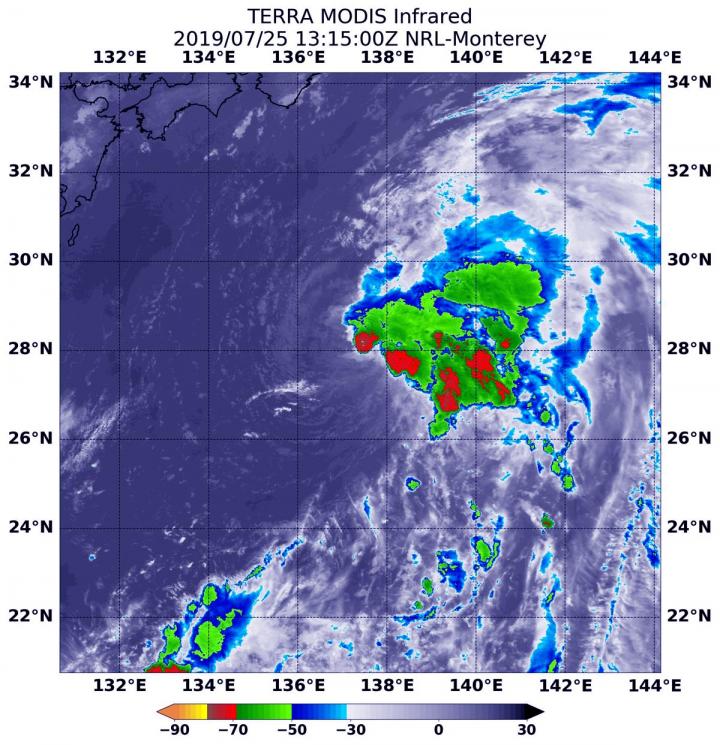
NASA’s terra satellite finds tropical storm 07W’s strength on the side

July 25, 2019

NASA finds one burst of energy in weakening Depression Dalila

July 25, 2019

Researcher’s innovative flood mapping helps water and emergency management officials

July 25, 2019
Please login to join discussion

POPULAR NEWS

  • Research Indicates Potential Connection Between Prenatal Medication Exposure and Elevated Autism Risk

    841 shares
    Share 336 Tweet 210
  • New Study Reveals Plants Can Detect the Sound of Rain

    728 shares
    Share 290 Tweet 182
  • Salmonella Haem Blocks Macrophages, Boosts Infection

    62 shares
    Share 25 Tweet 16
  • Breastmilk Balances E. coli and Beneficial Bacteria in Infant Gut Microbiomes

    57 shares
    Share 23 Tweet 14

About

We bring you the latest biotechnology news from best research centers and universities around the world. Check our website.

Follow us

Recent News

Humans and Zebra Finches Share Similar Speech Learning Techniques #ASA190

New Study Uncovers How Fungal Parasites Attack Strawberries and Raspberries

City of Hope Researchers to Present Groundbreaking Immunotherapy and Precision Medicine Advances Across Multiple Cancer Types at ASCO 2026

Subscribe to Blog via Email

Enter your email address to subscribe to this blog and receive notifications of new posts by email.

Join 82 other subscribers
  • Contact Us

Bioengineer.org © Copyright 2023 All Rights Reserved.

Welcome Back!

Login to your account below

Forgotten Password?

Retrieve your password

Please enter your username or email address to reset your password.

Log In
No Result
View All Result
  • Homepages
    • Home Page 1
    • Home Page 2
  • News
  • National
  • Business
  • Health
  • Lifestyle
  • Science

Bioengineer.org © Copyright 2023 All Rights Reserved.