• HOME
  • NEWS
  • EXPLORE
    • CAREER
      • Companies
      • Jobs
    • EVENTS
    • iGEM
      • News
      • Team
    • PHOTOS
    • VIDEO
    • WIKI
  • BLOG
  • COMMUNITY
    • FACEBOOK
    • INSTAGRAM
    • TWITTER
Saturday, February 7, 2026
BIOENGINEER.ORG
No Result
View All Result
  • Login
  • HOME
  • NEWS
  • EXPLORE
    • CAREER
      • Companies
      • Jobs
        • Lecturer
        • PhD Studentship
        • Postdoc
        • Research Assistant
    • EVENTS
    • iGEM
      • News
      • Team
    • PHOTOS
    • VIDEO
    • WIKI
  • BLOG
  • COMMUNITY
    • FACEBOOK
    • INSTAGRAM
    • TWITTER
  • HOME
  • NEWS
  • EXPLORE
    • CAREER
      • Companies
      • Jobs
        • Lecturer
        • PhD Studentship
        • Postdoc
        • Research Assistant
    • EVENTS
    • iGEM
      • News
      • Team
    • PHOTOS
    • VIDEO
    • WIKI
  • BLOG
  • COMMUNITY
    • FACEBOOK
    • INSTAGRAM
    • TWITTER
No Result
View All Result
Bioengineer.org
No Result
View All Result
Home NEWS Science News Health

Natural gene therapy for intractable skin disease discovered

Bioengineer by Bioengineer
April 1, 2019
in Health
Reading Time: 2 mins read
0
IMAGE
Share on FacebookShare on TwitterShare on LinkedinShare on RedditShare on Telegram

IMAGE

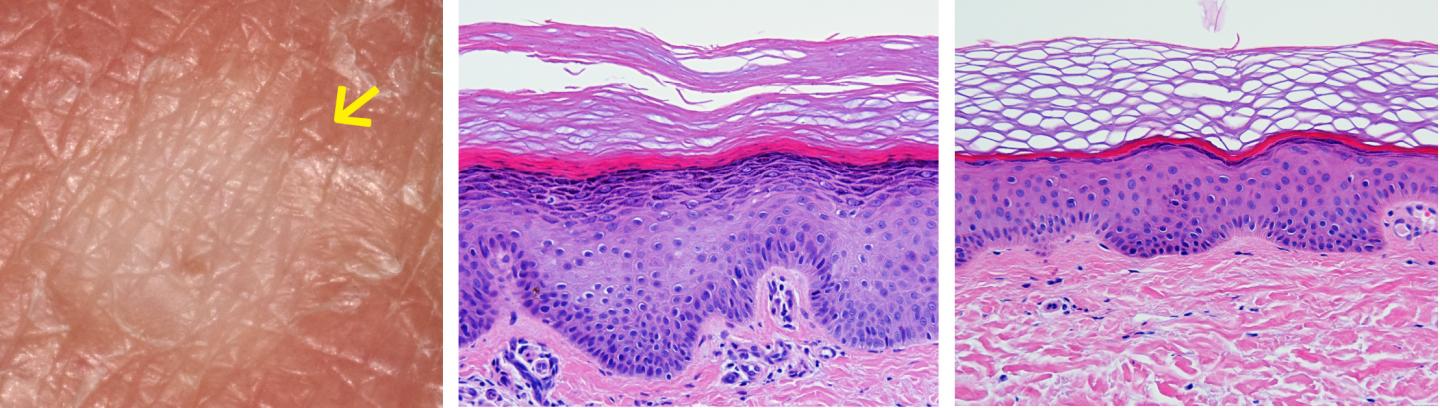
Credit: Suzuki S. et al., Life Science Alliance, February 4, 2019

Pathogenic gene mutations causing a type of intractable skin disease can be eliminated from some parts of patients’ skin as they age, according to Hokkaido University researchers and their collaborators in Japan. This represents a form of natural gene therapy.

In general, there is no fundamental treatment method capable of curing diseases caused by gene abnormality because it is difficult to remove certain genetic mutations from all affected cells. Loricrin keratoderma (LK) is one such disease; caused by loricrin mutations, it is characterized by dry, thickened, scaly skin from birth. Only symptomatic treatments are available to alleviate the conditions, which cause difficulties in patients’ daily lives. Thus far, doctors have not known how to treat the ailment.

In a study published in Life Science Alliance, the research team, including Toshifumi Nomura and Shotaro Suzuki of Hokkaido University, observed the patients’ skin for an extended period. They discovered that LK patients had normal-looking skin areas dotted around their body. Tissue from those areas was examined for histology, and DNA extracted from both the epidermis and dermis were checked for loricrin mutations.

The study found skin areas that looked normal were in fact skin that had returned to normal and that, surprisingly, the mutant loricrin which patients were supposed to have from birth had disappeared. Detailed analyses of the DNA sequences revealed that the mutation had disappeared due to somatic recombination — a type of DNA recombination that causes exchange of DNA strands that contain similar sequences¬¬. Normal skin stayed in the same location for at least several years, so the finding suggests gene mutations are eliminated from stem cells that keep providing new cells in the epidermis.

The study also found that cells with normal loricrin have higher reproduction ability and are more likely to form colonies than cells with mutant loricrin. This survival advantage could be why the normal cells became noticeable on the patients’ skin.

“If we could elucidate the mechanism of frequent somatic recombination occurring in epidermal cells, and could find a way to artificially induce it, that could lead to the development of a new treatment method for loricrin keratoderma, and potentially other genetic diseases,” says Toshifumi Nomura.

###

This study was conducted in collaboration with Asahikawa Medical University and Nagoya University in Japan.

Media Contact
Naoki Namba
 @hokkaidouni

011-706-2185

Original Source

https://www.global.hokudai.ac.jp/blog/natural-gene-therapy-for-intractable-skin-disease-discovered/

Related Journal Article

http://dx.doi.org/10.26508/lsa.201800284

Tags: BiologyDermatologyGene TherapyGenesGeneticsMedicine/Health
Share12Tweet8Share2ShareShareShare2

Related Posts

Personalized Guide to Understanding and Reducing Chemicals

February 7, 2026

Inflammasome Protein ASC Drives Pancreatic Cancer Metabolism

February 7, 2026

Phage-Antibiotic Combo Beats Resistant Peritoneal Infection

February 7, 2026

Boosting Remote Healthcare: Stepped-Wedge Trial Insights

February 7, 2026
Please login to join discussion

POPULAR NEWS

  • Robotic Ureteral Reconstruction: A Novel Approach

    Robotic Ureteral Reconstruction: A Novel Approach

    82 shares
    Share 33 Tweet 21
  • Digital Privacy: Health Data Control in Incarceration

    63 shares
    Share 25 Tweet 16
  • Study Reveals Lipid Accumulation in ME/CFS Cells

    57 shares
    Share 23 Tweet 14
  • Breakthrough in RNA Research Accelerates Medical Innovations Timeline

    53 shares
    Share 21 Tweet 13

About

We bring you the latest biotechnology news from best research centers and universities around the world. Check our website.

Follow us

Recent News

Personalized Guide to Understanding and Reducing Chemicals

Inflammasome Protein ASC Drives Pancreatic Cancer Metabolism

Phage-Antibiotic Combo Beats Resistant Peritoneal Infection

Subscribe to Blog via Email

Enter your email address to subscribe to this blog and receive notifications of new posts by email.

Join 73 other subscribers
  • Contact Us

Bioengineer.org © Copyright 2023 All Rights Reserved.

Welcome Back!

Login to your account below

Forgotten Password?

Retrieve your password

Please enter your username or email address to reset your password.

Log In
No Result
View All Result
  • Homepages
    • Home Page 1
    • Home Page 2
  • News
  • National
  • Business
  • Health
  • Lifestyle
  • Science

Bioengineer.org © Copyright 2023 All Rights Reserved.