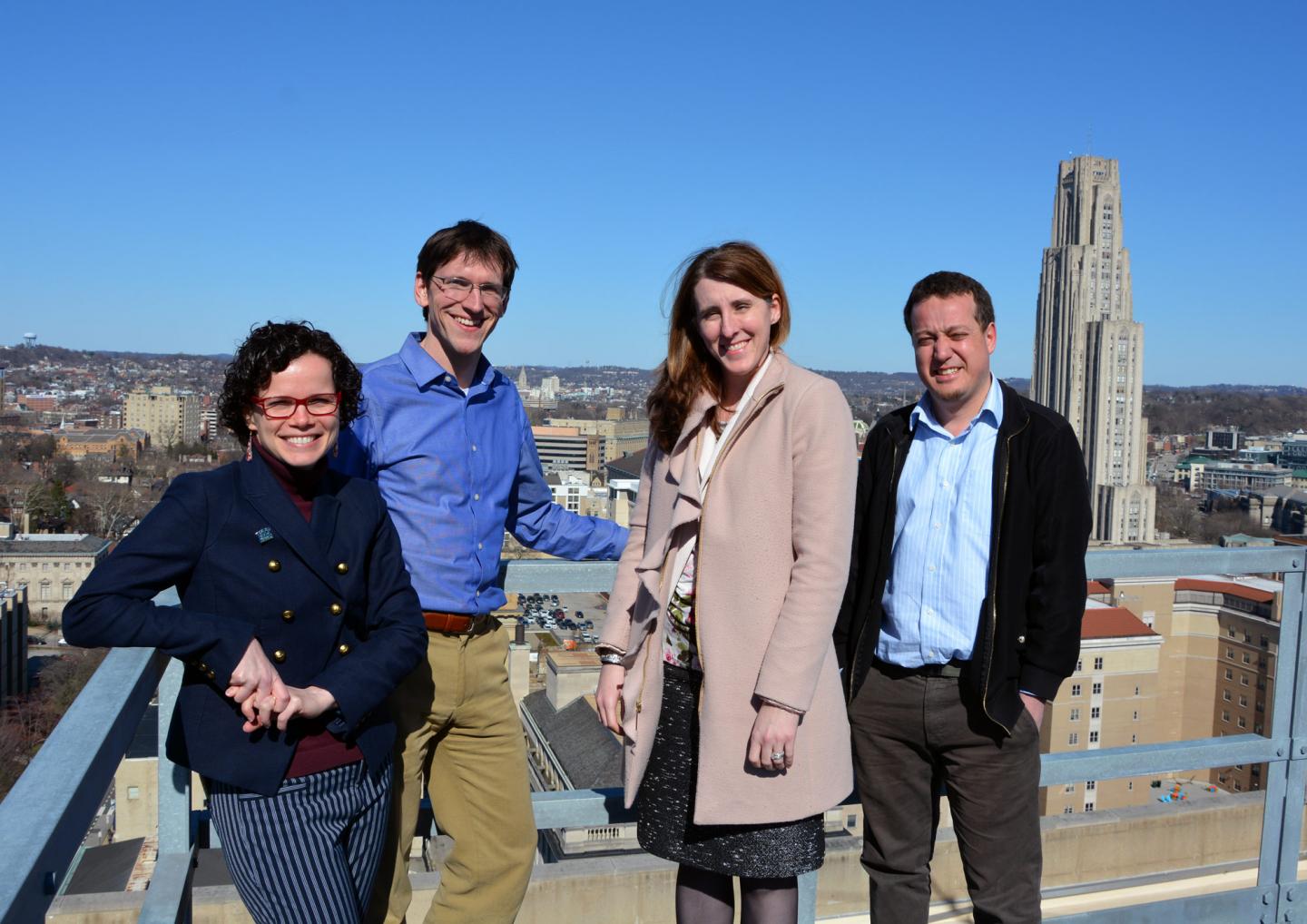
Credit: Swanson School of Engineering
PITTSBURGH (March 28, 2019) … Four faculty members from the University of Pittsburgh’s Swanson School of Engineering have been named CAREER Award recipients by the National Science Foundation (NSF). Recognized as the NSF’s most competitive award for junior faculty, the grants total more than $2 million in funding both for research and community engagement.
The CAREER program “recognizes faculty who exemplify the role of teacher-scholars through outstanding research, excellent education and the integration of education and research within the context of the mission of their organizations.” The four awards – one each in the departments of Chemical and Petroleum, Civil and Environmental, Electrical and Computer, and Mechanical Engineering and Materials Science – are the second most received by Pitt and Swanson School faculty in a single NSF CAREER funding announcement. Previously in 2017, five Swanson School faculty were recipients.
“Federal funding for academic research is extremely competitive, especially for faculty just beginning their academic careers. Receiving four prestigious NSF CAREER Awards in one cycle – exceeded only by our five two years ago – is a reflection of our winners’ distinctive research and support by their respective departments and the Swanson School,” noted David Vorp, PhD, the Swanson School’s Associate Dean for Research. He added, “Since a CAREER Award is also focused on community engagement, this is an opportunity for our faculty and their graduate students to promote STEM to children in the area, especially in underserved populations, and we will be working with them to develop impactful outreach programs.”
Dr. Vorp also noted that the Swanson School’s recent success with CAREER awards can be attributed to a number of factors, including the School’s Center for Faculty Excellence, directed by Prof. Anne Robertson, and the CAREER writing group developed and run by Julie Myers-Irvin, PhD, the Swanson School’s Grants Developer. “Participating faculty acknowledge that the writing group focus on early preparation, group comradery, technical feedback, and discussions of grantsmanship practices attribute to more well-rounded proposals,” Dr. Myers-Irvin says.
The award recipients include:
Murat Akcakaya, Assistant Professor of Electrical & Computer Engineering, with Carla A. Mazefsky, Associate Professor of Psychiatry and Psychology
Title: Toward a Biologically Informed Intervention for Emotionally Dysregulated Adolescents and Adults with Autism Spectrum Disorder (#1844885)
Summary: Although clinical techniques are used to help patients with Autism Spectrum Disorder (ASD) respond to stress and other factors, none are known to couple with technology that could monitor brain response in real time and provide the patient with feedback. Drs. Akcakaya and Mazefsky are developing a new intervention using electroencephalography (EEG)-guided, non-invasive brain-computer interface (BCI) technology could complement clinical treatments and improve emotion regulation in people with ASD.
Dr. Akcakaya will also develop courses related to the research and outreach activities to promote STEM and ASD research to K-12 populations and the broader public. Outreach will focus especially on individuals with ASD, their families, and caretakers.
Susan Fullerton, Assistant Professor of Chemical and Petroleum Engineering ($540,000)
Title:Scaling Electrolytes to a Single Monolayer for Low-Power Ion-Gated Electronics with Unconventional Characteristics (#1847808)
Summary: Two-dimensional (2D) materials are being explored for their exciting new physics that can impart novel functionalities in application spaces such as information storage, neuromorphic computing, and hardware security. Dr. Fullerton and her group invented a new type of ion-containing material, or electrolyte, which is only a single molecule thick. This “monolayer electrolyte” will ultimately introduce new functions that can be used by the electronic materials community to explore the fundamental properties of new semiconductor materials and to increase storage capacity, decrease power consumption, and vastly accelerate processing speed.
The NSF award will support a PhD student and postdoctoral researcher, as well as an outreach program to inspire curiosity and engagement of K-12 and underrepresented students in materials for next-generation electronics. Specifically, Dr. Fullerton has developed an activity where students can watch the polymer electrolytes used in this study crystallize in real-time using an inexpensive camera attached to a smart phone or iPad. The CAREER award will allow Dr. Fullerton to provide this microscope to classrooms so that the teachers can continue exploring with their students.
Tevis Jacobs, Assistant Professor of Mechanical Engineering and Materials Science ($500,000)
Title: Understanding Nanoparticle Adhesion to Guide the Surface Engineering of Supporting Structures (#1844739)
Summary: Although far thinner than a human hair, metal nanoparticles play an important role in advanced industries and technologies from electronics and pharmaceuticals to catalysts and sensors. Nanoparticles can be as small as ten atoms in diameter, and their small size makes them especially susceptible to coarsening with continued use, which reduces functionality and degrades performance. Dr. Jacobs will utilize electron microscopy to develop new methods to measure the attachment and stability of nanoparticles on surfaces under various conditions, allowing researchers to enhance both surfaces and nanoparticles in tandem to work more effectively together.
Additionally, Dr. Jacobs and his lab group will engage with the University of Pittsburgh School of Education and a local elementary school to create and nationally disseminate surface engineering-focused curricular units for sixth- to eighth-grade students and professional development training modules for teachers.
Carla Ng, Assistant Professor of Civil and Environmental Engineering ($500,000)
Title: Harnessing biology to tackle fluorinated alkyl substances in the environment (#1845336)
Summary: Per- and polyfluorinated alkyl substances (PFAS) are man-made chemicals that are useful in a variety of industries because of their durability, but do not naturally break down in the environment or human body. Because of their useful oil- and water-repellent properties, PFAS are used in many consumer products, industrial processes, and in firefighting foams, but unfortunately, their manufacturing and widespread use has contributed to the undesired release of these chemicals into the environment. With evidence showing that PFAS may have adverse effects on human health, Dr. Ng wants to further investigate the potential impacts of these chemicals and identify ways to remove them from the environment.
She plans to elevate K-12 and undergraduate education through the use of collaborative model-building in a game-like environment. Dr. Ng in particular will utilize the agent-based modeling language NetLogo, a freely available and accessible model-building tool that can be equally powerful for cutting edge research or for students exploring new STEM concepts in science and engineering.
###
###
Media Contact
Paul A. Kovach
[email protected]
Original Source
https:/