• HOME
  • NEWS
  • EXPLORE
    • CAREER
      • Companies
      • Jobs
    • EVENTS
    • iGEM
      • News
      • Team
    • PHOTOS
    • VIDEO
    • WIKI
  • BLOG
  • COMMUNITY
    • FACEBOOK
    • INSTAGRAM
    • TWITTER
Tuesday, January 13, 2026
BIOENGINEER.ORG
No Result
View All Result
  • Login
  • HOME
  • NEWS
  • EXPLORE
    • CAREER
      • Companies
      • Jobs
        • Lecturer
        • PhD Studentship
        • Postdoc
        • Research Assistant
    • EVENTS
    • iGEM
      • News
      • Team
    • PHOTOS
    • VIDEO
    • WIKI
  • BLOG
  • COMMUNITY
    • FACEBOOK
    • INSTAGRAM
    • TWITTER
  • HOME
  • NEWS
  • EXPLORE
    • CAREER
      • Companies
      • Jobs
        • Lecturer
        • PhD Studentship
        • Postdoc
        • Research Assistant
    • EVENTS
    • iGEM
      • News
      • Team
    • PHOTOS
    • VIDEO
    • WIKI
  • BLOG
  • COMMUNITY
    • FACEBOOK
    • INSTAGRAM
    • TWITTER
No Result
View All Result
Bioengineer.org
No Result
View All Result
Home NEWS Science News Biology

New muscular disease: Myoglobinopathy

Bioengineer by Bioengineer
March 27, 2019
in Biology
Reading Time: 2 mins read
0
IMAGE
Share on FacebookShare on TwitterShare on LinkedinShare on RedditShare on Telegram

An international collaboration led by IDIBELL identifies the first disease caused by a mutation in myoglobin
IMAGE

Credit: Bellvitge Biomedical Research Institute (IDIBELL)

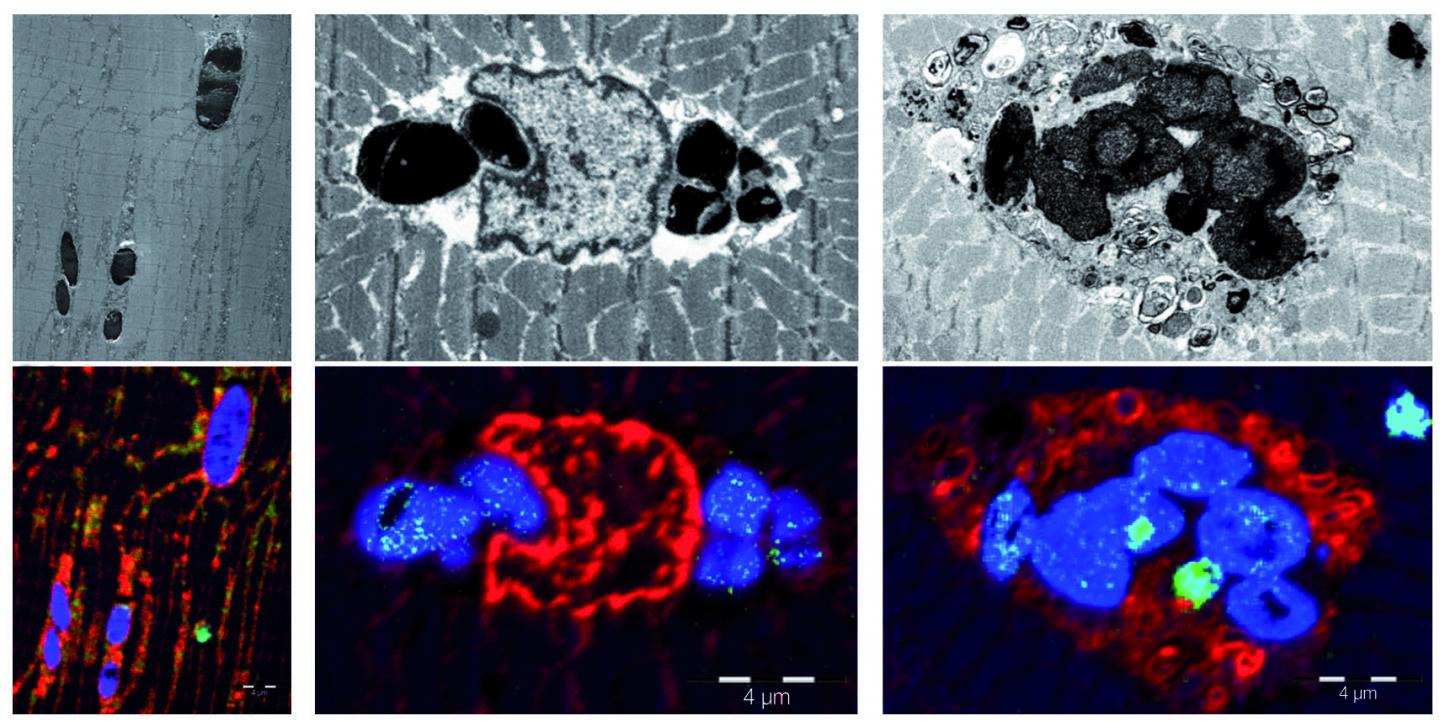
Researchers of the Bellvitge Biomedical Research Institute (IDIBELL) led by Dr. Montse Olivé have described in Nature Communications a new muscular disease caused by a mutation in the myoglobin gene. The study has been possible thanks to a collaboration with a group of geneticists from the University of Western Australia (UWA), led by Prof. Nigel Laing, and researchers from the Karolinska Institute (Stockholm, Sweden).

Myoglobin, the protein that gives muscles their red colour, has as its main function the transportation and intracellular storage of oxygen, acting as an oxygen reservoir when there are low levels (hypoxia) or a total lack thereof (anoxia). It also acts as scavenger of free radicals and other reactive oxygen species, avoiding cell damage due to oxidative stress.

“This is the first time that a disease caused by a mutation in the myoglobin gene has been identified”, says Montse Olivé, doctor at the Bellvitge University Hospital, responsible for the muscular disease area and researcher of the Human Molecular Genetics group of the Genes, Disease and Therapy at IDIBELL. “We have identified the same mutation in several members of 6 unrelated European families, all of whom had the same symptoms and showed very characteristic lesions – called sarcoplasmic bodies – in muscle biopsies,” adds Dr Olivé.

Myoglobinopathy, the name that has been proposed for the new disease, manifests between the fourth and fifth decade of life. It causes a progressive weakness of the axial and limb muscles, and in more advanced stages affects the respiratory musculature and the heart.

The study has also involved, among others, researchers from the ALBA synchrotron and the Autonomous University of Barcelona (UAB). The infrared microscopy of the MIRAS beamline at the synchrotron, which is able to characterize the chemical composition and structure of proteins, allowed researchers to demonstrate the presence of oxidized lipids in the damaged muscle cells. “We have observed that sarcoplasmic bodies correspond to oxidized lipids and misfolded proteins”, says Nuria Benseny, a postdoctoral researcher at the ALBA synchrotron.

Finally, researchers from the universities of Modena and Vienna have identified an alteration in the biochemical and thermodynamic properties of the mutated myoglobin, including an alteration in the oxygen-binding capacity that contributes to the formation of the lipid and protein aggregates that are found in the muscles of the patients.

This discovery has allowed to establish the diagnosis for some patients after many years and will allow researchers to focus on finding a cure for this disease from now on.

###

Media Contact
Gemma Fornons
[email protected]

Original Source

http://www.idibell.cat/en/whats-on/noticies/new-muscular-disease-myoglobinopathy

Related Journal Article

http://dx.doi.org/10.1038/s41467-019-09111-2.

Tags: CardiologyCell BiologyGenesGeneticsHealth CareMedicine/HealthMolecular BiologyPainPulmonary/Respiratory Medicine
Share12Tweet8Share2ShareShareShare2

Related Posts

blank

CDR2 Gene Variant Enhances Lung Disease Resistance in Xiang Pigs

January 13, 2026
blank

Gene Expression Changes in Freeze-Tolerant Vertebrates

January 13, 2026

Two Divergent Effectors Control Pm4 Resistance Virulence

January 12, 2026

Gene Expression and Growth in Sunit Lambs Analyzed

January 12, 2026
Please login to join discussion

POPULAR NEWS

  • Enhancing Spiritual Care Education in Nursing Programs

    154 shares
    Share 62 Tweet 39
  • PTSD, Depression, Anxiety in Childhood Cancer Survivors, Parents

    147 shares
    Share 59 Tweet 37
  • Robotic Ureteral Reconstruction: A Novel Approach

    72 shares
    Share 29 Tweet 18
  • Study Reveals Lipid Accumulation in ME/CFS Cells

    51 shares
    Share 20 Tweet 13

About

We bring you the latest biotechnology news from best research centers and universities around the world. Check our website.

Follow us

Recent News

Risk Factors for Early Hospitalization in Older Adults

Maternal Vitamin K Intake Shapes Early Brain Development

COVID-19 Mortality Linked to Hypertension and Comorbidities

Subscribe to Blog via Email

Enter your email address to subscribe to this blog and receive notifications of new posts by email.

Join 71 other subscribers
  • Contact Us

Bioengineer.org © Copyright 2023 All Rights Reserved.

Welcome Back!

Login to your account below

Forgotten Password?

Retrieve your password

Please enter your username or email address to reset your password.

Log In
No Result
View All Result
  • Homepages
    • Home Page 1
    • Home Page 2
  • News
  • National
  • Business
  • Health
  • Lifestyle
  • Science

Bioengineer.org © Copyright 2023 All Rights Reserved.