Conservation strategies focused on connectivity and coexistence could help
Credit: Johanna Turner
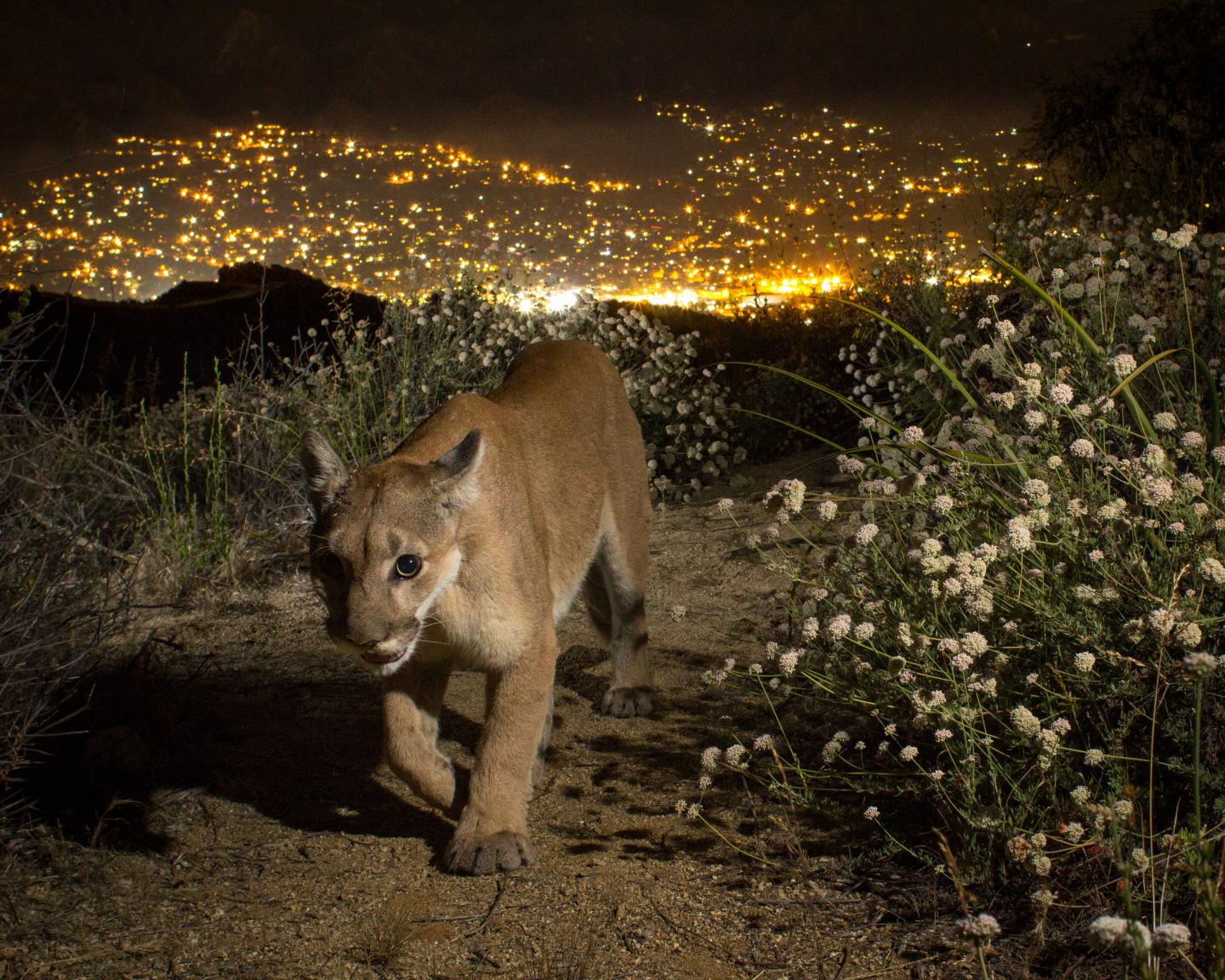
Two isolated mountain lion populations in southern California’s Santa Ana and Santa Monica Mountains are at risk of local extinction, perhaps as soon as within 50 years, according to a study published in the journal Ecological Applications.
The study showed the extinction risk is due to low genetic diversity and mortality that affects the stability of the population. Mountain lion mortality is often caused by humans, but can also result from changes in the environment, such as wildfire and fluctuations in prey density.
The two mountain lion populations in the human-dominated landscape of southern California are isolated by freeways and development. For the study, lead author John Benson of the University of Nebraska and co-authors at UCLA, the University of California, Davis, the National Park Service, the University of Washington, Northern Arizona University, and the University of Wyoming used population viability modeling to predict the possibilities of extinction from genetic and demographic risk factors.
“It’s easy to read our paper as yet another pessimistic story about wildlife threatened by human actions — and in a sense that is true,” said Benson. “However, there is also a more optimistic message in that our model predicted that these populations can persist with relatively modest increases in landscape connectivity. If we can maintain healthy populations of mountain lions — a species that roams widely and requires such large spaces — here in greater Los Angeles, that bodes well for our ability to conserve large carnivores anywhere.”
INBREEDING A CONCERN
Both mountain lion populations have very low genetic diversity as a result of inbreeding, which is inevitable given the lack of connectivity between the mountain ranges and surrounding areas.
Genetic diversity in these two populations is expected to rapidly decline over the next 50 years, which raises concern about inbreeding depression — a phenomenon in which survival and reproduction of animals decline due to low genetic diversity. When the researchers simulated the effects of inbreeding depression in the two populations, the model predicted that rapid extinction was almost certain.
The model predicted generally similar dynamics in the two populations, but the research also revealed differences driven by greater population size and higher mortality in the Santa Ana Mountains.
EFFORTS UNDERWAY, MORE NEEDED
“Our research has shown that the mountain lions in the coastal Santa Ana Mountain Range are primarily put at risk by restriction of their movement across Interstate 15, and their high mortality rates from vehicle collisions and being killed after they have killed unprotected pets or livestock,” said T. Winston Vickers, report co-author and associate veterinarian at the University of California, Davis’ Karen C. Drayer Wildlife Health Center. “Efforts are underway with highway engineers to improve wildlife crossing structures or build new ones on both the I-15 and 101 freeways to enhance movement into and out of both mountain ranges.”
The research highlighted that conservation of large carnivores, including mountain lions, is achievable within urbanized landscapes. But this requires effort. Land protection, connection between the lands and strategies to promote coexistence with humans are necessary to prevent the extinction of these top predators.
“It was interesting to see the differences between the two populations, such as the higher mortality rates in the Santa Anas, and sobering to see the fast rates of extinction predicted for both populations if serious inbreeding depression sets in,” said co-author and National Park Service Wildlife Ecologist Seth Riley, who has been studying mountain lions in the Santa Monica mountains since 2002. “However, it’s also really heartening to see how much of a difference increasing connectivity can make for these isolated populations.”
###
Research in the Santa Ana Mountains was supported by California State Department of Parks and Recreation, California Department of Fish and Game, The Nature Conservancy, McBeth Foundation, Anza Borrego Foundation, Nature Reserve of Orange County, National Science Foundation, Foothill/Eastern Transportation Corridor Agency, San Diego County Association of Governments Environmental Mitigation Program, San Diego Foundation, Felidae Conservation Fund, Mountain Lion Foundation, Santa Rosa Plateau Foundation, Institute for Wildlife Studies, and private donors.
Major funding for John Benson’s work on this project was provided by the La Kretz Center for California Conservation Science at UCLA and the National Park Service.
Media Contact
Kat Kerlin
[email protected]