• HOME
  • NEWS
  • EXPLORE
    • CAREER
      • Companies
      • Jobs
    • EVENTS
    • iGEM
      • News
      • Team
    • PHOTOS
    • VIDEO
    • WIKI
  • BLOG
  • COMMUNITY
    • FACEBOOK
    • INSTAGRAM
    • TWITTER
Sunday, May 10, 2026
BIOENGINEER.ORG
No Result
View All Result
  • Login
  • HOME
  • NEWS
  • EXPLORE
    • CAREER
      • Companies
      • Jobs
        • Lecturer
        • PhD Studentship
        • Postdoc
        • Research Assistant
    • EVENTS
    • iGEM
      • News
      • Team
    • PHOTOS
    • VIDEO
    • WIKI
  • BLOG
  • COMMUNITY
    • FACEBOOK
    • INSTAGRAM
    • TWITTER
  • HOME
  • NEWS
  • EXPLORE
    • CAREER
      • Companies
      • Jobs
        • Lecturer
        • PhD Studentship
        • Postdoc
        • Research Assistant
    • EVENTS
    • iGEM
      • News
      • Team
    • PHOTOS
    • VIDEO
    • WIKI
  • BLOG
  • COMMUNITY
    • FACEBOOK
    • INSTAGRAM
    • TWITTER
No Result
View All Result
Bioengineer.org
No Result
View All Result
Home NEWS Science News Chemistry

Levitating objects with light

Bioengineer by Bioengineer
March 19, 2019
in Chemistry
Reading Time: 3 mins read
0
IMAGE
Share on FacebookShare on TwitterShare on LinkedinShare on RedditShare on Telegram

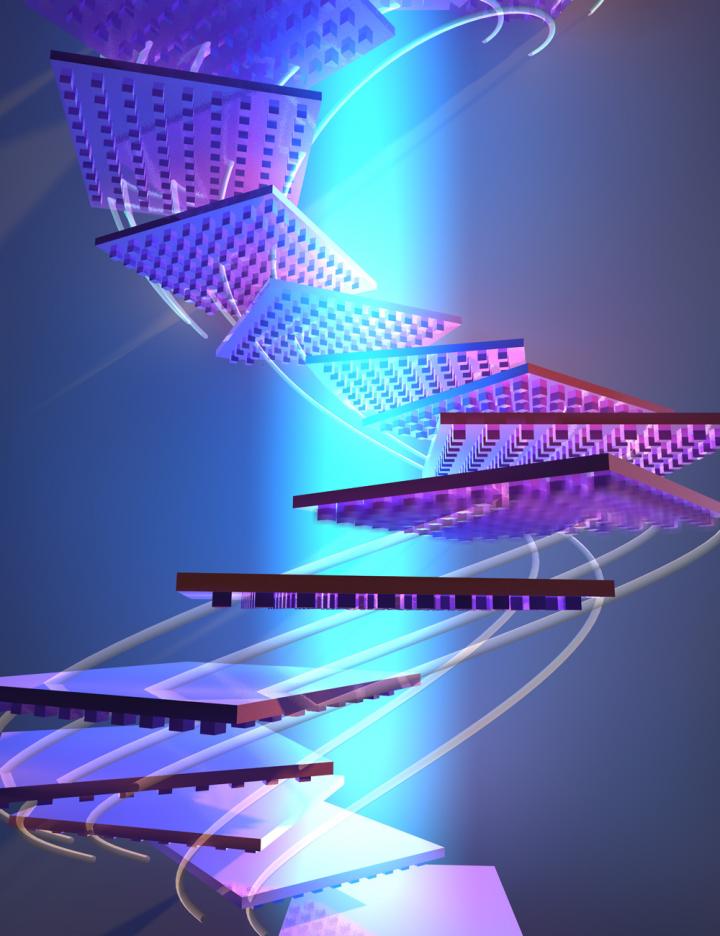
Nanoscale patterning could enable precise manipulation of objects on many scales
IMAGE

Credit: Courtesy of the Atwater laboratory

Researchers at Caltech have designed a way to levitate and propel objects using only light, by creating specific nanoscale patterning on the objects’ surfaces.

Though still theoretical, the work is a step toward developing a spacecraft that could reach the nearest planet outside of our solar system in 20 years, powered and accelerated only by light.

A paper describing the research appears online in the March 18 issue of the journal Nature Photonics. The research was done in the laboratory of Harry Atwater, Howard Hughes Professor of Applied Physics and Materials Science in Caltech’s Division of Engineering and Applied Science.

Decades ago, the development of so-called optical tweezers enabled scientists to move and manipulate tiny objects, like nanoparticles, using the radiative pressure from a sharply focused beam of laser light. This work formed the basis for the 2018 Nobel Prize in Physics. However, optical tweezers are only able to manipulate very small objects and only at very short distances.

Ognjen Ilic, postdoctoral scholar and the study’s first author, gives an analogy: “One can levitate a ping pong ball using a steady stream of air from a hair dryer. But it wouldn’t work if the ping pong ball were too big, or if it were too far away from the hair dryer, and so on.”

With this new research, objects of many different shapes and sizes–from micrometers to meters–could be manipulated with a light beam. The key is to create specific nanoscale patterns on an object’s surface. This patterning interacts with light in such a way that the object can right itself when perturbed, creating a restoring torque to keep it in the light beam. Thus, rather than requiring highly focused laser beams, the objects’ patterning is designed to “encode” their own stability. The light source can also be millions of miles away.

“We have come up with a method that could levitate macroscopic objects,” says Atwater, who is also the director of the Joint Center for Artificial Photosynthesis. “There is an audaciously interesting application to use this technique as a means for propulsion of a new generation of spacecraft. We’re a long way from actually doing that, but we are in the process of testing out the principles.”

In theory, this spacecraft could be patterned with nanoscale structures and accelerated by an Earth-based laser light. Without needing to carry fuel, the spacecraft could reach very high, even relativistic speeds and possibly travel to other stars.

Atwater also envisions that the technology could be used here on Earth to enable rapid manufacturing of ever-smaller objects, like circuit boards.

###

The paper is titled “Self-stabilizing photonic levitation and propulsion of nanostructured macroscopic objects.” Funding was provided by the Air Force Office of Scientific Research.

Media Contact
Lori Dajose
[email protected]

Original Source

https://www.caltech.edu/about/news/levitating-objects-light

Related Journal Article

http://dx.doi.org/10.1038/s41566-019-0373-y

Tags: Chemistry/Physics/Materials SciencesMaterialsNanotechnology/MicromachinesOpticsSatellite Missions/ShuttlesTechnology/Engineering/Computer Science
Share12Tweet8Share2ShareShareShare2

Related Posts

Miniature Sensor Uses Light to Detect Touch — Chemistry

Miniature Sensor Uses Light to Detect Touch

May 8, 2026
Iron Minerals Determine Whether Dissolved Organic Matter Fuels Microbes or Becomes Long-Term Carbon Storage — Chemistry

Iron Minerals Determine Whether Dissolved Organic Matter Fuels Microbes or Becomes Long-Term Carbon Storage

May 8, 2026

Kate Evans Appointed Associate Lab Director for Biological and Environmental Systems Science at ORNL

May 8, 2026

Advancing Multiscale Modeling and Overcoming Operational Challenges in Autothermal COâ‚‚-to-Methanol Reactors

May 8, 2026
Please login to join discussion

POPULAR NEWS

  • Research Indicates Potential Connection Between Prenatal Medication Exposure and Elevated Autism Risk

    840 shares
    Share 336 Tweet 210
  • New Study Reveals Plants Can Detect the Sound of Rain

    727 shares
    Share 290 Tweet 181
  • Scientists Investigate Possible Connection Between COVID-19 and Increased Lung Cancer Risk

    68 shares
    Share 27 Tweet 17
  • Salmonella Haem Blocks Macrophages, Boosts Infection

    61 shares
    Share 24 Tweet 15

About

We bring you the latest biotechnology news from best research centers and universities around the world. Check our website.

Follow us

Recent News

Evaluating Digoxin Use in Patients with Symptomatic Rheumatic Heart Disease

Evaluating the Effectiveness and Safety of Digitalis Glycosides in Treating Heart Failure

Urdu Fall Risk Questionnaire Adapted for Elderly

Subscribe to Blog via Email

Success! An email was just sent to confirm your subscription. Please find the email now and click 'Confirm' to start subscribing.

Join 82 other subscribers
  • Contact Us

Bioengineer.org © Copyright 2023 All Rights Reserved.

Welcome Back!

Login to your account below

Forgotten Password?

Retrieve your password

Please enter your username or email address to reset your password.

Log In
No Result
View All Result
  • Homepages
    • Home Page 1
    • Home Page 2
  • News
  • National
  • Business
  • Health
  • Lifestyle
  • Science

Bioengineer.org © Copyright 2023 All Rights Reserved.