• HOME
  • NEWS
  • EXPLORE
    • CAREER
      • Companies
      • Jobs
    • EVENTS
    • iGEM
      • News
      • Team
    • PHOTOS
    • VIDEO
    • WIKI
  • BLOG
  • COMMUNITY
    • FACEBOOK
    • INSTAGRAM
    • TWITTER
Saturday, January 17, 2026
BIOENGINEER.ORG
No Result
View All Result
  • Login
  • HOME
  • NEWS
  • EXPLORE
    • CAREER
      • Companies
      • Jobs
        • Lecturer
        • PhD Studentship
        • Postdoc
        • Research Assistant
    • EVENTS
    • iGEM
      • News
      • Team
    • PHOTOS
    • VIDEO
    • WIKI
  • BLOG
  • COMMUNITY
    • FACEBOOK
    • INSTAGRAM
    • TWITTER
  • HOME
  • NEWS
  • EXPLORE
    • CAREER
      • Companies
      • Jobs
        • Lecturer
        • PhD Studentship
        • Postdoc
        • Research Assistant
    • EVENTS
    • iGEM
      • News
      • Team
    • PHOTOS
    • VIDEO
    • WIKI
  • BLOG
  • COMMUNITY
    • FACEBOOK
    • INSTAGRAM
    • TWITTER
No Result
View All Result
Bioengineer.org
No Result
View All Result
Home NEWS Science News Biology

Expansion of transposable elements offers clue to genetic paradox

Bioengineer by Bioengineer
March 18, 2019
in Biology
Reading Time: 2 mins read
0
IMAGE
Share on FacebookShare on TwitterShare on LinkedinShare on RedditShare on Telegram

IMAGE

Credit: IBCAS

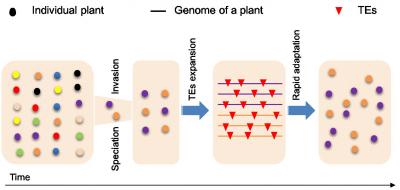
Species often experience a genetic bottleneck that diminishes genetic variation after speciation or introduction into a new area. Though bottlenecks in population size always reduce fitness and evolutionary potential, introduced species often become invasive. This is known as the genetic paradox of invasion.

Now, a research group led by Prof. GUO Yalong from the Institute of Botany of the Chinese Academy of Sciences (IBCAS), together with SONG Ge, and Sureshkumar Balasubramanian from the School of Biological Sciences, Monash University, Australia, has revealed that transposable element (TE) insertions could potentially help species with limited genetic variation adapt to novel environments.

To evaluate how TE insertions drive rapid phenotypic variation and help plants adapt to new environments, the researchers compared an annual and inbreeding forb (Brassicaceae), Capsella rubella, to its outcrossing sister species Capsella grandiflora.

They found that transposable elements (TEs) are highly enriched in the gene promoter regions of C. rubella compared with its outcrossing sister species C. grandiflora.

Interestingly, they found that a number of polymorphic TEs in C. rubella are associated with changes in gene expression, including TEs inserted into the FLOWERING LOCUS C gene, which is one of the key determinant genes of flowering time.

Intriguingly, the accessions with TE insertion are early flowering and distributed in the southernmost habitat of this species, around the Mediterranean region. This region has a Mediterranean climate and is characterized by high precipitation, warm winters, and dry, hot summers.

These results indicate that the genetic variation caused by the expansion of TEs can help species quickly adapt to new habitats. Its influence on adaptive traits could account for the genetic paradox of biological invasion to some extent.

This study was published in PNAS on March 15 and was supported by the National Natural Science Foundation of China, the Strategic Priority Research Program of the Chinese Academy of Sciences, the Innovative Academy of Seed Design, the Chinese Academy of Sciences, the Chinese Academy of Sciences President’s International Fellowship for Visiting Scientists, and the Monash University Larkins Fellowship.

###

Media Contact
JIN Shuo
[email protected]

Original Source

http://english.cas.cn/newsroom/research_news/201903/t20190316_206934.shtml

Related Journal Article

http://dx.doi.org/10.1073/pnas.1811498116

Tags: BiodiversityBiologyGenesPlant Sciences
Share14Tweet8Share2ShareShareShare2

Related Posts

Exploring BAHD Genes in Pecan Development and Stress

January 17, 2026
Gender Differences in Obesity and Stroke Outcomes

Gender Differences in Obesity and Stroke Outcomes

January 17, 2026

Genome Assembly of Helan Shan Pika Aids Conservation

January 17, 2026

New Genetic Insights into Strobilanthes cusia Cultivation

January 16, 2026
Please login to join discussion

POPULAR NEWS

  • Enhancing Spiritual Care Education in Nursing Programs

    155 shares
    Share 62 Tweet 39
  • PTSD, Depression, Anxiety in Childhood Cancer Survivors, Parents

    147 shares
    Share 59 Tweet 37
  • Robotic Ureteral Reconstruction: A Novel Approach

    77 shares
    Share 31 Tweet 19
  • Study Reveals Lipid Accumulation in ME/CFS Cells

    54 shares
    Share 22 Tweet 14

About

BIOENGINEER.ORG

We bring you the latest biotechnology news from best research centers and universities around the world. Check our website.

Follow us

Recent News

Achieving Balanced Behavior Cloning from Imbalanced Datasets

Optimizing Torque Distribution in Electric Vehicles

Studying Tumor Stem Cell Role in Oral Cancer

Subscribe to Blog via Email

Enter your email address to subscribe to this blog and receive notifications of new posts by email.

Join 71 other subscribers
  • Contact Us

Bioengineer.org © Copyright 2023 All Rights Reserved.

Welcome Back!

Login to your account below

Forgotten Password?

Retrieve your password

Please enter your username or email address to reset your password.

Log In
No Result
View All Result
  • Homepages
    • Home Page 1
    • Home Page 2
  • News
  • National
  • Business
  • Health
  • Lifestyle
  • Science

Bioengineer.org © Copyright 2023 All Rights Reserved.