• HOME
  • NEWS
  • EXPLORE
    • CAREER
      • Companies
      • Jobs
    • EVENTS
    • iGEM
      • News
      • Team
    • PHOTOS
    • VIDEO
    • WIKI
  • BLOG
  • COMMUNITY
    • FACEBOOK
    • INSTAGRAM
    • TWITTER
Sunday, October 4, 2026
BIOENGINEER.ORG
No Result
View All Result
  • Login
  • HOME
  • NEWS
  • EXPLORE
    • CAREER
      • Companies
      • Jobs
        • Lecturer
        • PhD Studentship
        • Postdoc
        • Research Assistant
    • EVENTS
    • iGEM
      • News
      • Team
    • PHOTOS
    • VIDEO
    • WIKI
  • BLOG
  • COMMUNITY
    • FACEBOOK
    • INSTAGRAM
    • TWITTER
  • HOME
  • NEWS
  • EXPLORE
    • CAREER
      • Companies
      • Jobs
        • Lecturer
        • PhD Studentship
        • Postdoc
        • Research Assistant
    • EVENTS
    • iGEM
      • News
      • Team
    • PHOTOS
    • VIDEO
    • WIKI
  • BLOG
  • COMMUNITY
    • FACEBOOK
    • INSTAGRAM
    • TWITTER
No Result
View All Result
Bioengineer.org
No Result
View All Result
Home NEWS Science News Science

Scientists develop bubble diameter prediction model for industrial use

Bioengineer by Bioengineer
March 1, 2019
in Science
Reading Time: 2 mins read
0
IMAGE
Share on FacebookShare on TwitterShare on LinkedinShare on RedditShare on Telegram

IMAGE

Credit: HUANG Qingshan

Gas-liquid and gas-liquid-solid reactors have been widely applied in fermentation, photosynthetic culture, metallurgy, and many other processes in chemical industries.

Accurate prediction of bubble diameter is crucial for the proper design, optimization, and scale-up of gas-liquid apparatuses. Most previous research focused only on orifice superficial gas velocity Recently, a research team led by Prof. YANG Chao from the Qingdao Institute of Bioenergy and Bioprocess Technology (QIBEBT), Chinese Academy of Sciences (CAS), systematically investigated the influence of orifice diameter, liquid viscosity, surface tension and orifice superficial gas velocity on the bubble diameter of gas spargers under industrial jetting conditions.

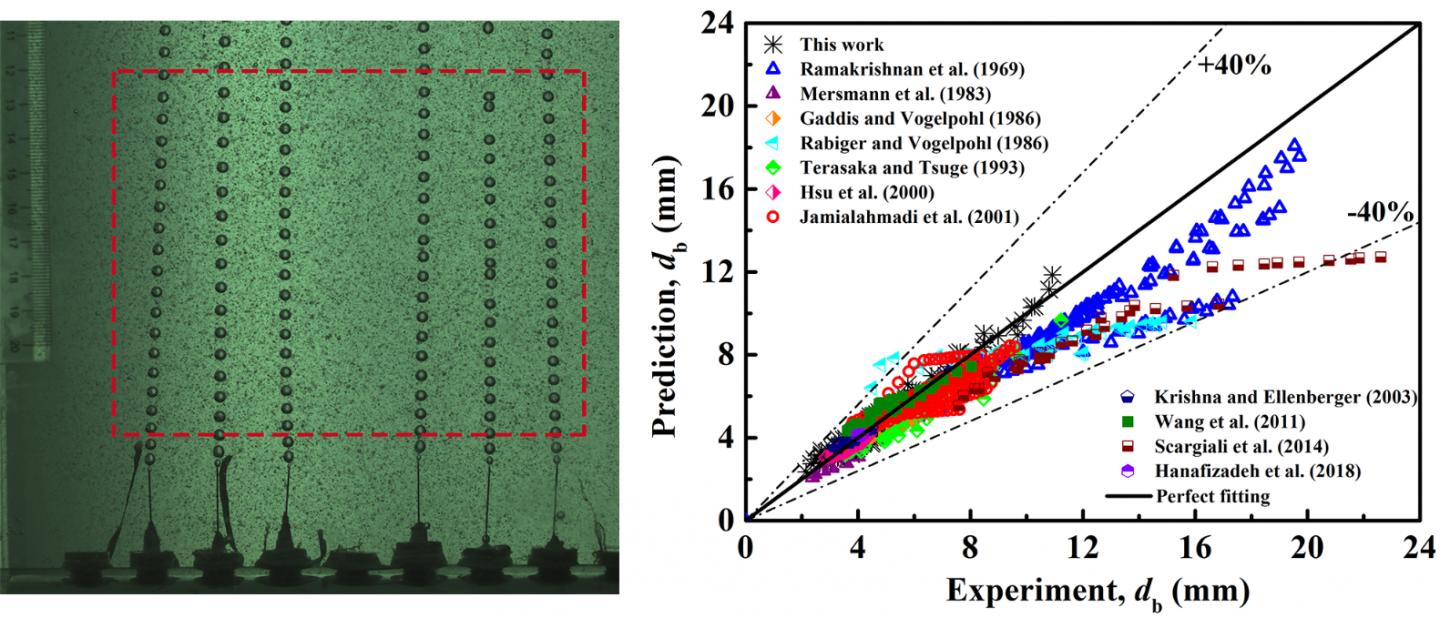
In the study, the bubble diameter was investigated in a rectangular vessel made of transparent Plexiglas. Bubbles were recorded through a single-lens reflex camera. A typical bubble formation image is illustrated in Fig.1 (a). Bubble sizes were analyzed and calculated using patented software (Chinese Software Copyright Registration Number: 2017SR354522).

Based on extensive experimental results, a simple correlation for predicting bubble diameter was proposed using nonlinear least square optimization. The new correlation was successfully validated by comparing prediction results with experimental data over a wide range of operating conditions and working systems from the literature.

The comparison of the results predicted by the new model versus the experimental data from our work and the literature is shown in Fig. 1 (b). Only 6.54% of the 657 experimental results obtained from the literature had deviations of more than 30%, indicating that the proposed correlation in this work can be applied extensively with reasonable accuracy.

These findings were published in Chemical Engineering Science. This work was supported by the National Natural Science Foundation of China, the Instrument Developing Project of CAS, and the “Transformational Technologies for Clean Energy and Demonstration”, Strategic Priority Research Program of CAS.

###

Media Contact
CHENG Jing
[email protected]

Related Journal Article

http://dx.doi.org/10.1016/j.ces.2019.02.009

Tags: Chemistry/Physics/Materials SciencesIndustrial Engineering/Chemistry
Share12Tweet8Share2ShareShareShare2

Related Posts

Five or more hours of smartphone usage per day may increase obesity

July 25, 2019
IMAGE

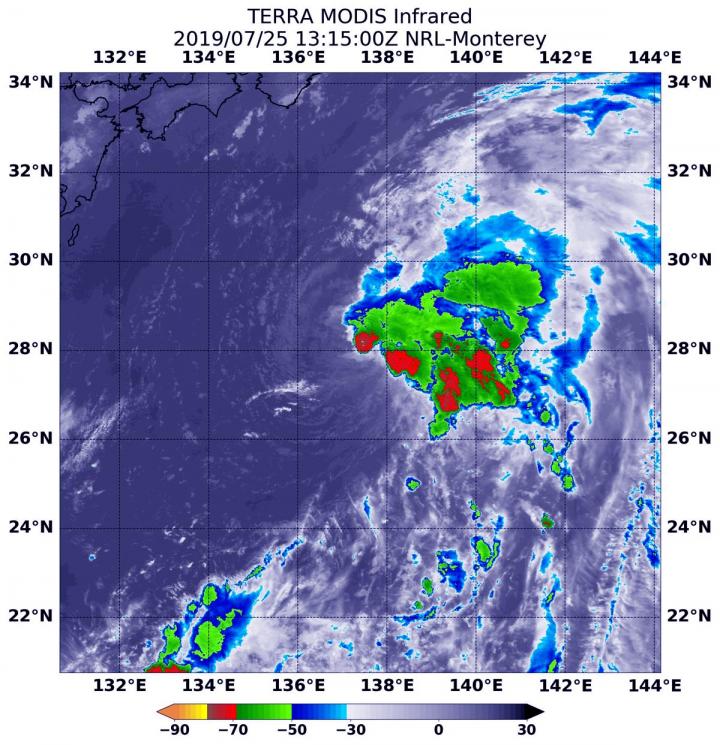
NASA’s terra satellite finds tropical storm 07W’s strength on the side

July 25, 2019

NASA finds one burst of energy in weakening Depression Dalila

July 25, 2019

Researcher’s innovative flood mapping helps water and emergency management officials

July 25, 2019
Please login to join discussion

POPULAR NEWS

  • Alloys That Shrink Their Own Grains: New PIX Mechanism Refines Metals With Heat Alone

    Alloys That Shrink Their Own Grains: New PIX Mechanism Refines Metals With Heat Alone

    29 shares
    Share 12 Tweet 7
  • Endurance Exercise Reshapes the Liver in Males and Females Through Distinct Molecular Routes

    29 shares
    Share 12 Tweet 7
  • Single Transcription Factor PU.1 Rapidly Converts Fibroblasts into Macrophage-Lineage Cells

    29 shares
    Share 12 Tweet 7
  • New Scale Measures How Ready Nurse Educators Really Are for the AI Era

    29 shares
    Share 12 Tweet 7

About

We bring you the latest biotechnology news from best research centers and universities around the world. Check our website.

Follow us

Recent News

Alloys That Shrink Their Own Grains: New PIX Mechanism Refines Metals With Heat Alone

Endurance Exercise Reshapes the Liver in Males and Females Through Distinct Molecular Routes

Single Transcription Factor PU.1 Rapidly Converts Fibroblasts into Macrophage-Lineage Cells

Subscribe to Blog via Email

Success! An email was just sent to confirm your subscription. Please find the email now and click 'Confirm' to start subscribing.

Join 85 other subscribers
  • Contact Us

Bioengineer.org © Copyright 2023 All Rights Reserved.

Welcome Back!

Login to your account below

Forgotten Password?

Retrieve your password

Please enter your username or email address to reset your password.

Log In
No Result
View All Result
  • Homepages
    • Home Page 1
    • Home Page 2
  • News
  • National
  • Business
  • Health
  • Lifestyle
  • Science

Bioengineer.org © Copyright 2023 All Rights Reserved.