• HOME
  • NEWS
  • EXPLORE
    • CAREER
      • Companies
      • Jobs
    • EVENTS
    • iGEM
      • News
      • Team
    • PHOTOS
    • VIDEO
    • WIKI
  • BLOG
  • COMMUNITY
    • FACEBOOK
    • INSTAGRAM
    • TWITTER
Thursday, March 26, 2026
BIOENGINEER.ORG
No Result
View All Result
  • Login
  • HOME
  • NEWS
  • EXPLORE
    • CAREER
      • Companies
      • Jobs
        • Lecturer
        • PhD Studentship
        • Postdoc
        • Research Assistant
    • EVENTS
    • iGEM
      • News
      • Team
    • PHOTOS
    • VIDEO
    • WIKI
  • BLOG
  • COMMUNITY
    • FACEBOOK
    • INSTAGRAM
    • TWITTER
  • HOME
  • NEWS
  • EXPLORE
    • CAREER
      • Companies
      • Jobs
        • Lecturer
        • PhD Studentship
        • Postdoc
        • Research Assistant
    • EVENTS
    • iGEM
      • News
      • Team
    • PHOTOS
    • VIDEO
    • WIKI
  • BLOG
  • COMMUNITY
    • FACEBOOK
    • INSTAGRAM
    • TWITTER
No Result
View All Result
Bioengineer.org
No Result
View All Result
Home NEWS Science News Biology

Newly discovered turtle species is facing extinction

Bioengineer by Bioengineer
February 13, 2019
in Biology
Reading Time: 2 mins read
0
IMAGE
Share on FacebookShare on TwitterShare on LinkedinShare on RedditShare on Telegram

IMAGE

Credit: Thomas Ziegler

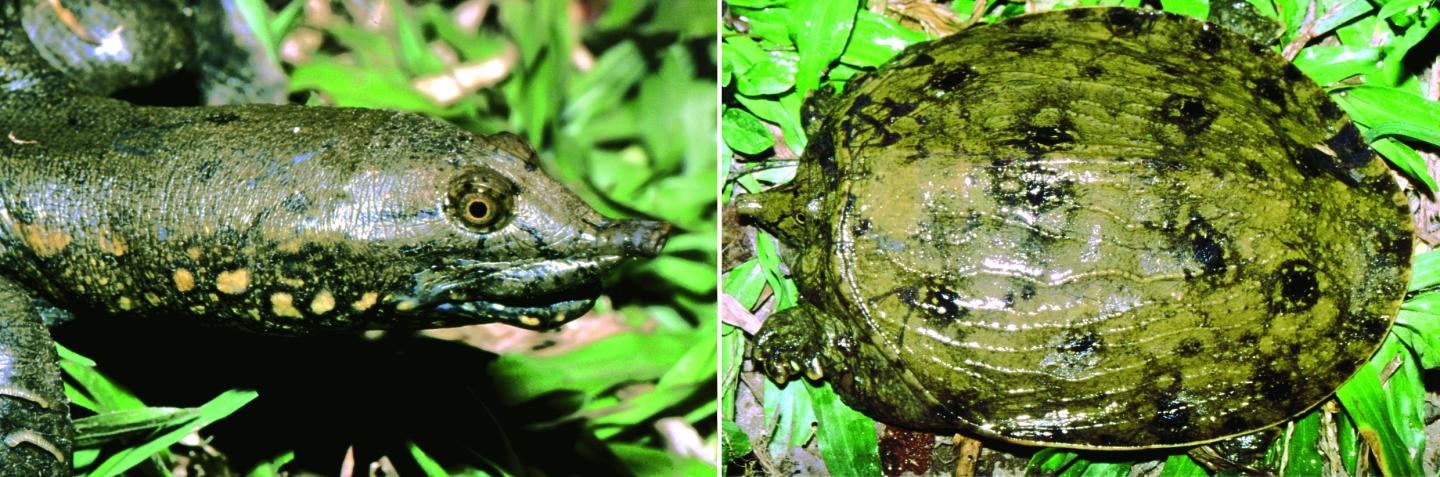
For decades, it has been assumed that the Chinese Softshell Turtles from East Asia all belonged to one and the same species, Pelodiscus sinensis. Widely distributed all the way from the Russian Far East through the Korean Peninsula to China and Vietnam, the species was said to vary substantially in terms of its looks across localities. However, around the turn of the century, following a series of taxonomic debates, scientists revalidated or discovered a total of three species distinct from the ‘original’.

Recently, a Hungarian-Vietnamese-German team of researchers described a fifth species in the genus. Their discovery is published in the open-access journal ZooKeys.

The new species, which differs both genetically and morphologically from the other four, has well-pronounced dark blotches on the underside of its shell. The markings are also the reason why these turtles are going by the scientific name Pelodiscus variegatus, where “variegatus” translates to “spotted” in Latin.

“This morphological feature, among others, led to the discovery that these animals belong to a hitherto undescribed species,” explains Professor Dr. Uwe Fritz of the Senckenberg Natural History Collections in Dresden.

Unfortunately, the identification of multiple species within what used to be a single one has its potentially ill-fated consequences. While the Chinese Softshell Turtle was once considered widespread and not threatened, each newly discovered species “reduces” the individual population numbers.

“When we look at each species, the distribution range as well as the number of individuals is much smaller than when all were combined. Until now, the newly described Spotted Softshell Turtle was considered part of the Lesser Chinese Softshell Turtle Pelodiscus parviformis, which was discovered by Chinese researchers in 1997. Pelodiscus parviformis was already considered critically endangered. Now that its southern representatives have been assigned to a different species, the Spotted Softshell Turtle, the overall population size of each species is even smaller,” explains Balázs Farkas, the study’s Hungarian lead author.

Because of its restricted range and the levels of exploitation it is subjected to, the conservation status of the new species is proposed to be Critically Endangered, according to the criteria of the IUCN Red List of Threatened Species.

###

Original source:

Farkas B, Ziegler T, Pham CT, Ong AV, Fritz U (2019) A new species of Pelodiscus from northeastern Indochina (Testudines, Trionychidae). ZooKeys 824: 71-86. https://doi.org/10.3897/zookeys.824.31376

Media Contact
Uwe Fritz
[email protected]

Related Journal Article

http://dx.doi.org/10.3897/zookeys.824.31376

Tags: BiodiversityBiologyEcology/EnvironmentEvolutionPopulation BiologyZoology/Veterinary Science
Share12Tweet8Share2ShareShareShare2

Related Posts

How to sway group opinions: Encourage opponents to stay undecided

How to sway group opinions: Encourage opponents to stay undecided

March 23, 2026
Deep Learning Model Maps How Individual Cells Shape Disease Outcomes

Deep Learning Model Maps How Individual Cells Shape Disease Outcomes

March 20, 2026

Removing only 15 female sharks annually could endanger the entire population, scientists warn

March 20, 2026

Scientists Urge Fragrance Industry to Transition from Sustainability Talk to Active Funding of Plant Conservation

March 20, 2026
Please login to join discussion

POPULAR NEWS

  • blank

    Revolutionary AI Model Enhances Precision in Detecting Food Contamination

    96 shares
    Share 38 Tweet 24
  • Imagine a Social Media Feed That Challenges Your Views Instead of Reinforcing Them

    1003 shares
    Share 397 Tweet 248
  • Uncovering Functions of Cavernous Malformation Proteins in Organoids

    54 shares
    Share 22 Tweet 14
  • Promising Outcomes from First Clinical Trials of Gene Regulation in Epilepsy

    51 shares
    Share 20 Tweet 13

About

We bring you the latest biotechnology news from best research centers and universities around the world. Check our website.

Follow us

Recent News

In-Sensor Cryptography Links Physical Process to Digital Identity

Can Psychosocial Factors Influence Cancer Risk?

Depression Factors in Elderly: Pre vs. Post-COVID Analysis

Subscribe to Blog via Email

Success! An email was just sent to confirm your subscription. Please find the email now and click 'Confirm' to start subscribing.

Join 78 other subscribers
  • Contact Us

Bioengineer.org © Copyright 2023 All Rights Reserved.

Welcome Back!

Login to your account below

Forgotten Password?

Retrieve your password

Please enter your username or email address to reset your password.

Log In
No Result
View All Result
  • Homepages
    • Home Page 1
    • Home Page 2
  • News
  • National
  • Business
  • Health
  • Lifestyle
  • Science

Bioengineer.org © Copyright 2023 All Rights Reserved.