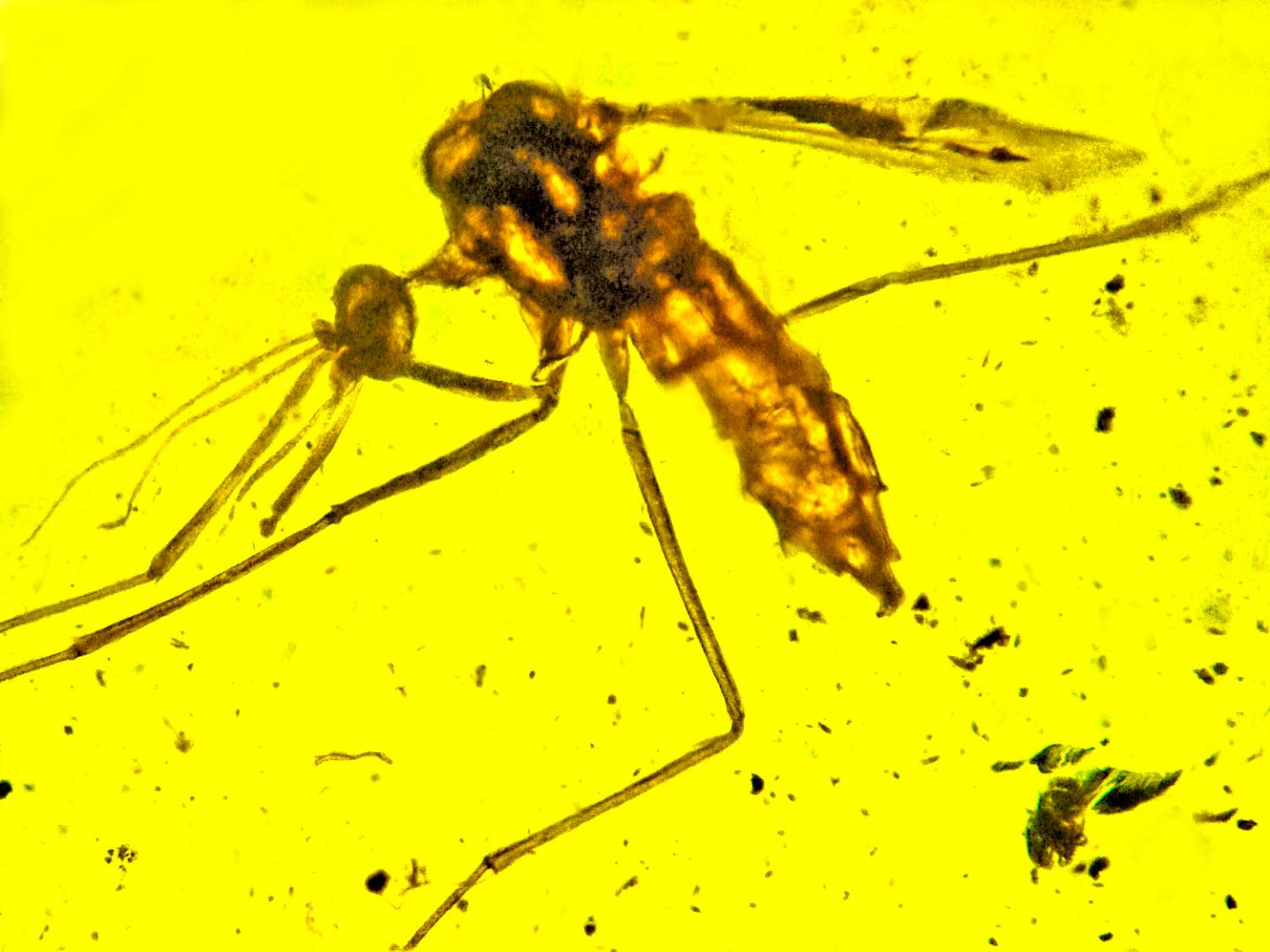
Credit: George Poinar Jr.
CORVALLIS, Ore. – The anopheline mosquitoes that carry malaria were present 100 million years ago, new research shows, potentially shedding fresh light on the history of a disease that continues to kill more than 400,000 people annually.
“Mosquitoes could have been vectoring malaria at that time, but it’s still an open question,” said the study’s corresponding author, George Poinar Jr. of Oregon State University’s College of Science. “Back then anopheline mosquitoes were probably biting birds, small mammals and reptiles since they still feed on those groups today.”
In amber from Myanmar that dates to the mid-Cretaceous Period, Poinar and co-authors described a new genus and species of mosquito, which was named Priscoculex burmanicus. Various characteristics, including those related to wing veins, proboscis, antennae and abdomen indicate that Priscoculex is an early lineage of the anopheline mosquitoes.
“This discovery provides evidence that anophelines were radiating – diversifying from ancestral species – on the ancient megacontinent of Gondwana because it is now thought that Myanmar amber fossils originated on Gondwana,” said Poinar, an international expert in using plant and animal life forms preserved in amber to learn more about the biology and ecology of the distant past.
Findings were published in Historical Biology.
Most malaria, especially the species that infect humans and other primates, is caused primarily by one genus of protozoa, Plasmodium, and spread mainly by anopheline mosquitoes. Ancestral forms of the disease may literally have determined animal survival and evolution, according to Poinar.
In a previous work, he suggested that the origins of malaria, which today can infect animals ranging from humans and other mammals to birds and reptiles, may have first appeared in an insect such as a biting midge that was found to be vectoring a type of malaria some 100 million years ago. Now he can include mosquitoes as possible malaria vectors that existed at the same time.
In a 2007 book, “What Bugged the Dinosaurs? Insects, Disease and Death in the Cretaceous,” Poinar and his wife, Roberta, showed insect vectors from the Cretaceous with pathogens that could have contributed to the widespread extinction of the dinosaurs some 65 million years ago.
“There were catastrophic events that happened around that time, such as asteroid impacts, climatic changes and lava flows,” the Poinars’ wrote. “But it’s still clear that dinosaurs declined and slowly became extinct over thousands of years, which suggests other issues must also have been at work. Insects, microbial pathogens such as malaria, and other vertebrate diseases were just emerging around that time.”
Scientists have long debated about how and when malaria evolved, said Poinar, who was the first to discover malaria in a 15- to 20-million-year-old fossil mosquito from the New World, in what is now the Dominican Republic.
It was the first fossil record of Plasmodium malaria, one type of which is now the strain that infects and kills humans.
Understanding the ancient history of malaria, Poinar said, might offer clues on how its modern-day life cycle evolved and how to interrupt its transmission. Since the sexual reproductive stage of malaria only occurs in the insect vectors, Poinar considers the vectors to be the primary hosts of the malarial pathogen, rather than the vertebrates they infect.
The first human recording of malaria was in China in 2,700 B.C., and some researchers say it may have resulted in the fall of the Roman Empire. In 2017 there were 219 million cases of malaria worldwide, according to the World Health Organization. Immunity rarely occurs naturally and the search for a vaccine has not yet been successful.
###
Media Contact
George Poinar, Jr.
[email protected]
Original Source
http://bit.
Related Journal Article
http://dx.