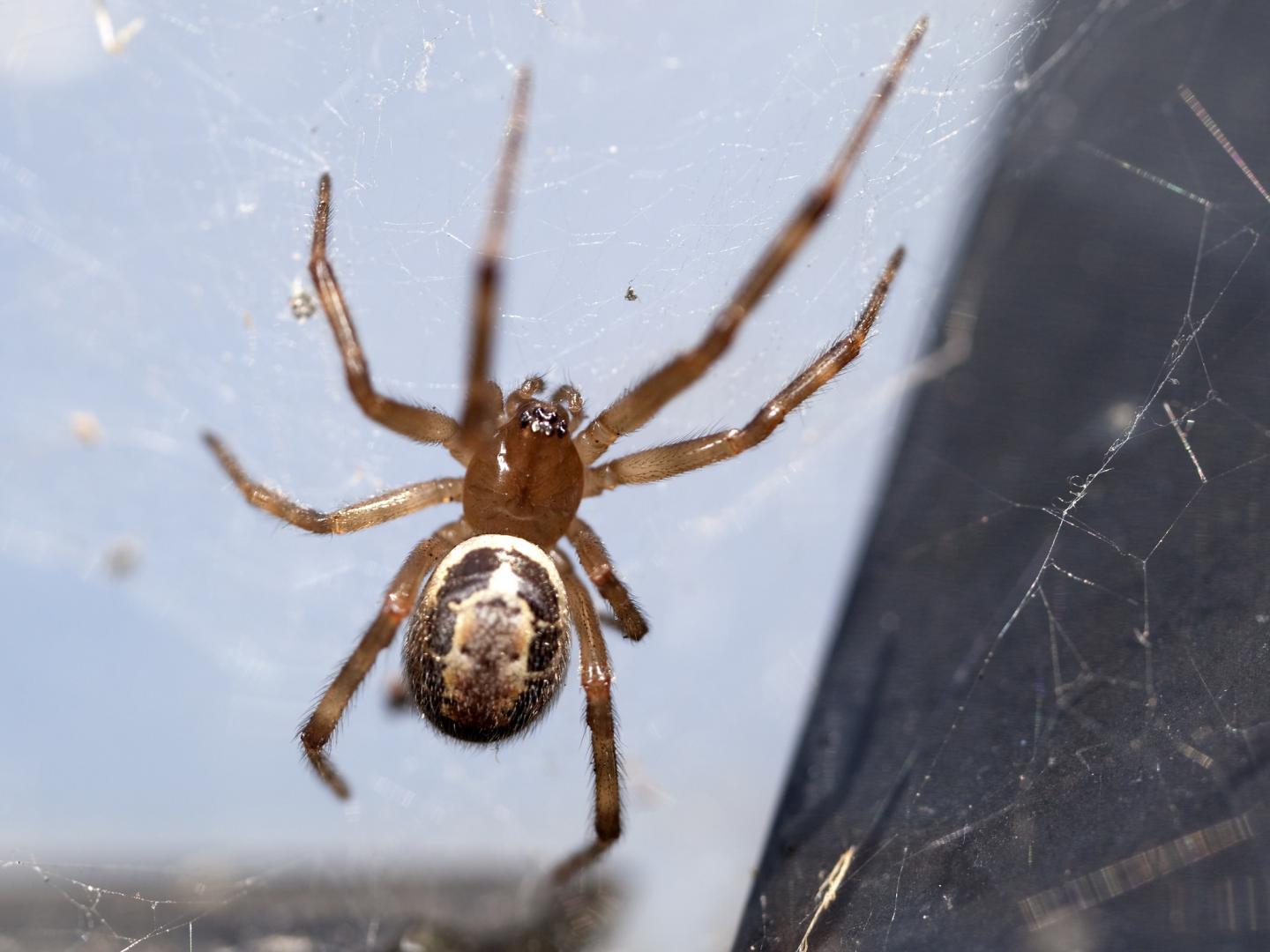
Credit: Rainer Breitling
Spiders are one of the most successful groups of ‘invaders’ on the planet. Out of over 47,000 species of spiders known today, there are some that tend to follow humans across the globe and settle in habitats far away from their native homelands. A particularly notorious example is the species Steatoda nobilis, the Noble False Widow spider.
Originating from Madeira (Portugal) and the Canary Islands (Spain), the Noble False Widow has been rapidly spreading around the globe over the last few decades. While the species is already well established in Western Europe and large parts of the Mediterranean area, it has recently spread into California, South America and Central Europe. Meanwhile, its populations in England, where the spider used to be restricted to the very southern parts of the country, are now seen to experience a sudden expansion northwards.
As its name suggests, this is a relatively large species that resembles the well-known Black Widow and can inflict a painful – yet mostly harmless to humans – bite. Naturally, its ‘arrival’ causes widespread concerns and public disruptions. Specifically, the Noble False Widow poses a threat to native faunas, since it can prey on nearly every smaller animal thanks to its potent venom and sturdy webs.
Recently, experts and non-professional citizen scientists joined forces to reconstruct the invasion path of the Noble False Widow in Europe and the Americas, so that they could identify patterns and predict which regions are likely to be the next colonised by the spider.
By combining data from museum collections and the Spider and Harvestman Recording Scheme of the British Arachnological Society with published literature and their own observations from England, Germany, France and Ecuador, the researchers provided an unprecedented detailed view of the expansion of the Noble False Widow. The study, conducted by Tobias Bauer (State Museum of Natural History Karlsruhe), Stephan Feldmeier (Trier University), Henrik Krehenwinkel (Trier University and University of California Berkeley), Rainer Breitling (University of Manchester) and citizen scientists Carsten Wieczorrek and Nils Reiser, is published in the open-access journal Neobiota.
While it had largely been assumed that the Noble False Widow turned up in Europe along with bananas traded from the Canary Islands, a new look at the data revealed that the spiders have most likely been transported via imports of ornamental plants. Further, rather than the result of climate change, the establishment of the species across new, large territories is rather linked to the fact that these habitats all share similar conditions to the spider’s native localities.
“Similar suitable False Widow habitats occur in quite specific regions all around the globe,” explain the researchers. “Most importantly, South Africa, some areas in southern Australia, and a large part of New Zealand turn out to be highly likely targets for future invasions, unless appropriate import control measures are implemented.”
In conclusion, the authors call for enhanced monitoring of the Noble False Widow as well as its still little known ecological impact on the environment in newly colonised areas. They also urge scientists in the predicted potential invasion target regions to search for specimens, especially in coastal cities.
###
Original source:
Bauer T, Feldmeier S, Krehenwinkel H, Wieczorrek C, Reiser N, Breitling R (2019) Steatoda nobilis, a false widow on the rise: a synthesis of past and current distribution trends. NeoBiota 42: 19-43. https:/
Media Contact
Tobias Bauer
[email protected]
Related Journal Article
http://dx.