• HOME
  • NEWS
  • EXPLORE
    • CAREER
      • Companies
      • Jobs
    • EVENTS
    • iGEM
      • News
      • Team
    • PHOTOS
    • VIDEO
    • WIKI
  • BLOG
  • COMMUNITY
    • FACEBOOK
    • INSTAGRAM
    • TWITTER
Monday, June 29, 2026
BIOENGINEER.ORG
No Result
View All Result
  • Login
  • HOME
  • NEWS
  • EXPLORE
    • CAREER
      • Companies
      • Jobs
        • Lecturer
        • PhD Studentship
        • Postdoc
        • Research Assistant
    • EVENTS
    • iGEM
      • News
      • Team
    • PHOTOS
    • VIDEO
    • WIKI
  • BLOG
  • COMMUNITY
    • FACEBOOK
    • INSTAGRAM
    • TWITTER
  • HOME
  • NEWS
  • EXPLORE
    • CAREER
      • Companies
      • Jobs
        • Lecturer
        • PhD Studentship
        • Postdoc
        • Research Assistant
    • EVENTS
    • iGEM
      • News
      • Team
    • PHOTOS
    • VIDEO
    • WIKI
  • BLOG
  • COMMUNITY
    • FACEBOOK
    • INSTAGRAM
    • TWITTER
No Result
View All Result
Bioengineer.org
No Result
View All Result
Home NEWS Science News Health

New drug brings unexpected hope in targeting cancer cells

Bioengineer by Bioengineer
February 8, 2019
in Health
Reading Time: 2 mins read
0
IMAGE
Share on FacebookShare on TwitterShare on LinkedinShare on RedditShare on Telegram

IMAGE

Credit: N/A


An unexpected finding in pre-clinical platelet studies by Baker Institute researchers could provide a novel approach to targeting and destroying difficult-to-treat cancer cells, providing new therapeutic options for a range of cancers.

This latest finding, published in the journal Theranostics, was discovered while studying activated platelets in the setting of heart disease and may now prove useful for delivering targeted treatment to cancer cells without major side effects.

Early detection of cancer is crucial for successful therapy. However, some cancer types do not have specific cancer surface markers that can be used to detect them and even the same cancer type can exhibit different properties in different patients.

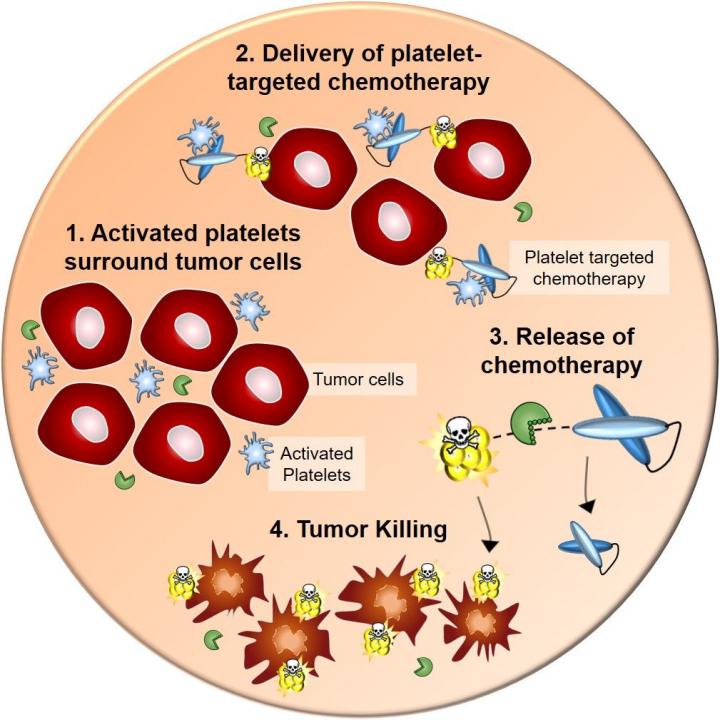
Professor Karlheinz Peter, Deputy Director, Basic and Translational Science at the Baker Heart and Diabetes Institute has been working for many years with platelets, which are small blood cells in the circulation that mainly promote blood clotting (for example, platelets are the main perpetrator of a heart attack) and prevent us from bleeding when we are injured. In his recent experiments, he observed that platelets and more specifically, “activated platelets” accumulate in the area surrounding a wide range at tumour types.

Based on this observation, Prof Peter’s team has now developed a new imaging and platelet targeting chemotherapy agent for the early detection and treatment of cancers. “We have shown that we can image activated platelets to detect tumours with clinically available imaging technologies such as ultrasound and PET/CT,” he said.

“This unique approach holds great promise both for the diagnosis and therapy of a broad range of tumors. It provides a new treatment option particularly for difficult to treat cancer types that lack specific markers for therapy with conventional chemotherapy such as breast cancer etc…,” said Prof Karlheinz.

“This activated platelet targeted chemotherapy approach also provides the means to deliver high concentrations of chemotherapy specifically to tumour cells whilst minimising side effects and preventing tumour growth.

“This highly promising and unexpected discovery with immense importance for cancer diagnosis and therapy emerged from years of research on the function of platelets in heart disease. It is a good example of the importance of funding in basic research which often produces unexpected but highly relevant discoveries that ultimately will provide benefit for patients.”

His team has now patented the drug and is looking for funding to test in large-scale clinical studies.

###

Media Contact
Suzana Talevski
[email protected]
043-997-7203

Original Source

https://baker.edu.au/news/media-releases/novel-cancer-therapy

Tags: Breast CancercancerCardiologyClinical TrialsMedicine/Health
Share12Tweet8Share2ShareShareShare2

Related Posts

Tracking Lanthanide-Labeled Microplastics in Plants

June 25, 2026

Neural Design Enables Zero-Shot Drug-Binding Proteins

June 25, 2026

Genomic Insights into Human Skin Fungi Diversity

June 25, 2026

Chiral Laser Gyroscopes Surpass Lock-In Limit

June 25, 2026
Please login to join discussion

POPULAR NEWS

  • Saying Goodbye to PGY-6: Pediatric Fellowship Realities

    103 shares
    Share 41 Tweet 26
  • Multi-Hospital Study Reveals Long Covid Burden Is Twice as High as Current Estimates

    92 shares
    Share 36 Tweet 23
  • Detection of EDCs in Breast Milk and Infant Urine Up to Six Months Highlights Early Exposure Risks

    77 shares
    Share 31 Tweet 19
  • New Drug Candidate Developed at McMaster Shows Potential for Treating Brain Cancer

    58 shares
    Share 23 Tweet 15

About

We bring you the latest biotechnology news from best research centers and universities around the world. Check our website.

Follow us

Recent News

Tracking Lanthanide-Labeled Microplastics in Plants

POSTECH Researchers Slash Cost of Reconstituted Cell-Free Systems by 95%

AI and Physics Collaborate to Design Advanced Hydrogen Storage Materials

Subscribe to Blog via Email

Success! An email was just sent to confirm your subscription. Please find the email now and click 'Confirm' to start subscribing.

Join 82 other subscribers
  • Contact Us

Bioengineer.org © Copyright 2023 All Rights Reserved.

Welcome Back!

Login to your account below

Forgotten Password?

Retrieve your password

Please enter your username or email address to reset your password.

Log In
No Result
View All Result
  • Homepages
    • Home Page 1
    • Home Page 2
  • News
  • National
  • Business
  • Health
  • Lifestyle
  • Science

Bioengineer.org © Copyright 2023 All Rights Reserved.