UD researchers synthesize renewable oils for use in lubricants
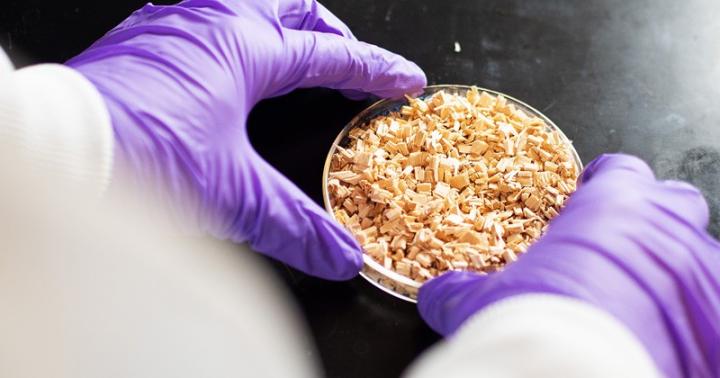
Credit: Photo by Jaynell Keely
Engine gears, plane thrusters, refrigerator compressors, wind turbines — the list of important industrial machinery, agricultural equipment, transportation vessels, and home applications that depend on lubricants might be endless. These slick substances quite literally keep the world turning, touching nearly every facet of modern life and comprising a global industry worth more than $60 billion dollars annually.
And yet, as essential as they are to our way of life, lubricants leave a heavy environmental footprint. Common lubricants, oils, greases and emollients typically consist of mineral, or petroleum, base oils — often up to 90 percent by weight. These mineral base oils are highly volatile and tend to thicken quickly, which means that lubricants need to be replaced often, generating waste.
Synthetic base oils are key to efficient lubricants — owing to their better lubrication properties, stability, and suitability for extreme temperatures compared to their regular mineral-base oils counterparts — but producing them with tunable (i.e. customizable) structures and specifications can be both challenging and expensive. This lack of tunability creates a need for mixing the base-oil with several expensive additives, increasing the environmental footprint of lubricants.
Now, researchers at the University of Delaware-led Catalysis Center for Energy Innovation (CCEI) and investigators from its partner institutions are working to solve these problems. Their findings report a strategy to create renewable lubricant base oils efficiently from non-food biomass — things like wood, switchgrass and other sustainable, organic waste — and fatty acids, which are present in used vegetable oils and animal fat.
The group’s research has been published in the latest issue of Science Advances, and an international patent application has been filed to secure intellectual property rights for their innovative methods.
“This is one of the first attempts to make renewable lubricants from abundant raw materials, and in a very precise chemical way so that the architecture of these large molecules is dialed in, something unachievable using crude oil,” said Dion Vlachos, founder and director of CCEI and the Allan and Myra Ferguson Professor of Chemical and Biomolecular Engineering. “The product is clearly a high-performance material with tunable properties, unlike anything in the market.”
Basu Saha, associate director at CCEI, points to catalysis as the key to synthesizing these new base-oils.
“Catalysts are used to accelerate chemical reactions and create new materials,” Saha said. “For lubricants, catalysis allows researchers to not only synthesize new and existing structurally similar base-oils from bio-based feedstock, but lends extensive control over the molecules’ weight, size distribution, branching and specifications.”
Produced base oils are suitable for a wide range of existing applications without requiring high amounts of additives in the lubricant formulation, said Sibao Liu, a postdoctoral researcher at UD and one of the paper’s co-authors.
“We’ve provided a new, efficient and versatile catalytic reaction pathway for synthesis of renewable lubricants with tunable properties,” Liu adds. “We hope this could eventually displace the manufacturing process for some lubricants used today and minimize environmental carbon footprint, though there is still a long way to go.”
###
About CCEI
The Catalysis Center for Energy Innovation is a multi-institutional research center led by the University of Delaware and comprised of 10 academic institutions and two national research laboratories. Supported by the U.S. Department of Energy, Office of Basic Energy Sciences, through its Energy Frontier Research Centers (EFRC) program since 2009, CCEI and its researchers have been developing innovative catalytic technologies to efficiently convert biomass, such as trees and grasses, into chemicals and fuels.
Media Contact
Peter Kerwin
[email protected]
302-831-8749
Original Source
https:/
Related Journal Article
http://dx.