• HOME
  • NEWS
  • EXPLORE
    • CAREER
      • Companies
      • Jobs
    • EVENTS
    • iGEM
      • News
      • Team
    • PHOTOS
    • VIDEO
    • WIKI
  • BLOG
  • COMMUNITY
    • FACEBOOK
    • INSTAGRAM
    • TWITTER
Tuesday, January 13, 2026
BIOENGINEER.ORG
No Result
View All Result
  • Login
  • HOME
  • NEWS
  • EXPLORE
    • CAREER
      • Companies
      • Jobs
        • Lecturer
        • PhD Studentship
        • Postdoc
        • Research Assistant
    • EVENTS
    • iGEM
      • News
      • Team
    • PHOTOS
    • VIDEO
    • WIKI
  • BLOG
  • COMMUNITY
    • FACEBOOK
    • INSTAGRAM
    • TWITTER
  • HOME
  • NEWS
  • EXPLORE
    • CAREER
      • Companies
      • Jobs
        • Lecturer
        • PhD Studentship
        • Postdoc
        • Research Assistant
    • EVENTS
    • iGEM
      • News
      • Team
    • PHOTOS
    • VIDEO
    • WIKI
  • BLOG
  • COMMUNITY
    • FACEBOOK
    • INSTAGRAM
    • TWITTER
No Result
View All Result
Bioengineer.org
No Result
View All Result
Home NEWS Science News Biology

SUTD researchers developed customizable microfluidic nozzles for generating complex emulsions

Bioengineer by Bioengineer
February 1, 2019
in Biology
Reading Time: 2 mins read
0
IMAGE
Share on FacebookShare on TwitterShare on LinkedinShare on RedditShare on Telegram

IMAGE

Credit: SUTD

Droplets or emulsions are widely employed in the fields of drug delivery, chemical analysis, biological assays and material synthesis. Emulsions can be created using a microfluidic device that allows generation of droplets of one phase dispersed in an immiscible phase. Unlike bulk emulsification process, microfluidic devices allow for controlled generation of droplets with high monodispersity.

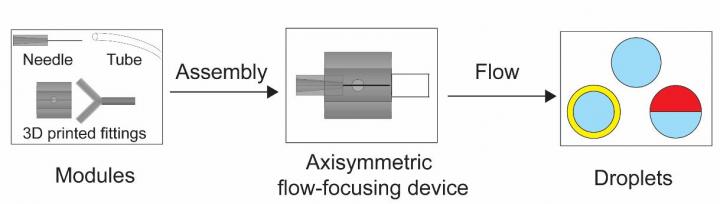
Microfluidic droplet generators are being made by various methods including photolithography, manual assembly of fluidic units and 3D printing. It is challenging to achieve a balance between ease of fabrication of devices and complexity of emulsions produced. Developing a customisable droplet generator that can produce emulsions of varying size and complexity is of great interest. Such devices can be employed for different applications to produce custom-made emulsions. To this end, researchers from the Singapore University of Technology and Design (SUTD) developed a modular approach to fabricate microfluidic axisymmetric droplet generators with distinct modules of 3D printed fittings, needles and tubes.

A single device was made by co-axially aligning a 3D printed connector and needle secured by elastic tubes. The plug-and-play fabrication of these devices allowed for facile reconfiguration and customisation. Each module of the device can be individually altered, and additional modules can be easily attached to vary the type of emulsions. Droplets of varying diameters can be produced by switching the needles attached to the device, and the researchers have achieved a minimum diameter of 332 ± 10 μm for the needle of standard inner diameter of 60 μm. The devices were extended in serial and parallel directions by using appropriate fittings that produced double emulsions and Janus particles.

“By using simple fittings and low-cost units, we were able to rapidly prototype the device in a plug-and -play way. We demonstrated the customisability of the devices by producing simple and complex emulsions by assembling multiple modules together,” said SUTD Assistant Professor Michinao Hashimoto.

This work has been published in RSC Advances, an esteemed journal that encourages high quality multi-disciplinary research. Sindhu Vijayan, a graduate student at SUTD also participated in this research project.

###

Media Contact
Melissa Koh
[email protected]
65-649-98742

Related Journal Article

http://dx.doi.org/10.1039/C8RA08686A

Tags: Biomedical/Environmental/Chemical EngineeringBiotechnologyTechnology/Engineering/Computer Science
Share12Tweet8Share2ShareShareShare2

Related Posts

Hidden Parasites in Saudi Rodents: Molecular Insights

Hidden Parasites in Saudi Rodents: Molecular Insights

January 13, 2026
High Helminth Seropositivity in Immunosuppressed Patients

High Helminth Seropositivity in Immunosuppressed Patients

January 13, 2026

Morphological Anomalies Found in Japanese Haemaphysalis Ticks

January 13, 2026

Comparing Microscopy, LAMP, PCR for Detecting Bovine Babesiosis

January 13, 2026
Please login to join discussion

POPULAR NEWS

  • Enhancing Spiritual Care Education in Nursing Programs

    154 shares
    Share 62 Tweet 39
  • PTSD, Depression, Anxiety in Childhood Cancer Survivors, Parents

    147 shares
    Share 59 Tweet 37
  • Robotic Ureteral Reconstruction: A Novel Approach

    72 shares
    Share 29 Tweet 18
  • Study Reveals Lipid Accumulation in ME/CFS Cells

    52 shares
    Share 21 Tweet 13

About

We bring you the latest biotechnology news from best research centers and universities around the world. Check our website.

Follow us

Recent News

Hidden Parasites in Saudi Rodents: Molecular Insights

High Helminth Seropositivity in Immunosuppressed Patients

Tumor Exosomal tsRNA Drives Lung Cancer Immune Tolerance

Subscribe to Blog via Email

Enter your email address to subscribe to this blog and receive notifications of new posts by email.

Join 71 other subscribers
  • Contact Us

Bioengineer.org © Copyright 2023 All Rights Reserved.

Welcome Back!

Login to your account below

Forgotten Password?

Retrieve your password

Please enter your username or email address to reset your password.

Log In
No Result
View All Result
  • Homepages
    • Home Page 1
    • Home Page 2
  • News
  • National
  • Business
  • Health
  • Lifestyle
  • Science

Bioengineer.org © Copyright 2023 All Rights Reserved.