Credit: Photo: Matthias Klapproth
Life on earth is complex and diverse. In the course of evolution, more and more new species have emerged that are adapted to constantly changing environments. Using modern genetic analyses, researchers can now fully decipher the genetic information of organisms in order to better understand their evolutionary histories and adaptations. Under the leadership of the Human Genome Sequencing Center at Baylor College of Medicine, USA, an international team of researchers, including scientists from the German Primate Center (DPZ) – Leibniz Institute for Primate Research, has reconstructed the phylogenetic tree of the six African baboon species. The genetic information of baboons also provided clear indications that genes were exchanged between the species, i.e. that the species hybridized. The work sheds new light on the fundamental biological processes that produce new species. Since the baboons evolved at about the same time and in the same habitats as humans, the results of the study also allow conclusions about the evolutionary history of early human species (Science Advances).
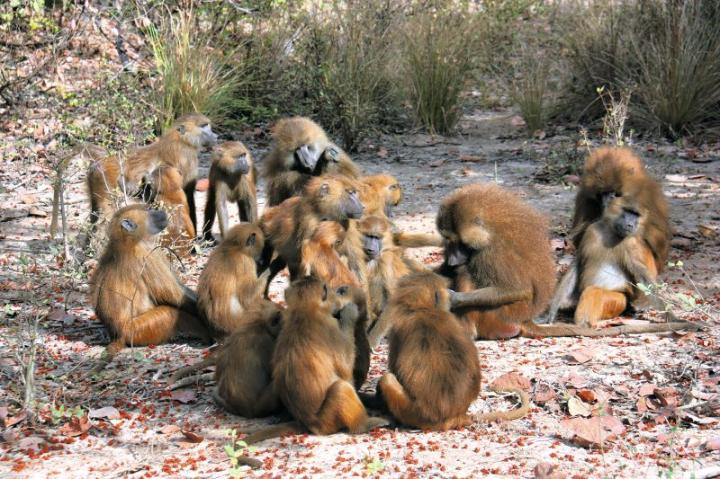
Baboons are Old World monkeys and the six species are widespread in sub-Saharan Africa. They are well studied for their morphology, behavior and ecology. So far, however, little has been known about their genetic adaptations and evolutionary history.
To investigate these questions in detail, the researchers sequenced the complete genomes of the six species. By comparing the genomes and applying different phylogenetic tree models, the scientists detected that, in addition to speciation by lineage splitting, speciation by hybridization and associated gene exchange also occurred.
“The Kinda baboon, a species of baboon endemic to southern Africa, is most likely a product of the fusion of two ancestral baboon lineages,” explains Christian Roos, a scientist in the Primate Genetics Laboratory at the German Primate Center and one of the authors of the study. “We were also able to identify genetic traits that could not be assigned to any of the baboon species living today, indicating that gene flow from an extinct baboon lineage, a so-called ghost line occurred.”
Hybridization between baboon species can still be observed today in areas where species’ ranges meet. Since baboons evolved in the same sub-Saharan habitats as humans about two million years ago, they provide an excellent analogous model for the evolutionary history of the genus Homo, of which modern humans are the only species which has survived.
“Our colleagues at the Max Planck Institute for Evolutionary Anthropology in Leipzig and in other laboratories have already shown that modern humans hybridized with other species such as Neanderthals or Denisovans,” summarizes Dietmar Zinner, scientist in the Cognitive Ethology Laboratory at the DPZ and also one of the authors. “In contrast to humans, whose sister species are now extinct, hybridization and genetic exchange among baboon species can still be studied today. This gives us a better understanding of the evolution of our own species”.
Baboons are not only a model for hybridization studies. They also serve as an excellent comparative model for studies of the impact of historical climate and environmental changes on the evolution of savannah primates, including humans.
###
Media Contact
Dr. Sylvia Siersleben
[email protected]
Related Journal Article
http://dx.