• HOME
  • NEWS
  • EXPLORE
    • CAREER
      • Companies
      • Jobs
    • EVENTS
    • iGEM
      • News
      • Team
    • PHOTOS
    • VIDEO
    • WIKI
  • BLOG
  • COMMUNITY
    • FACEBOOK
    • INSTAGRAM
    • TWITTER
Saturday, February 7, 2026
BIOENGINEER.ORG
No Result
View All Result
  • Login
  • HOME
  • NEWS
  • EXPLORE
    • CAREER
      • Companies
      • Jobs
        • Lecturer
        • PhD Studentship
        • Postdoc
        • Research Assistant
    • EVENTS
    • iGEM
      • News
      • Team
    • PHOTOS
    • VIDEO
    • WIKI
  • BLOG
  • COMMUNITY
    • FACEBOOK
    • INSTAGRAM
    • TWITTER
  • HOME
  • NEWS
  • EXPLORE
    • CAREER
      • Companies
      • Jobs
        • Lecturer
        • PhD Studentship
        • Postdoc
        • Research Assistant
    • EVENTS
    • iGEM
      • News
      • Team
    • PHOTOS
    • VIDEO
    • WIKI
  • BLOG
  • COMMUNITY
    • FACEBOOK
    • INSTAGRAM
    • TWITTER
No Result
View All Result
Bioengineer.org
No Result
View All Result
Home NEWS Science News Health

What makes the deadly pufferfish so delectable

Bioengineer by Bioengineer
January 23, 2019
in Health
Reading Time: 2 mins read
0
IMAGE
Share on FacebookShare on TwitterShare on LinkedinShare on RedditShare on Telegram

IMAGE

Credit: Yuan Liu


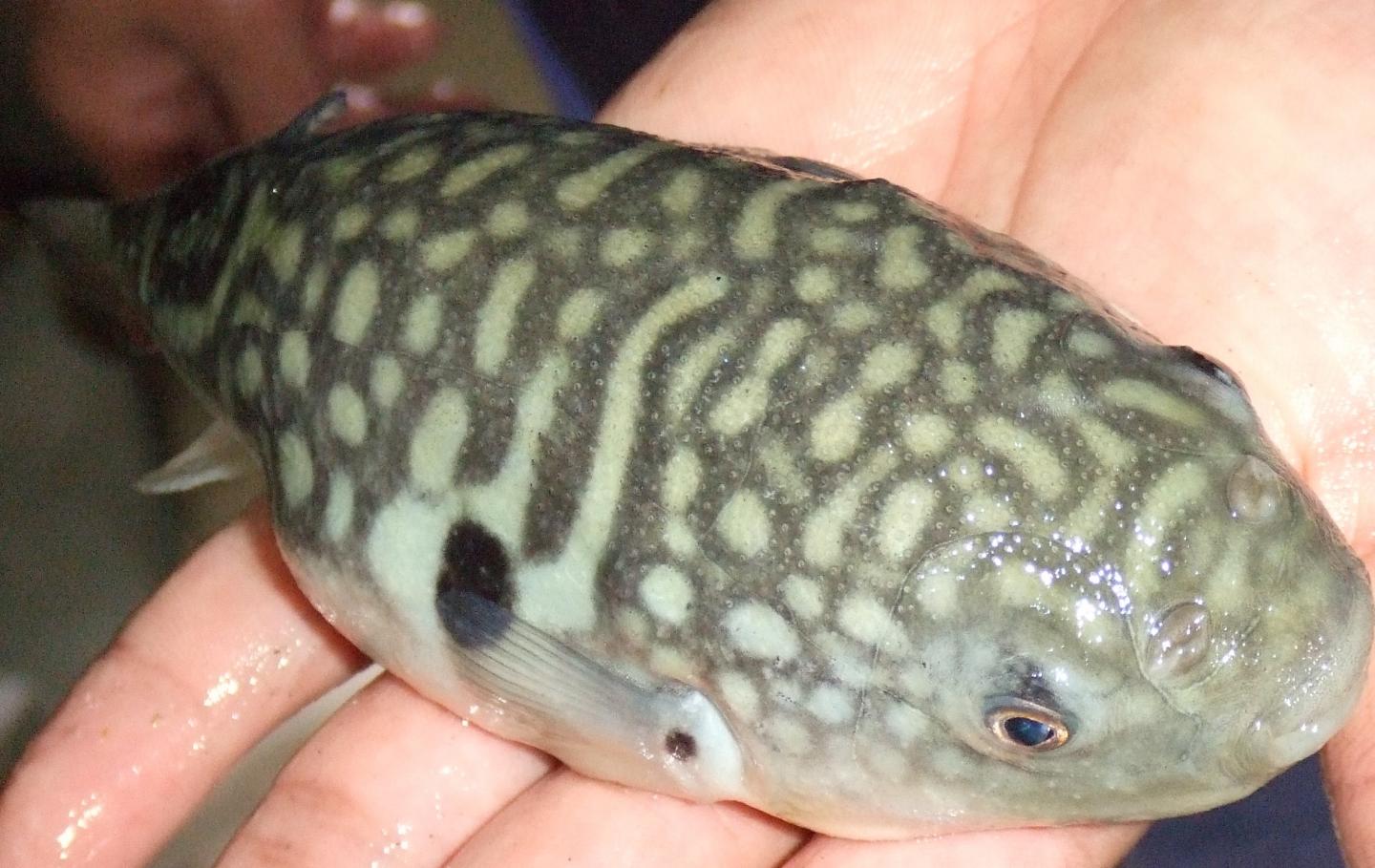
Some people consider pufferfish, also known as fugu, a delicacy because of its unique and exquisite flavor, which is perhaps seasoned by knowledge that consumption of the fish could be deadly. Now, researchers have identified the major compounds responsible for the taste of pufferfish, minus the thrill of living dangerously. They report their results in ACS’ Journal of Agricultural and Food Chemistry.

Pufferfish get their name from their ability to inflate to a much larger size when threatened by predators. But if that defense mechanism fails, the predator may not survive long after its meal: The liver, ovaries, eyes and skin of most species of pufferfish contain tetrodotoxin, a potent neurotoxin. Although specially trained chefs can prepare fugu that’s safe to eat, Yuan Liu and colleagues wondered if they could reproduce the flavor of pufferfish without the life-threatening toxin.

The researchers analyzed the key taste-active compounds in Takifugu obscurus, a species of pufferfish found mainly in the East and South China Seas. First, the team ground up pufferfish muscle tissue and cooked, filtered and centrifuged it to produce a liquid pufferfish extract. They then analyzed the extract and found amounts of 28 potential taste compounds, such as free amino acids, nucleotides and inorganic ions. Taste tests with trained panelists revealed that 12 of these compounds, when added to water, best simulated the flavor of pufferfish, which involved strong umami (savory) and kokumi (mouthfulness) components. When the researchers added two flavor peptides they isolated in a prior study, the imitation pufferfish extract tasted even more like the real thing.

###

These authors acknowledge funding from the National Natural Science Foundation of China.

The abstract that accompanies this study is available here.

The American Chemical Society, the world’s largest scientific society, is a not-for-profit organization chartered by the U.S. Congress. ACS is a global leader in providing access to chemistry-related information and research through its multiple databases, peer-reviewed journals and scientific conferences. ACS does not conduct research, but publishes and publicizes peer-reviewed scientific studies. Its main offices are in Washington, D.C., and Columbus, Ohio.

To automatically receive news releases from the American Chemical Society, contact [email protected].

Follow us on Twitter | Facebook

Media Contact
Katie Cottingham
[email protected]
301-775-8455

Tags: Chemistry/Physics/Materials SciencesFisheries/AquacultureFood/Food ScienceGenesMarine/Freshwater BiologyNutrition/Nutrients
Share12Tweet8Share2ShareShareShare2

Related Posts

Evaluating Pediatric Emergency Care Quality in Ethiopia

February 7, 2026

TPMT Expression Predictions Linked to Azathioprine Side Effects

February 7, 2026

Improving Dementia Care with Enhanced Activity Kits

February 7, 2026

Decoding Prostate Cancer Origins via snFLARE-seq, mxFRIZNGRND

February 7, 2026
Please login to join discussion

POPULAR NEWS

  • Robotic Ureteral Reconstruction: A Novel Approach

    Robotic Ureteral Reconstruction: A Novel Approach

    82 shares
    Share 33 Tweet 21
  • Digital Privacy: Health Data Control in Incarceration

    63 shares
    Share 25 Tweet 16
  • Study Reveals Lipid Accumulation in ME/CFS Cells

    57 shares
    Share 23 Tweet 14
  • Breakthrough in RNA Research Accelerates Medical Innovations Timeline

    53 shares
    Share 21 Tweet 13

About

We bring you the latest biotechnology news from best research centers and universities around the world. Check our website.

Follow us

Recent News

Evaluating Pediatric Emergency Care Quality in Ethiopia

TPMT Expression Predictions Linked to Azathioprine Side Effects

Improving Dementia Care with Enhanced Activity Kits

Subscribe to Blog via Email

Enter your email address to subscribe to this blog and receive notifications of new posts by email.

Join 73 other subscribers
  • Contact Us

Bioengineer.org © Copyright 2023 All Rights Reserved.

Welcome Back!

Login to your account below

Forgotten Password?

Retrieve your password

Please enter your username or email address to reset your password.

Log In
No Result
View All Result
  • Homepages
    • Home Page 1
    • Home Page 2
  • News
  • National
  • Business
  • Health
  • Lifestyle
  • Science

Bioengineer.org © Copyright 2023 All Rights Reserved.