New evolutionary research could help explain color differences in other species, predict some animal survival and reproduction in warming climate
Credit: Michael Moore/Case Western Reserve University
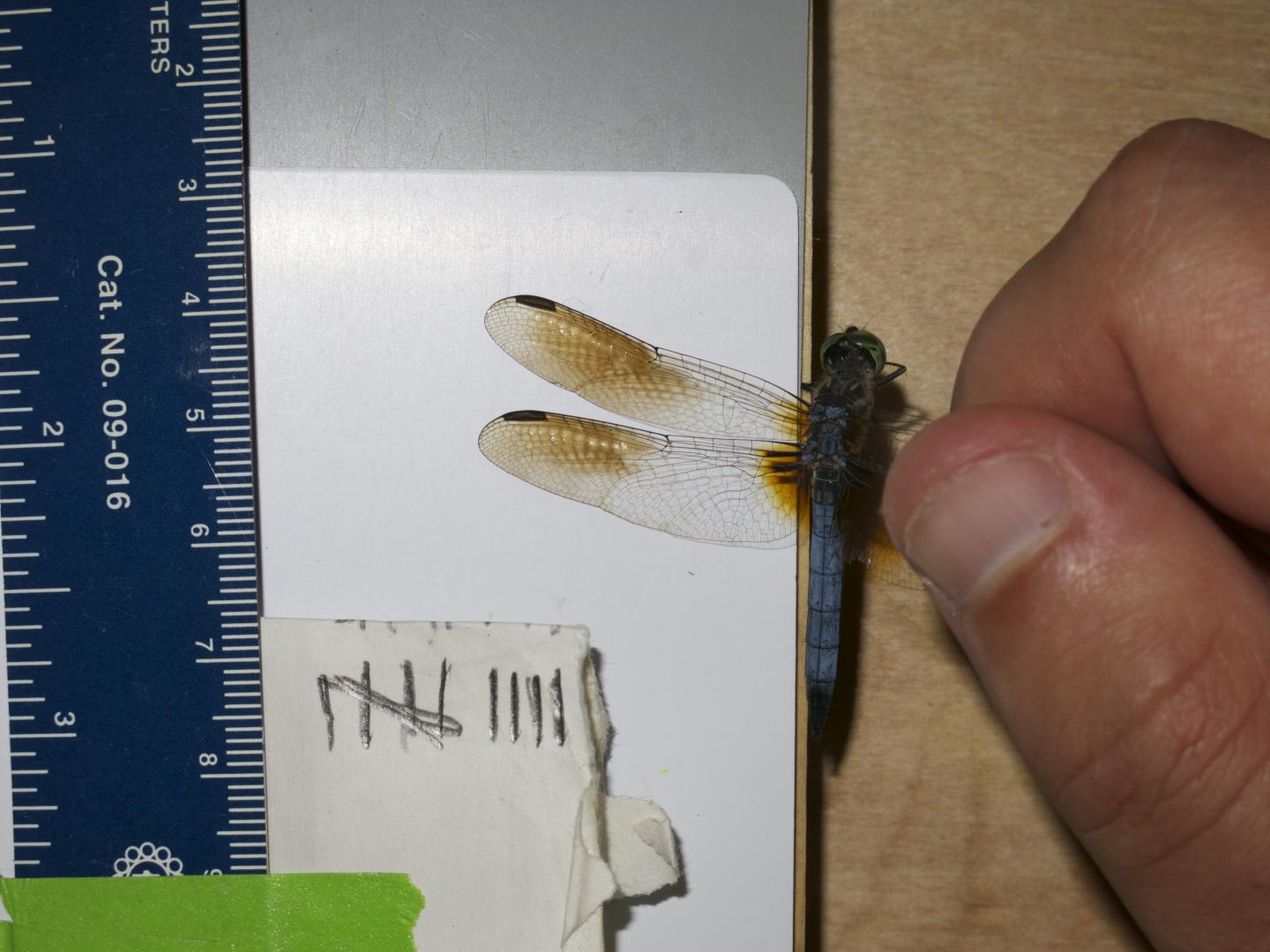
CLEVELAND–New research from Case Western Reserve University in how dragonflies may adapt their wing color to temperature differences might explain color variation in other animals, from lions to birds.
Further, the findings could also provide evolutionary biologists clues about whether rising global temperatures might adversely affect some species.
Michael Moore, a graduate biology student, and Ryan Martin, an assistant professor of biology, recently published their findings in the journal Ecology Letters.
“People have long been aware of variation in dragonfly wing color, but what we are showing in this new work is an overlooked environmental factor–how temperature affects coloration,” Martin said. “This could turn out to also determine some of the really cool extravagant traits we like to look at, such as coloration in birds.”
Their findings follow a two-year study that began with a hunch about how the wing color on male Blue Dasher dragonflies in the western United States was different from their counterparts in Northeast Ohio.
They reviewed vast amounts of dragonfly photographs compiled by citizen scientists on the website iNaturalist.org and then, with the help of graduate student Iulian Gherghel, cross-referenced that information with weather data.
“I went through 600 pictures from the couch to begin this research,” said Moore with a laugh. “After that, it was just mapping it with the corresponding environmental and weather data. It turns out that males in the hottest parts of North America have way less colorful wings, and we wanted to know why. “
Dragonfly weightlifting and other experiments
But the research really took off in the summer of 2017 at the Case Western Reserve farm in Hunting Valley, Ohio, as Moore and Hathaway Brown high-school student Cassandra Lis chased down male dragonflies as they fought to defend their respective territories surrounding a pond.
Across a series of experiments, they then marked each male’s body with a series of colors for individual identification at the pond, colored some of their wings with a dark marker, and put the different groups through a weightlifting test to measure their strength.
The conclusion: The dragonflies with darker wings absorbed more heat from the sun, much like we do when wearing a dark shirt on a sunny day. That simple act caused the muscles of those cold-blooded dragonflies to warm more quickly, grow stronger and more successfully defend their territory or win females.
Findings may extend to other species
“Further tests, however, showed that, when temperatures were too hot, darker wings caused the dragonflies to overheat and fly poorly,” Moore said.
“These findings suggest that this poor flight would then cause those overheated males to lose the territorial battles and their mates, which in turn could be why males in the warmest parts of North America have adapted to produce less colorful wings.”
The study’s three main conclusions:
1, The dragonfly observations could help scientists explain how similar traits have evolved across the animal kingdom globally.
“We know, for example, that male lions with dark manes tend to overheat more, which translated into how mane size and darkness have evolved across Africa and Asia,” Moore said, citing previous scientific research.
“And if it’s happening in dragonflies and lions, two species separated by hundreds of millions years of evolution, it’s seems possible that it could be a pretty common pattern.”
2. Dragonflies with dark coloring–and other animals–could begin to overheat as global temperatures continue to rise if they can’t adapt quickly enough, or if they do adapt, might do so by losing their distinctive colors.
3. Because different dragonfly species, like many animal species, mate based on appearance, adaptation to rising global temperatures could lead to more interbreeding because of the confusion over color.
###
For more information, contact Mike Scott at [email protected]
Media Contact
Michael Scott
[email protected]
216-368-1004
Original Source
https:/
Related Journal Article
http://dx.