• HOME
  • NEWS
  • EXPLORE
    • CAREER
      • Companies
      • Jobs
    • EVENTS
    • iGEM
      • News
      • Team
    • PHOTOS
    • VIDEO
    • WIKI
  • BLOG
  • COMMUNITY
    • FACEBOOK
    • INSTAGRAM
    • TWITTER
Wednesday, January 14, 2026
BIOENGINEER.ORG
No Result
View All Result
  • Login
  • HOME
  • NEWS
  • EXPLORE
    • CAREER
      • Companies
      • Jobs
        • Lecturer
        • PhD Studentship
        • Postdoc
        • Research Assistant
    • EVENTS
    • iGEM
      • News
      • Team
    • PHOTOS
    • VIDEO
    • WIKI
  • BLOG
  • COMMUNITY
    • FACEBOOK
    • INSTAGRAM
    • TWITTER
  • HOME
  • NEWS
  • EXPLORE
    • CAREER
      • Companies
      • Jobs
        • Lecturer
        • PhD Studentship
        • Postdoc
        • Research Assistant
    • EVENTS
    • iGEM
      • News
      • Team
    • PHOTOS
    • VIDEO
    • WIKI
  • BLOG
  • COMMUNITY
    • FACEBOOK
    • INSTAGRAM
    • TWITTER
No Result
View All Result
Bioengineer.org
No Result
View All Result
Home NEWS Science News Biology

Research reveals mechanism for leukaemia cell growth, prompting new treatment hopes

Bioengineer by Bioengineer
January 16, 2019
in Biology
Reading Time: 2 mins read
0
IMAGE
Share on FacebookShare on TwitterShare on LinkedinShare on RedditShare on Telegram

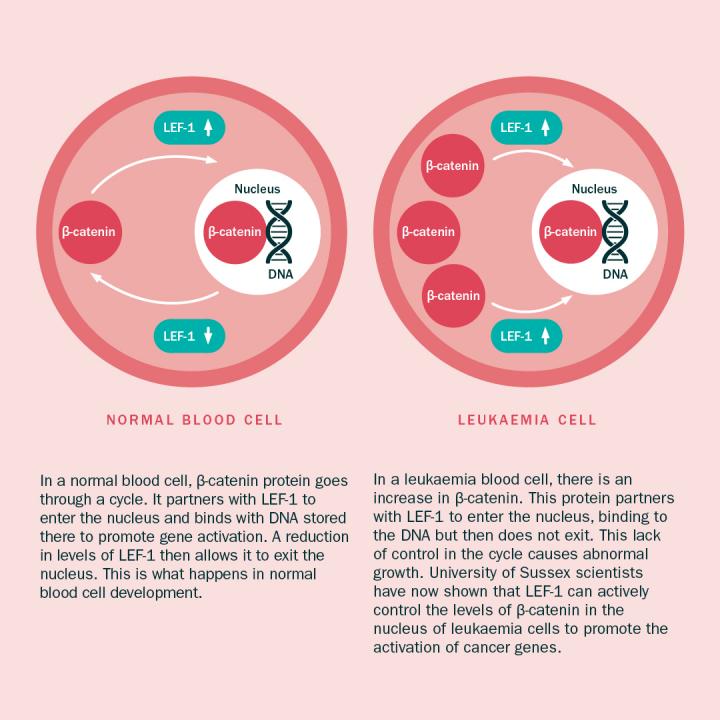
Research reveals new blood cell mechanism which drives leukaemia growth
IMAGE

Credit: University of Sussex


A mechanism which drives leukaemia cell growth has been discovered by researchers at the University of Sussex, who believe their findings could help to inform new strategies when it comes to treating the cancer.

Acute myeloid leukaemia (AML) is a devastating blood cancer with around 3,000 new cases annually in the UK.

Despite considerable improvement in patient survival over the last 50 years, the prognosis remains poor for many subsets of adults and children who suffer from the disease.

Current chemotherapies are highly toxic, and often fail to induce a long-term cure resulting in an urgent clinical need for the design of better tolerated and highly targeted therapies that induce durable remissions.

Leukaemia cells are known to have an overactive level of a protein called β-catenin, which can drive cancer development. Once this protein moves into the nucleus of cells, where DNA is stored, it can assist the activation of genes important for leukaemia development. The activity of β-catenin is highly dependent upon the interactions it forms with other proteins in the cell.

Up until now, the movement of β-catenin into the nucleus of leukaemia cells has been a poorly understood process in blood cells.

But researchers from the University of Sussex, Bristol and Cardiff using funding from the Kay Kendall Leukaemia Fund (KKLF) and Bloodwise have now discovered a protein partner that promotes this process and therefore helps leukaemia cells to grow. Their findings could lead to the development of new therapeutic strategies to treat AML.

In a paper published in the journal Haematologica, Dr Rhys Morgan, Lecturer in Biomedical Science, observed that protein LEF-1 can actively control the level of β-catenin in the nucleus of myeloid leukaemia cells. This is the first study to reveal such a mechanism is active in leukaemia cells, and also the first to reveal β-catenin’s interaction partners in blood cells.

Dr Rhys Morgan, from the University of Sussex, said: “Whilst scientists have long been aware of the involvement of β-catenin in cancer progression, drugs directly targeting the protein or its partners haven’t yet reached the clinic. From our research findings we’d suggest that pharmacological targeting of β-catenin’s movement into the nucleus, through a partner like LEF-1, could be a viable treatment strategy in leukaemia.”

He explained further: “This research is at a very early stage and targeting the activity of β-catenin won’t be a solution for all leukaemia cases and subtypes.

“However data suggests that anywhere between 20-80% of AML cases display elevated levels of this molecule which justifies further investigation in this setting.”

Dr Morgan and his team are now working to further understand the biological significance of many of the new interacting proteins discovered in the study, with the belief that others could be worth targeting to inhibit β-catenin level and activity in leukaemia.

###

Media Contact
Stephanie Allen
[email protected]
01-273-873-659

Related Journal Article

http://dx.doi.org/10.3324/haematol.2018.202846

Tags: cancerCell BiologyHealth Care Systems/ServicesMedicine/HealthMolecular BiologyPublic Health
Share12Tweet8Share2ShareShareShare2

Related Posts

Accelerated Donkey Breed Classification via SNP Insights

Accelerated Donkey Breed Classification via SNP Insights

January 14, 2026
Integrative Multi-Omics Links GWAS to Genes in Cattle

Integrative Multi-Omics Links GWAS to Genes in Cattle

January 14, 2026

Astaxanthin’s Role in Easing Exercise Muscle Damage

January 14, 2026

Impact of Sex on Mortality in Sjögren’s Disease

January 14, 2026
Please login to join discussion

POPULAR NEWS

  • Enhancing Spiritual Care Education in Nursing Programs

    155 shares
    Share 62 Tweet 39
  • PTSD, Depression, Anxiety in Childhood Cancer Survivors, Parents

    147 shares
    Share 59 Tweet 37
  • Robotic Ureteral Reconstruction: A Novel Approach

    73 shares
    Share 29 Tweet 18
  • Study Reveals Lipid Accumulation in ME/CFS Cells

    52 shares
    Share 21 Tweet 13

About

We bring you the latest biotechnology news from best research centers and universities around the world. Check our website.

Follow us

Recent News

Pre-Breakfast Hand Bathing Boosts Postoperative Recovery Comfort

Exploring Dorstenia barnimiana’s Antioxidant and Antibacterial Properties

Pre-Breakfast Bathing Boosts Post-Surgery Comfort in Japan

Subscribe to Blog via Email

Enter your email address to subscribe to this blog and receive notifications of new posts by email.

Join 71 other subscribers
  • Contact Us

Bioengineer.org © Copyright 2023 All Rights Reserved.

Welcome Back!

Login to your account below

Forgotten Password?

Retrieve your password

Please enter your username or email address to reset your password.

Log In
No Result
View All Result
  • Homepages
    • Home Page 1
    • Home Page 2
  • News
  • National
  • Business
  • Health
  • Lifestyle
  • Science

Bioengineer.org © Copyright 2023 All Rights Reserved.