• HOME
  • NEWS
  • EXPLORE
    • CAREER
      • Companies
      • Jobs
    • EVENTS
    • iGEM
      • News
      • Team
    • PHOTOS
    • VIDEO
    • WIKI
  • BLOG
  • COMMUNITY
    • FACEBOOK
    • INSTAGRAM
    • TWITTER
Friday, June 26, 2026
BIOENGINEER.ORG
No Result
View All Result
  • Login
  • HOME
  • NEWS
  • EXPLORE
    • CAREER
      • Companies
      • Jobs
        • Lecturer
        • PhD Studentship
        • Postdoc
        • Research Assistant
    • EVENTS
    • iGEM
      • News
      • Team
    • PHOTOS
    • VIDEO
    • WIKI
  • BLOG
  • COMMUNITY
    • FACEBOOK
    • INSTAGRAM
    • TWITTER
  • HOME
  • NEWS
  • EXPLORE
    • CAREER
      • Companies
      • Jobs
        • Lecturer
        • PhD Studentship
        • Postdoc
        • Research Assistant
    • EVENTS
    • iGEM
      • News
      • Team
    • PHOTOS
    • VIDEO
    • WIKI
  • BLOG
  • COMMUNITY
    • FACEBOOK
    • INSTAGRAM
    • TWITTER
No Result
View All Result
Bioengineer.org
No Result
View All Result
Home NEWS Science News Health

Application of nanosized LiFePO4 modified electrode to electrochemical sensor & biosensor

Bioengineer by Bioengineer
January 10, 2019
in Health
Reading Time: 2 mins read
0
IMAGE
Share on FacebookShare on TwitterShare on LinkedinShare on RedditShare on Telegram

This article by Dr. Wei Sunf et al. is published in Current Analytical Chemistry, Volume 14 , Issue 5 , 2018
IMAGE

Credit: Wei Sunf and Bentham Science Publishers


Electrochemical sensors and biosensors allow researchers to measure small quantities of chemicals or physico-chemical parameters in experimental settings. This is achieved with the use of sensitive electrodes which can detect small changes in electrical signals. Due to this sensitivity, they have diverse applications in engineering and medicine. Newer versions of sensors offer greater sensitivity and accuracy with the help of nanomaterials incorporated in electrodes used in the sensor.

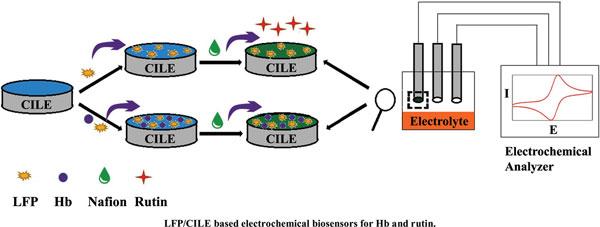
Researchers led by Wei Sun at the College of Chemistry and Chemical Engineering, Hainan Normal University have tested electrodes modified with Lithium Iron Phosphate (LFP) for biochemical analysis or rutin (a citrus flavonoid) and hemoglobin. According to the researchers, LFP is a promising candidate to develop new modified electrodes owing to its advantages such a low cost, environmental compatibility, high safety, non-toxicity, long cycle life and abundance in the environment.

Sun’s team employed scanning electron microscopy to distinguish nanosized LFP particles. The LFP modified electrodes were then prepared by casting the a solution of the particles over the surface of a Carbon Ionic Liquid Electrode (CILE) and adding drops of chitosan on the modified electrodes. Two separate electrodes were prepared for analyzing rutin and hemoglobin, respectively.

The team studied the electrochemical activity of rutin and hemoglobin with these nano-LFP electrodes and achieved detection limits of 8.0 nmol L-1 for rutin and, in the case of hemoglobin, 0.068 mmol L-1 for trichloroacetic acid reduction and 0.07 μmol L-1 for hydrogen peroxide reduction.

###

This article is Open Access. To obtain the article please visit http://www.eurekaselect.com/155154

Media Contact
Faizan ul Haq
[email protected]

Related Journal Article

http://dx.doi.org/10.2174/1573411013666170824150715

Tags: Atomic/Molecular/Particle PhysicsBiochemistryCell BiologyMedicine/HealthNanotechnology/Micromachines
Share12Tweet8Share2ShareShareShare2

Related Posts

Tracking Lanthanide-Labeled Microplastics in Plants

June 25, 2026

Neural Design Enables Zero-Shot Drug-Binding Proteins

June 25, 2026

Genomic Insights into Human Skin Fungi Diversity

June 25, 2026

Chiral Laser Gyroscopes Surpass Lock-In Limit

June 25, 2026
Please login to join discussion

POPULAR NEWS

  • Saying Goodbye to PGY-6: Pediatric Fellowship Realities

    103 shares
    Share 41 Tweet 26
  • Multi-Hospital Study Reveals Long Covid Burden Is Twice as High as Current Estimates

    92 shares
    Share 36 Tweet 23
  • Detection of EDCs in Breast Milk and Infant Urine Up to Six Months Highlights Early Exposure Risks

    77 shares
    Share 31 Tweet 19
  • New Drug Candidate Developed at McMaster Shows Potential for Treating Brain Cancer

    58 shares
    Share 23 Tweet 15

About

We bring you the latest biotechnology news from best research centers and universities around the world. Check our website.

Follow us

Recent News

Tracking Lanthanide-Labeled Microplastics in Plants

POSTECH Researchers Slash Cost of Reconstituted Cell-Free Systems by 95%

AI and Physics Collaborate to Design Advanced Hydrogen Storage Materials

Subscribe to Blog via Email

Success! An email was just sent to confirm your subscription. Please find the email now and click 'Confirm' to start subscribing.

Join 82 other subscribers
  • Contact Us

Bioengineer.org © Copyright 2023 All Rights Reserved.

Welcome Back!

Login to your account below

Forgotten Password?

Retrieve your password

Please enter your username or email address to reset your password.

Log In
No Result
View All Result
  • Homepages
    • Home Page 1
    • Home Page 2
  • News
  • National
  • Business
  • Health
  • Lifestyle
  • Science

Bioengineer.org © Copyright 2023 All Rights Reserved.