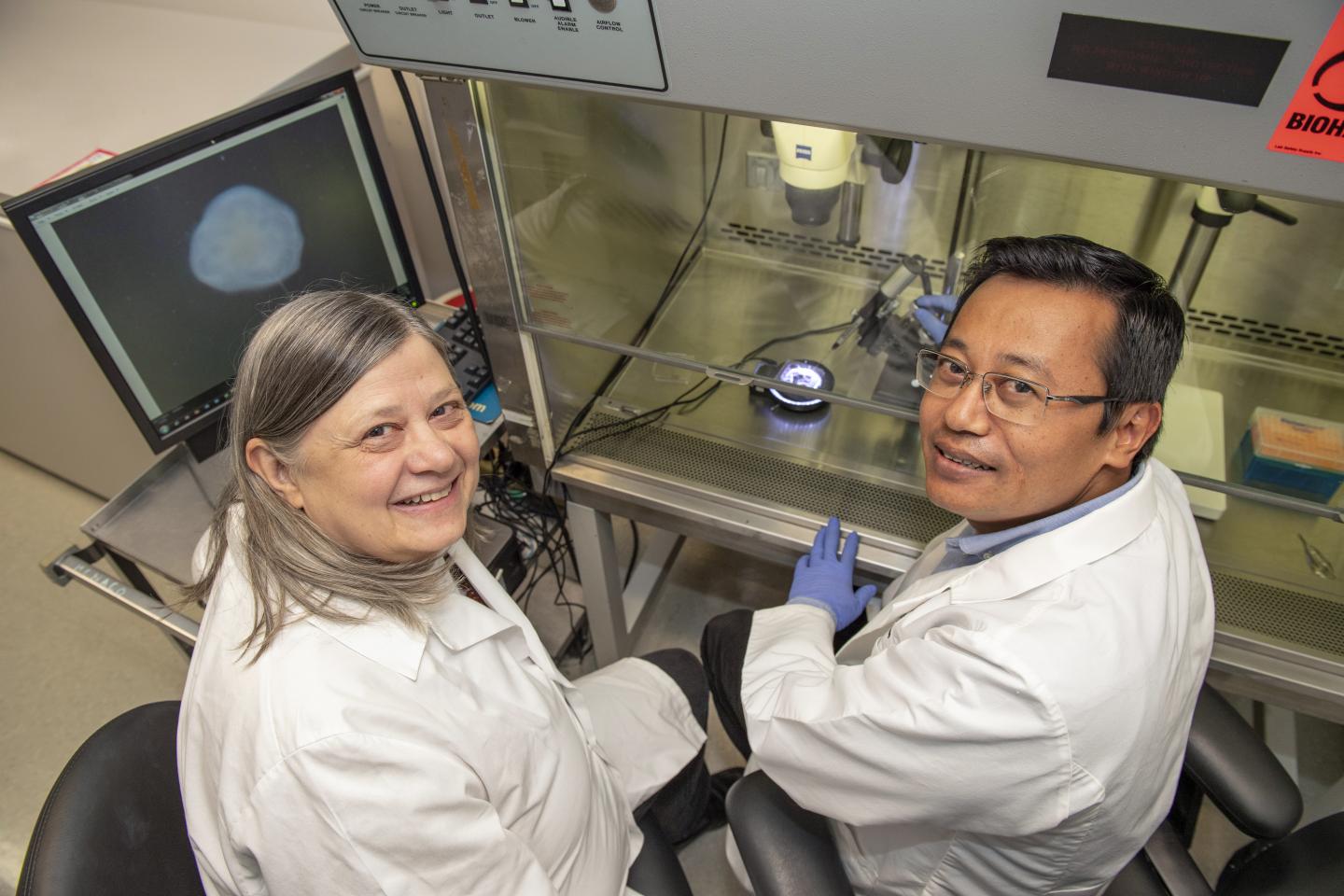
Credit: University of Cincinnati College of Medicine
Alison Weiss, PhD, professor in the Department of Molecular Genetics, Biochemistry and Microbiology in UC College of Medicine, has been awarded a four-year grant of $1.6 million from the National Institute of Allergy and Infectious Diseases (NIAID) to study Shiga toxin producing Escherichia coli 0157:H7, also sometimes referred to as Hamburger E. coli.
Hamburger E. coli is the cause of foodborne illness and is an infection that often leads to bloody diarrhea and can result in kidney failure. It is mostly associated with eating undercooked, contaminated ground beef, and can be spread by person-to-person contact. In severe cases it can be fatal.
The infection was first discovered in hamburger meat, but it is carried asymptotically by many creatures so anything that has fecal matter from cattle can contaminate food, says Weiss. Vegetables and fruits can also carry E. coli if contaminated with animal fecal matter during field irrigation or as a result of harvesting or preparation of produce. Human hygiene practices can also spread E. coli.
Shiga toxin producing E. coli (STEC), including 0157:H7, are an important cause of diarrheal disease, causing about 265,000 illnesses in the United States annually.
“It’s a human specific disease and it has been impossible to understand until we can study these human tissue models,” says Weiss.
She says researchers have used embryonic stem cells to create intestinal tissue which her laboratory will now use to test potential treatments for Hamburger E. coli. Weiss says that Shiga toxin is responsible for hemolytic uremic syndrome, a condition caused by the abnormal destruction of red blood cells resulting in those damaged red blood cells clogging the kidneys leading to their failure and possibly death.
Weiss and Suman Pradhan, PhD, research associate in the Weiss Laboratory, explained their findings on Shiga toxin producing E. coli in a 2017 article “Intestinal Organoids Model Human Response to Infection by Commensal and Shiga Toxin Producing Escherichia coli” published in the scholarly journal PLOS One.
The largest E. coli outbreak of 2018 in the United States occurred March to June because of possible contamination of romaine lettuce which health officials say came from Arizona’s Yuma growing region. The outbreak sickened 210 people in 36 states. Five people died and 96 were hospitalized. A second outbreak due to lettuce grown in California began in October. Fortunately, some romaine lettuce products are now labeled with a harvest location by region, allowing produce from unaffected regions to be marketed, says Weiss.
“What is interesting is in the cattle that carry the disease, the organisms just live right at their anal junction,” says Weiss. “It doesn’t bother the cattle systematically so we can’t identify them as sick and then they inoculate all of their fecal matter when they defecate.
“For humans, the organisms grew in our small intestine and colon and those are very vital parts of our body that are attacked by the bacteria whereas a non-essential part of animal’s body is attacked. We had no way of looking at what the bacteria do until we got these human intestinal organoids.”
###
Research on E. coli is funded by NIAID grant 1R01AI139027-01.
Media Contact
Cedric Ricks
[email protected]
513-558-4657