

• HOME
  • NEWS
  • EXPLORE
    • CAREER
      • Companies
      • Jobs
    • EVENTS
    • iGEM
      • News
      • Team
    • PHOTOS
    • VIDEO
    • WIKI
  • BLOG
  • COMMUNITY
    • FACEBOOK
    • INSTAGRAM
    • TWITTER
Friday, January 2, 2026
BIOENGINEER.ORG
No Result
View All Result
  • Login
  • HOME
  • NEWS
  • EXPLORE
    • CAREER
      • Companies
      • Jobs
        • Lecturer
        • PhD Studentship
        • Postdoc
        • Research Assistant
    • EVENTS
    • iGEM
      • News
      • Team
    • PHOTOS
    • VIDEO
    • WIKI
  • BLOG
  • COMMUNITY
    • FACEBOOK
    • INSTAGRAM
    • TWITTER
  • HOME
  • NEWS
  • EXPLORE
    • CAREER
      • Companies
      • Jobs
        • Lecturer
        • PhD Studentship
        • Postdoc
        • Research Assistant
    • EVENTS
    • iGEM
      • News
      • Team
    • PHOTOS
    • VIDEO
    • WIKI
  • BLOG
  • COMMUNITY
    • FACEBOOK
    • INSTAGRAM
    • TWITTER
No Result
View All Result
Bioengineer.org
No Result
View All Result
Home NEWS Science News Cancer

IL-34: New, possible target to tackle drug-resistant cancer cells

Bioengineer by Bioengineer
October 3, 2016
in Cancer
Reading Time: 2 mins read
0
Share on FacebookShare on TwitterShare on LinkedinShare on RedditShare on Telegram

A team of researchers has discovered that chemoresistant lung cancer cells suppress immune functions and strengthen resistance to chemotherapy by producing interleukin-34 (IL-34) — a type of cytokine.
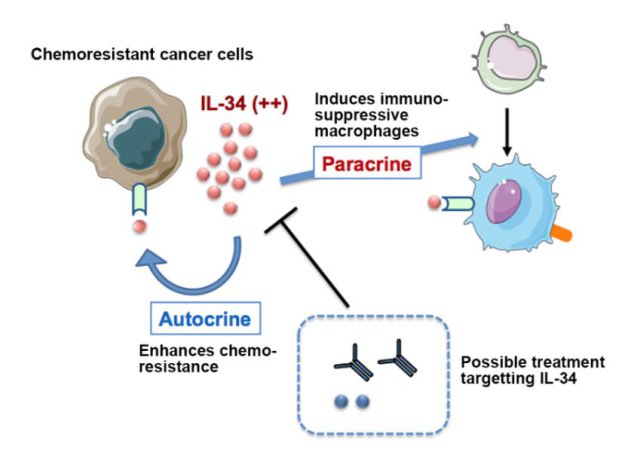
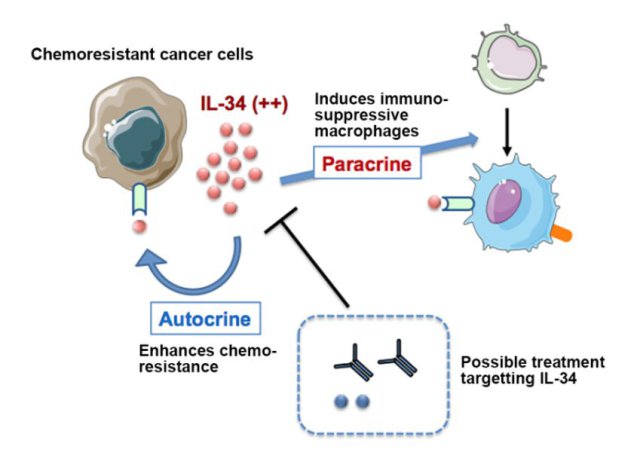
Chemoresistant cancer cells secrete IL-34, which induces production of immunosuppressive macrophages and enhances chemoresistance of the cancer cells. Credit: Image courtesy of Hokkaido University
Chemoresistant cancer cells secrete IL-34, which induces production of immunosuppressive macrophages and enhances chemoresistance of the cancer cells.
Credit: Image courtesy of Hokkaido University

Chemotherapy is one of the most important treatments for many cancer patients. In recent years, chemotherapies that target the immune system have been developed, resulting in remarkable advances in cancer treatments. However, the ability of tumor cells to escape immune destruction and acquire resistance to chemotherapy remain major obstacles to effective cancer therapy.

It is known that immunosuppressive macrophages accumulate at tumor sites where the tumor cells have become resistant to chemotherapy. Assistant Professor Muhammad Baghdadi, Lecturer Haruka Wada and Professor Ken-ichiro Seino of the Division of Immunobiology at Hokkaido University’s Institute for Genetic Medicine, conducted research with collaborators based on a theory that chemoresistant tumor cells produce an unidentified substance that increases tumor-associated macrophages, thus enhancing their resistance to chemotherapy.

In the latest research, the team cultivated chemosensitive A549-DS, made from A549 lung cancer cells, together with the chemotherapeutic drug doxorubicin, to create doxorubicin-resistant A549-DR. The researchers examined the two cells, finding a large amount of IL-34 was produced in the A549-DR, but not in the A549-DS. They also found that the IL-34 produced by A549-DR contributed to the production of immunosuppressive macrophages. Furthermore, their experiment showed that IL-34 enhanced the chemoresistance of A549-DR.

In experiments using mice, researchers found that A549-DR was resistant to the chemotherapeutic drug when transplanted in mice, while A549-DR with depleted IL-34 became sensitive to the same drug, suggesting that IL-34 enhanced chemoresistance in the animal body.

Furthermore, researchers discovered high levels of IL-34 in tumors removed from several lung cancer patients. They also examined the prognoses of post-operative patients — studying those with, and those without IL-34 in their tumors, finding that the former’s prognoses were poorer than the latter’s.

“Currently, there are only a few options to treat chemoresistant tumors.,” Professor Seino said. “This latest finding could make it possible to develop a new therapy, which targets IL-34, to treat chemoresistant cancer cells.”

Web Source:

Materials provided by Hokkaido University.

Journal Reference:

Baghdadi M. et. al. Chemotherapy-induced IL-34 enhances immunosuppression by tumor-associated macrophages and mediates survival of chemoresistant lung cancer cells. Cancer Research, October 2016 DOI: 10.1158/0008-5472

The post IL-34: New, possible target to tackle drug-resistant cancer cells appeared first on Scienmag.
Share13Tweet8Share2ShareShareShare2

Related Posts

Derazantinib Boosts Gemcitabine by Blocking MUC5AC

December 30, 2025

FOCUS Study Reveals Insights on Melphalan for Uveal Melanoma

December 29, 2025

Black Grape Anthocyanins Boost 5-FU Cancer Therapy

December 29, 2025

Girdin Silencing Boosts Mebendazole’s Ovarian Cancer Fight

December 29, 2025
Please login to join discussion

POPULAR NEWS

  • blank

    PTSD, Depression, Anxiety in Childhood Cancer Survivors, Parents

    114 shares
    Share 46 Tweet 29
  • NSF funds machine-learning research at UNO and UNL to study energy requirements of walking in older adults

    71 shares
    Share 28 Tweet 18
  • Exploring Audiology Accessibility in Johannesburg, South Africa

    52 shares
    Share 21 Tweet 13
  • SARS-CoV-2 Subvariants Affect Outcomes in Elderly Hip Fractures

    44 shares
    Share 18 Tweet 11

About

BIOENGINEER.ORG

We bring you the latest biotechnology news from best research centers and universities around the world. Check our website.

Follow us

Recent News

Self-Assembling Peptide Micelles Enable Potent Antifungal Therapy

Ultrahigh-Nickel Cathodes Near Density Limit

TGFβ Boosts Microglial Defense Against Myelin Damage

Subscribe to Blog via Email

Enter your email address to subscribe to this blog and receive notifications of new posts by email.

Join 71 other subscribers
  • Contact Us

Bioengineer.org © Copyright 2023 All Rights Reserved.

Welcome Back!

Login to your account below

Forgotten Password?

Retrieve your password

Please enter your username or email address to reset your password.

Log In
No Result
View All Result
  • Homepages
    • Home Page 1
    • Home Page 2
  • News
  • National
  • Business
  • Health
  • Lifestyle
  • Science

Bioengineer.org © Copyright 2023 All Rights Reserved.
