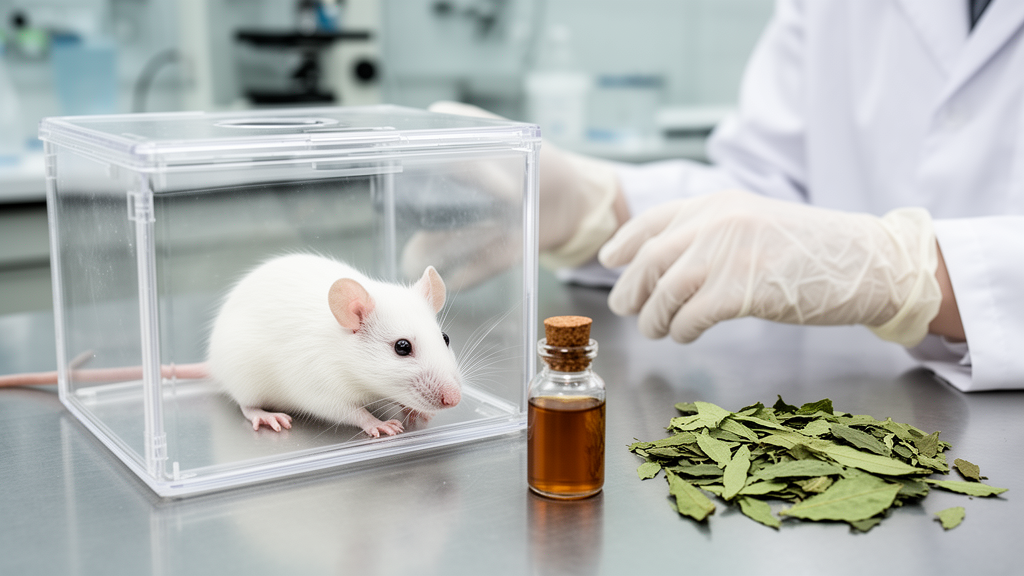
A 90-day toxicity study in rats has identified the highest daily dose of a proprietary kratom leaf extract that caused no adverse effects, while revealing that the same extract damaged the ovaries, testes, and epididymis at the highest dose tested. The study, published in Frontiers in Pharmacology, was designed to establish a no observed adverse effect level, or NOAEL, for SpecioTea, a water-based extract of Mitragyna speciosa leaf standardized to a mitragynine concentration of 0.5 milligrams per milliliter. The researchers report that 30 milligrams per kilogram of body weight per day was designated as the NOAEL for both male and female rats, based on adverse changes observed only at the 60 milligram per kilogram dose.
Kratom is a deciduous evergreen tree in the coffee family, native to Thailand, Malaysia, Indonesia, and New Guinea, where its leaves have traditionally been chewed or consumed as a tea or decoction prepared by boiling or steeping dry or fresh leaves. The leaves contain a spectrum of secondary metabolites, with alkaloids representing 0.5 to 3.0 percent of total leaf weight. Mitragynine is the principal alkaloid, comprising approximately 51 to 82 percent of total alkaloids in leaves cultivated in Southeast Asia, alongside paynantheine, speciogynine, and speciociliatine. The compound 7-hydroxymitragynine, once thought to occur naturally in the leaf, is now recognized as a transient human metabolite and oxidative by-product found only at trace levels in post-harvest leaf material.
The test article used in the study was prepared from dried, ground kratom leaves extracted with water acidified by an organic acid, a procedure analogous to traditional tea preparation. High-performance liquid chromatography confirmed the mitragynine concentration of the batch and the relative abundance of the major alkaloids: 59.3 percent mitragynine, 32.1 percent paynantheine, 7.8 percent speciogynine, and 0.8 percent speciociliatine, with 7-hydroxymitragynine not detected. Because the original liquid extract was too dilute for gavage dosing, it was lyophilized and re-dissolved in reverse osmosis deionized water to produce test solutions containing 1.5, 3, and 6 milligrams of mitragynine per milliliter.
The study was conducted at Charles River Laboratories in Ohio in compliance with OECD testing guidelines 407 and 408 and Good Laboratory Practice standards. Eighty male and eighty female Sprague Dawley Crl:CD rats, eight weeks old at the start of dosing, were assigned to four groups of twenty animals per sex. Three groups received the extract by once-daily oral gavage at dose volumes of 10 milliliters per kilogram, delivering mitragynine at 15, 30, or 60 milligrams per kilogram per day for 90 days, while the control group received the vehicle water alone. Evaluations included clinical signs, body weights, food consumption, ophthalmology, hematology, coagulation, clinical chemistry, urinalysis, gross necropsy, organ weights, a functional observational battery, and histopathology.
Body weight and food consumption effects emerged at every dose level. Mean body weight gain was reduced by 10.9 to 28.4 percent in a dose-related manner across both sexes, and final body weights on Day 91 were 6.5 to 12.5 percent lower than controls. Food consumption declined correspondingly, most pronouncedly in the high-dose animals, where intake ran 6.2 to 25.0 percent below controls in males and 6.8 to 23.6 percent below controls in females over extended periods. The authors attributed the reduced weight gain primarily to reduced food consumption, which they suggested could reflect either a pharmacological effect of mitragynine or appetite suppression from mild gastrointestinal irritation caused by the gavage administration, and they classified these changes as non-adverse because no clinical signs of toxicity accompanied them.
Functional observational battery testing in the final week of dosing revealed changes consistent with the known pharmacology of kratom alkaloids. High-dose males showed mild tremors in four of nineteen animals, decreased tail pinch response, and reduced hind limb grip strength, while both sexes at the highest dose showed gait abnormalities, decreased arousal, reduced rearing, lower body temperature, and diminished motor activity. Animals at 30 milligrams per kilogram also showed decreased body temperature, motor activity, and rearing scores. The authors judged these findings consistent with antinociceptive, muscle-relaxant, antipyretic, and sedative properties reported for kratom, and considered them non-adverse, noting that the tremors were not observed during routine clinical observations and that no comparable findings appeared at other observation intervals.
Histopathology identified the findings that ultimately determined the NOAEL. At 60 milligrams per kilogram per day, females showed a marked reduction in corpora lutea of the ovary, occurring in eight of seventeen high-dose females compared with three of twenty controls, together with a substantial decrease of more than 30 percent in absolute and relative ovarian weight. Males at the same dose showed minimal to moderate degeneration and atrophy of the testes, accompanied by cellular debris and minimal spermatid depletion in the epididymis. A minimal vaginal epithelial hyperplasia in high-dose females was considered secondary to the ovarian change. By contrast, thyroid follicular cell hypertrophy and hepatocellular hypertrophy, seen at lower doses, were interpreted as adaptive, non-adverse responses consistent with microsomal enzyme induction, lacking proliferative changes, cytotoxicity, or markers of organ dysfunction.
Clinical pathology findings were largely unremarkable. No adverse effects on hematology or coagulation parameters appeared at any sampling interval, and clinical chemistry changes were minimal and associated with reduced food consumption, including slight decreases in blood urea nitrogen and glucose. Urinalysis revealed increased urine volume with decreased specific gravity at the mid and high doses, consistent with a mild diuretic effect that the authors did not regard as adverse. Mortality during the study was not attributed to the test article: one high-dose male and one high-dose female died of esophageal perforations attributed to gavage errors, two high-dose females died after a blood collection procedure, and one low-dose female death was considered incidental because no adverse clinical signs or additional deaths occurred at that dose.
Because effects on body weight and food consumption appeared at all dose levels, the authors could not establish a no-observed effect level, meaning some biological changes occurred even at the lowest dose tested. The NOAEL of 30 milligrams per kilogram per day translates, using body surface area normalization, to an estimated human equivalent dose of 4.8 milligrams per kilogram per day, or 288 milligrams per day for a 60-kilogram adult. For context, cross-sectional observational studies in Malaysia have reported that traditionally prepared kratom decoctions contain 21 to 33 milligrams of mitragynine per serving, with daily consumption of 72 to 115 milligrams among regular users.
The authors emphasize that the results are specific to the tested material and cannot be unilaterally extended to the wide variety of kratom products on the market, many of which differ substantially from traditional preparations. Reports of serious adverse events associated with kratom in the United States have often involved commercially modified products in which alkaloid concentrations greatly exceed traditional levels, and some products have been found to contain enriched or augmented 7-hydroxymitragynine. The study, conducted in a single species over 90 days with gavage delivery of a concentrated extract, provides evidence of low toxicity for this particular kratom leaf extract at doses the authors describe as aligned with traditional preparations, while the reproductive findings at the highest dose underscore that dose remains a critical determinant of safety in sub-chronic toxicity assessment.
Subject of Research: A 90-day oral toxicity study in rats establishing the NOAEL of a standardized Mitragyna speciosa leaf extract
Article Title: Safety assessment of a Mitragyna speciosa leaf extract by a 90-day feeding study in rats
Article References: Brown, P. N., & Chan, M. (2026). Safety assessment of a Mitragyna speciosa leaf extract by a 90-day feeding study in rats. Frontiers in Pharmacology, 17, Article 1922596. https://doi.org/10.3389/fphar.2026.1922596
Image Credits: AI Generated
DOI: 10.3389/fphar.2026.1922596
Keywords: kratom, Mitragyna speciosa, mitragynine, toxicity study, NOAEL, Sprague Dawley rats, sub-chronic toxicity, histopathology, reproductive toxicity, functional observational battery, herbal extract safety, Frontiers in Pharmacology
News Source: Ophelia Keating. (October 28, 2026). 90-Day Rat Study Finds Reproductive Effects at High Doses of a Kratom Leaf Extract. Scienmag.