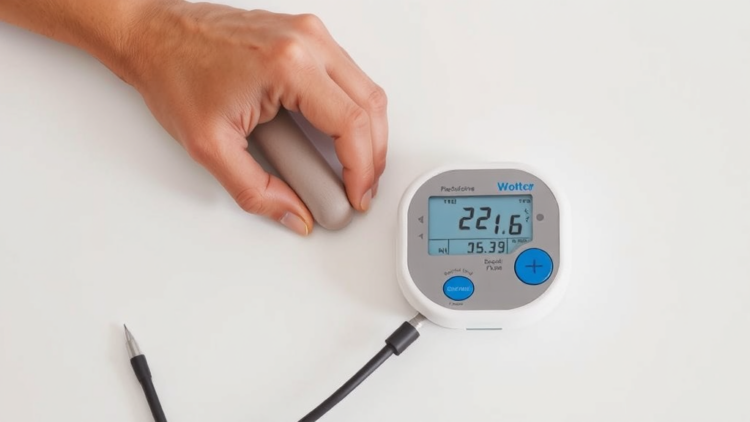
Hypertension remains the world’s deadliest silent condition, contributing to more than 10 million deaths every year, yet the simple act of measuring blood pressure reliably is still out of reach for millions of people in low-resource settings. A team of biomedical engineers has now unveiled an open-source device called PressSure, a semi-automatic blood pressure monitor that costs less than $8 to build while delivering accuracy comparable to commercial monitors that sell for four times as much. The design, published in the journal HardwareX under an MIT license, could reshape how blood pressure is monitored in clinics, homes, and classrooms across the developing world.
The core innovation lies in what the device leaves out. Conventional automatic digital blood pressure monitors rely on a motorized air pump and a solenoid valve to inflate and deflate the cuff, two components that drive up manufacturing costs and power consumption. PressSure eliminates both. Instead, the user inflates the cuff manually with a hand bulb, and deflation is managed by a carefully calibrated controlled-leakage regulator that releases air at a steady rate of roughly 2.2 to 2.5 millimeters of mercury per second. That deflation speed is critical, because the oscillometric measurement technique the device uses depends on a slow, consistent pressure drop to capture the small pressure oscillations produced by arterial pulsation.
At the heart of the electronics is the MPS20N0040D-S pressure sensor, which outputs a tiny voltage between 2.3 and 30 millivolts in response to cuff pressure. A differential amplifier with a gain of 100 boosts this signal to a usable range of 0.23 to 3 volts. The signal is then split into two paths: a low-pass filter with a 10-hertz cutoff extracts the DC component representing absolute cuff pressure, while a high-pass filter with a 2-hertz cutoff isolates the AC component containing the pulsatile oscillations. Remarkably, all of the active filtering, amplification, and comparison is accomplished with a single LM324 quad operational amplifier chip, one of the cheapest integrated circuits on the market.
Signal processing is handled by an ATmega328P microcontroller, the same chip found in the Arduino Uno, preloaded with the Arduino bootloader so that anyone with a USB-to-serial adapter can reprogram it. The firmware implements an oscillometric algorithm that analyzes pulse amplitudes during deflation. As cuff pressure falls, oscillation amplitude rises to a maximum at the mean arterial pressure and then declines. The device estimates systolic pressure when the amplitude reaches 47 percent of the maximum on the rising side and diastolic pressure at 78 percent on the falling side, ratios the team empirically optimized against reference measurements and which fall squarely within ranges reported in the scientific literature.
One of the most sophisticated aspects of the design is its artifact rejection algorithm. Motion, speech, and muscle tension can all corrupt oscillometric pulse data, and the researchers found that disabling their rejection routine nearly doubled the mean absolute error for diastolic pressure, from 6.50 to 12.92 millimeters of mercury, and raised systolic error from 4.50 to 7.33 millimeters of mercury. The algorithm examines the timing between successive pulses and discards those with abnormal temporal characteristics before constructing the oscillometric envelope. Across representative measurements, it rejected an average of about 6 percent of detected pulses, keeping roughly 40 of the 43 to 50 pulses captured in each reading.
Power efficiency is another standout feature. The entire system draws approximately 50 milliamps, or about 300 milliwatts, during active measurement, and a 4N35 optocoupler completely disconnects the battery from the circuit during standby, reducing idle drain to less than a microampere. Four AA alkaline batteries can therefore power roughly 40 hours of continuous operation, equivalent to about 1,600 individual measurements. For clinics where electricity is unreliable and batteries are expensive, this ultra-low-power architecture is arguably as important as the device’s low price.
The enclosure demonstrates how far 3D printing has come as a manufacturing tool rather than merely a prototyping method. The body, cover, and button caps were designed in SolidWorks and printed in ABS plastic at 100 percent infill, chosen for its durability and heat resistance. A modular design philosophy means individual parts can be modified and reprinted without rebuilding the whole device. The curved handle at the bottom of the unit holds the inflation bulb ergonomically, and a detachable back cover provides access to the four-slot AA battery holder. All CAD files, PCB schematics, gerber files, and Arduino source code are freely available through the Open Science Framework repository.
Validation involved 88 adult volunteers ranging from 18 to 66 years old, including 30 hypertensive and 58 normotensive participants, whose readings were compared against two clinically established devices, the Riester and the Microlife. Against the Riester, the prototype showed a mean systolic bias of just minus 2.17 millimeters of mercury with a standard deviation of 5.36, comfortably within the ANSI/AAMI SP10 criterion of a mean difference within plus or minus 5 millimeters of mercury and a standard deviation no greater than 8. Heart rate agreement was similarly strong. Diastolic measurements showed greater variability, and comparisons against the Microlife device revealed wider limits of agreement, suggesting the diastolic detection threshold could benefit from further refinement. The authors are careful to note that the study does not constitute formal ANSI/AAMI or ISO validation, but the results are comparable to errors reported in the literature for commercial home monitors.
Beyond its clinical promise, the team positions PressSure as an educational and research platform. Because every design file is open, students can study pressure sensing, analog signal conditioning, oscillometric estimation, and embedded firmware on real hardware, while researchers can swap in alternative sensors, displays, or algorithms to test new ideas. The bill of materials reads like a lesson in frugal engineering: a $1.33 cuff, a $0.47 latex inflation bulb, a $1.17 microcontroller, a $1.55 TFT display, and $2 worth of ABS filament, among other parts. With mass production and a customized display, the authors estimate the unit cost could fall below $5.
The broader implications extend past the device itself. Studies have found that the average price of blood pressure monitors among the best-selling listings in ten countries is around $32, and the World Health Organization has emphasized that an ideal device for low-resource settings must be accurate, durable, affordable, and usable with minimal training. PressSure ticks every box while sidestepping the calibration drift and measurement inconsistency that plague many inexpensive digital monitors. Home measurements also help avoid white-coat hypertension, the well-documented phenomenon in which readings taken in clinical settings are artificially elevated by patient anxiety. By putting a validated, repairable, and transparent measurement tool into the hands of communities that need it most, this $8 device demonstrates that the barriers to global cardiovascular care may be more engineering than economics.
Subject of Research: Design and validation of a low-cost semi-automatic oscillometric blood pressure monitoring device for resource-constrained settings
Article Title: A comprehensive approach to the design and development of a low-cost semi-automatic blood pressure monitoring device for resource-constrained
Article References: Al-Ayyad, M., Moh’d, B. A.-H., Shamsan, M. H., Ahmad, M. A.-S., Al-Takrouri, M., & Owida, H. A. (2026). A comprehensive approach to the design and development of a low-cost semi-automatic blood pressure monitoring device for resource-constrained. HardwareX, Article e00843. https://doi.org/10.1016/j.ohx.2026.e00843
Image Credits: AI Generated
DOI: Not provided
Keywords: blood pressure monitor, hypertension, open-source hardware, oscillometric measurement, Arduino, ATmega328P, 3D printing, low-cost medical devices, signal processing, artifact rejection, resource-limited settings, biomedical engineering
Cite Scienmag News
APA
MLA
Chicago
Denise Maddox. (September 20, 2026). $8 Open-Source Blood Pressure Monitor Brings Accurate Readings to Resource-Limited Clinics. Scienmag. https://scienmag.com/8-open-source-blood-pressure-monitor-brings-accurate-readings-to-resource-limited-clinics/
Denise Maddox. “$8 Open-Source Blood Pressure Monitor Brings Accurate Readings to Resource-Limited Clinics.” Scienmag, 20 September 2026, https://scienmag.com/8-open-source-blood-pressure-monitor-brings-accurate-readings-to-resource-limited-clinics/. Accessed 20 September 2026.
Denise Maddox. “$8 Open-Source Blood Pressure Monitor Brings Accurate Readings to Resource-Limited Clinics.” Scienmag. September 20, 2026. https://scienmag.com/8-open-source-blood-pressure-monitor-brings-accurate-readings-to-resource-limited-clinics/
Copy citation
Download RIS
Tags: 3D printingaccessible healthcare technology for clinicsaccurate blood pressure readingsAffordable open-source blood pressure monitorArduinoartifact rejectionATmega328Pbiomedical engineeringblood pressure monitorcost-effective medical devicesDIY blood pressure measurement toolshardware design for low-resource settingshypertensioninnovative deflation control in BP monitorslow-cost hypertension screening devicelow-cost medical devicesopen-source biomedical engineeringopen-source hardwareoscillometric measurementpresssure monitoring in developing countriesresource-limited healthcare technologyresource-limited settingssemi-automatic blood pressure cuffSignal Processing