


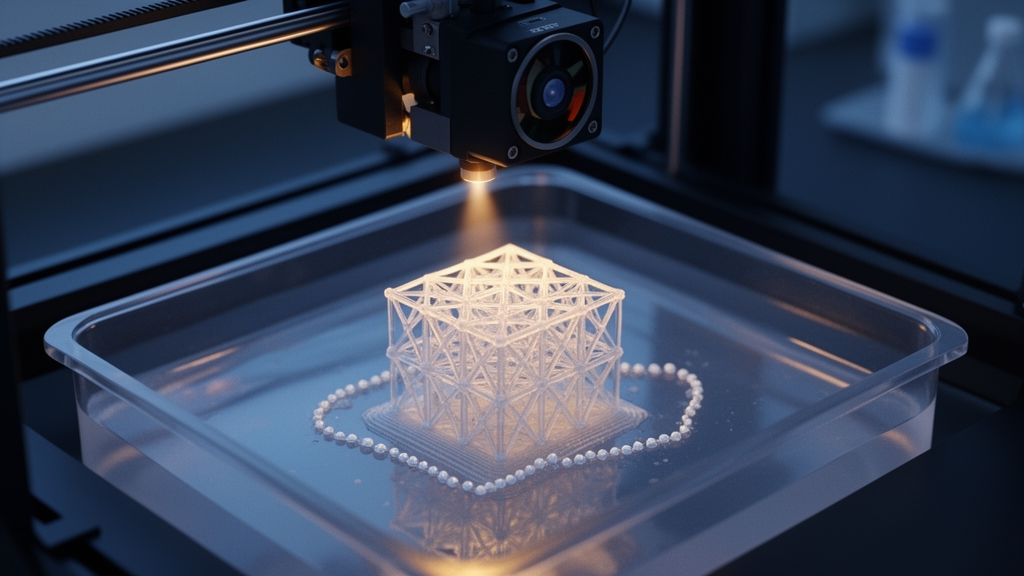
Most 3D printers are obedient but rigid: they follow a toolpath computed before the machine ever starts moving, and they assume that the material and the surrounding environment will behave exactly as predicted. A study published on 21 July 2026 in the journal Architectural Intelligence challenges that paradigm with a fabrication framework called Responsive Discrete Deposition Modelling, or R-DDM, which abandons the precomputed path altogether. Instead of extruding one continuous filament along a fixed route, the system deposits material as a sequence of individual beads, and the placement of every single bead is recalculated during fabrication based on what the machine senses in its environment. In the demonstration reported by Lucas Helle, Joseph Naguib and Roberto Naboni, the environmental cue is light, and the printed structure grows toward it in a manner inspired by phototropism, the process by which plants reorient their growth in response to directional illumination.
The core idea is a closed sensing–response–action loop executed at the scale of a single deposition event. Each cycle begins with a camera capturing the build area; the image is processed to estimate the direction of a light source relative to the growing structure. A computational decision model then converts that stimulus into updated deposition directives, and the printer executes the resulting bead placement before the loop starts again. Because the cycle repeats continuously, geometry is never specified in advance. The structure emerges from successive local decisions, each informed by live input, rather than from a digital model that is sliced and converted into toolpaths before printing begins. The authors frame this as a shift from adaptation as correction, where sensing merely keeps a print faithful to a predefined form, toward responsiveness as a generative process in which feedback actively shapes what is built.
The hardware is deliberately modest. The experimental platform pairs a Prusa i3 MK3 fused deposition modelling printer with a 220 lumen LED lamp used as a controllable stimulus and an Intel RealSense D455C depth camera mounted above the print bed. All components run within a ROS2 workspace on a Raspberry Pi 4, which coordinates sensing, decision making and printer actuation through a finite-state machine that enforces the discrete sequence of sensing, computation and deposition. The behavioural model itself is implemented in Grasshopper, where an agent-based model computes displacement vectors for each deposition instance, and the resulting instructions are streamed to the printer as incremental G-code segments, one per bead. The light source is physically repositioned during printing to introduce deliberate changes in the sensed environment.
The sensing pipeline translates raw camera input into a directional vector through a chain of image-processing operations. The captured frame is cropped to the print bed, converted to grayscale and brightness-normalised to sharpen the contrast between illuminated and shadowed regions. Pixels are mapped to physical coordinates on the bed, and within a circular analysis zone the darkest pixels are extracted to compute a centroid representing the effective shadow displacement. A vector from that centroid to the initial bead is projected outward to estimate the light source position, and the resulting normalised direction is passed to the agent-based model. Notably, the authors did not aim for precise localisation of the lamp. A validation study placed the light at eight positions around the bed and captured three images at different print heights for each; the mean positional deviation was 19.70 millimetres with a standard deviation of 15.20 millimetres. That is far from exact, but it produced a directionally coherent signal, which proved sufficient for steering behaviour.
The agent-based model builds on the Boids flocking framework, combining attraction to the light source with local forces that govern how neighbouring deposition agents interact. Cohesion pulls each agent toward the mean position of its neighbours, separation pushes agents apart within a threshold radius, and conditional rules trigger branching, when lateral displacement exceeds a limit and the trajectory splits into two symmetric vectors, or merging, when two agents come close enough for their displacements to be averaged into a single combined path. Each interaction carries an independently tunable weight, and the deviation between successive steering vectors is constrained so that direction changes remain smooth and printable. A constant vertical increment maintains upward growth. Extrusion dosage is controlled through a calibration study that established a non-linear relationship between commanded extrusion volume and resulting bead height, expressed as volume equal to 9.57 times the target height raised to the power of 2.6, with a validated operating range from 0.5 to 4.8 millimetres in bead height.
Before any physical printing, a parallel simulation environment mirrored the same sensing–response–action logic, replacing the camera with a virtual light source and approximating extrusion with mesh-based bead proxies whose dimensions derive from the calibration data. Four representative behaviours were defined in simulation: light-seeking, in which growth continuously reorients as the light moves; merging, driven by dominant cohesion; branching, produced by increased separation and reduced cohesion; and a hybrid case in which interaction parameters are modulated in phases, yielding sequential merging and branching within one growth process. These simulated scenarios served as a behavioural baseline for the physical experiments rather than as geometric targets to be replicated.
The physical programme comprised three experiments, each run three times. The first tested stimulus-driven adaptation: after an initial stabilisation of five deposition cycles, the light was manually repositioned every ten cycles during printing, without interruption. Across all three runs, light shifts were followed by updated steering behaviour and a subsequent tendency for the distance between the deposition front and the light to decrease, with the delay between a shift and the onset of directional response limited to a single deposition cycle. Absolute distances varied between runs by roughly 10 to 20 millimetres, which the authors attribute to sensing noise and the manual repositioning of the lamp, but the direction, timing and rate of response remained closely aligned with the simulated trend.
The second experiment examined whether local interaction rules alone could generate distinct collective organisations. In the branching configuration, agent distances increased progressively after an initial shared growth phase, indicating sustained lateral divergence, with all three physical trials showing comparable onset timing and slope. In the merging configuration, distances showed a sharp discontinuity at the activation of the merging regime, followed by rapid convergence into a narrow band that clustered tightly across runs and followed the simulated trajectory closely. Branching and merging thus produced distinct temporal signatures, gradual and sustained divergence versus abrupt and stabilising convergence, reproduced consistently across repeated prints. The third experiment demonstrated that behaviour can be reconfigured mid-print: a structure that began under a merging configuration transitioned, after a predefined number of cycles and without any reset or interruption, into a branching configuration, with all three hybrid trials showing the same contraction-then-expansion pattern in active agent count.
The authors are careful to scope their claims. This is a proof of concept implemented with a single light stimulus, a basic shadow-sensing mechanism and controlled laboratory conditions, using an FDM platform chosen as a controllable testbed rather than a final production configuration. The study addresses responsiveness to environmental input, not full compensation for unstable material behaviour, and manufacturing efficiency lies outside its scope. Physical prints deviated from simulated trajectories due to unmodelled material effects and environmental noise, yet consistently achieved their behavioural goals, which the authors read as evidence that the system replicates behavioural rules rather than shapes. The agents are computational rather than physically autonomous robots, and translating them into independent robotic deposition units remains an open research direction, as does extending the framework to multi-axis, non-planar deposition and richer multi-modal sensing.
Even within those limits, the demonstration points toward a different way of thinking about digital fabrication. By structuring printing as a stream of local, stimulus-informed decisions, R-DDM shows that coherent, reproducible structures can emerge without any predefined geometry, and that behavioural regimes can be swapped mid-process while growth continues. The framework is particularly relevant, the authors suggest, for unstructured or variable contexts where standard toolpath logic fails, and it reframes responsiveness not as a corrective layer bolted onto a fixed design but as the principle of formation itself. Whether such behavioural coherence can be maintained at scale, across distributed agents negotiating shared environmental fields, is the question the authors leave open, but the bead-level loop they demonstrate establishes a working foundation for environment-aware construction systems in which form is negotiated with the world rather than dictated to it.
Subject of Research: A responsive discrete deposition modelling framework for environment-situated additive manufacturing that steers bead-scale 3D printing through live light sensing and agent-based decision-making
Article Title: Responsive discrete deposition modelling for environment-situated additive manufacturing
Article References: Helle, L., Naguib, J., & Naboni, R. (2026). Responsive discrete deposition modelling for environment-situated additive manufacturing. Architectural Intelligence, 5(1), Article 21. https://doi.org/10.1007/s44223-026-00133-7
Image Credits: AI Generated
DOI: 10.1007/s44223-026-00133-7
Keywords: additive manufacturing, 3D printing, responsive fabrication, agent-based modelling, phototropism, closed-loop control, discrete deposition, digital fabrication, computer vision sensing, fused deposition modelling, light-seeking behaviour, cyber-physical systems
News Source: Denise Maddox. (October 29, 2026). 3D printer grows structures by chasing light, bead by bead. Scienmag.



