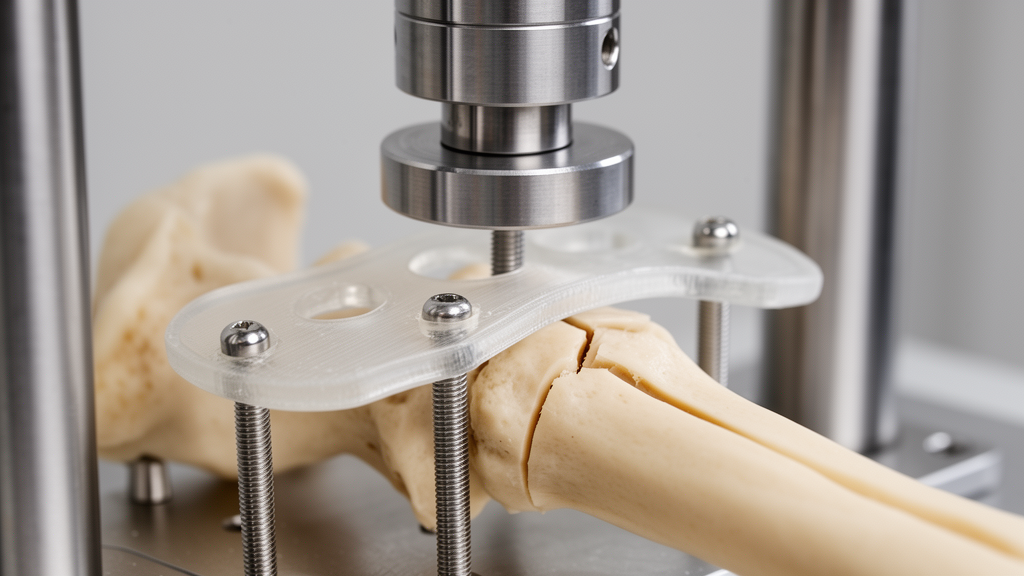
In an ex vivo biomechanical study, experimental osteosynthesis constructs assembled with 3D-printed polylactic acid plates achieved static load capacity and stiffness comparable to conventional metallic plates in stabilizing standardized bone fractures. Researchers evaluated bioresorbable polylactic acid implants as an alternative to permanent metal hardware, finding that while standalone polymer plates lacked structural strength, complete bone-plate constructs matched metallic controls under static forces.
Conventional metallic osteosynthesis plates provide robust mechanical stability for healing fractures, yet their clinical use frequently necessitates secondary surgical operations for hardware removal. To address this limitation, bioresorbable polymers such as 3D-printed polylactic acid have emerged as potential alternatives designed to provide temporary support without requiring subsequent operative extraction.
To evaluate this concept, investigators used an ex vivo model involving porcine metatarsals with standardized AO/OTA A2 fracture patterns. The fractured bones were stabilized using either conventional 2.0 mm Synthes Dynamic Compression Plates or prototype plates produced through Fused Deposition Modelling. The researchers manufactured polymeric prototypes at two architectures, examining specimens with 100 percent infill density alongside porous versions featuring 20 percent infill density.
Mechanical performance was evaluated across experimental configurations using standardized three-point bending tests. Tested in isolation without bone, standalone polylactic acid plates failed at loads between 61 N and 74 N, confirming insufficient standalone stability. However, when secured across fractured porcine metatarsals to form complete osteosynthesis constructs, the polylactic acid assemblies achieved maximum static loads and stiffness comparable to metal dynamic compression plate controls, with p-values of 0.087 and 0.104, respectively.
Despite favorable static behavior, the experimental polymeric plates exhibited notable structural limitations under repetitive forces. While metal constructs failed through screw pull-out, polylactic acid constructs failed primarily through plate fracture. Under cyclic fatigue loading, the 3D-printed plates experienced significantly earlier mechanical breakdown than metallic counterparts, yielding statistically significant failure differences marked by p-values of 0.004 and 0.014.
The researchers also examined environmental breakdown by immersing polylactic acid plates in phosphate-buffered saline over 12 months to evaluate hydrolytic degradation. Nevertheless, the experimental implants reliably maintained baseline mechanical stability through week 6 of hydrolytic exposure.
All experimental datasets were analyzed using ANOVA or Kruskal-Wallis statistical tests with Bonferroni post hoc corrections at a significance threshold of p less than 0.05. The study authors concluded that while 3D-printed polylactic acid plates exhibit predictable hydrolytic degradation and construct stability under static conditions, reduced fatigue resistance means clinical applicability remains unestablished. Looking forward, the team noted that internal spaces within the 20 percent infill architecture may provide reservoirs for drug delivery.
Subject of Research: Biomechanical feasibility and degradation of 3D-printed polylactic acid osteosynthesis plates
Article Title: Feasibility of 3D-printed polylactic acid (PLA) osteosynthesis plates: an ex vivo biomechanical study
Article References: dos Santos, V., Helminiak, J., Cornelius, J., Canarius, M., Koch, M., Ruchholtz, S., Paletta, J. R. J., & Bäumlein, M. (2026). Feasibility of 3D-printed polylactic acid (PLA) osteosynthesis plates: an ex vivo biomechanical study. Journal of Materials Science: Materials in Medicine, 37(1), Article 141. https://doi.org/10.1007/s10856-026-07138-8
Image Credits: AI Generated
DOI: 10.1007/s10856-026-07138-8
Keywords: polylactic acid, 3D-printed plates, osteosynthesis plates, biomechanical testing, ex vivo study, porcine metatarsals, AO/OTA A2 fractures, dynamic compression plates, fused deposition modelling, infill density, three-point bending tests, hydrolytic degradation, phosphate-buffered saline, static loading, cyclic loading, fatigue resistance, bioresorbable implants, drug delivery reservoirs
News Source: Ophelia Keating. (November 24, 2026). 3D-Printed PLA Plates Match Metal Static Stability in Fracture Model. Scienmag.