A new passive flux sampler for measuring ammonia emissions uses a 3D-printed helix inside its cartridge to hold two layers of acid-coated microfiber glass filter, and calibration tests show the design raises the mass of ammonia the sampler can capture before breakthrough to 1115 micrograms, compared with 465 micrograms for a ring-shaped alternative. The helix-equipped sampler also achieved 100 percent ammonia collection efficiency during the first minutes of exposure, a substantial gain over a previous prototype that captured only about 60 percent of the ammonia transported through it. The work, published in the journal Discover Sensors, comes from researchers including Ángela María Trivino, Patrick Brassard, Stéphane Godbout and Vijaya Raghavan.
Passive flux samplers have become widely adopted for quantifying ammonia emissions because they are operationally simple and cost-effective, yet their performance can be limited by sorption capacity and incomplete collection. Around 80 to 90 percent of anthropogenic ammonia emissions come from agricultural activities, mainly manure management, fertilizer application and livestock production. Once emitted, ammonia reacts with nitric and sulfuric acids to form secondary inorganic aerosols, a major component of fine particulate matter that affects air quality and human health, while atmospheric transport and deposition of the gas disrupts nutrient balances in ecosystems, accelerating soil acidification, eutrophication of waters and loss of biodiversity.
The sampler operates on two coupled transport regimes. Aerodynamically, it relies on a proportional relationship between external wind velocity and internal air velocity, conventionally expressed as Vin equals k times Vex, where the sampler-specific k factor represents the proportional attenuation of airflow through the device. Maintaining this linear proportionality across the operational wind-speed range is essential for reliable flux estimation, because it allows accumulated mass to be converted into emission fluxes without direct wind-speed measurements. From a sorption perspective, the mass collected in the trapping medium is directly proportional to the external pollutant flux. Previous work showed that an earlier ammonia passive flux sampler collected only approximately 60 percent of the ammonia transported through it, while other configurations relied on empirical correction factors, such as 0.66 for a recurved design, to compensate for incomplete collection without identifying whether aerodynamic transport, gas-sorbent interaction or sorbent configuration was responsible.
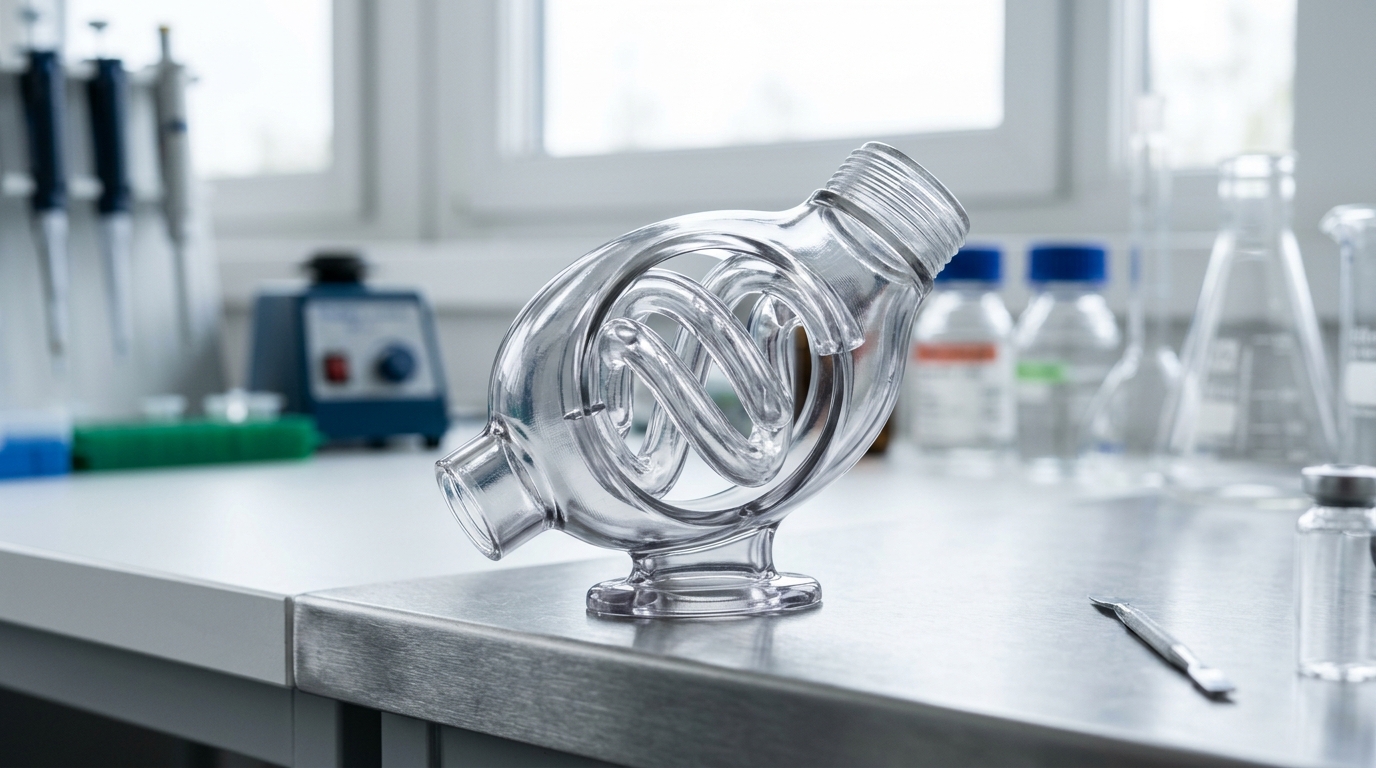
Improving sorption performance has been constrained by the limited internal volume of the sampler cartridge. Increasing sorbent loading may increase aerodynamic resistance, and uncontrolled sorbent placement may introduce variability in sorbent geometry and gas-sorbent interaction. The research team addressed this by designing two 3D-printed supports using fused deposition modeling with polylactic acid filament: a helix with a 7 millimeter diameter, 2 millimeter width and 75 millimeter height comprising three full turns, and three independent rings of the same diameter and width. The supports standardized the position and shape of a second microfiber glass filter inside the cartridge, providing a consistent filter configuration among replicate samplers and limiting variability associated with manual placement in the restricted space. The smaller filter sat on the inner surface of the printed structure and the larger one on the outer surface, creating a dual-filter configuration intended to increase sorption capacity while minimally affecting aerodynamic behavior.
The printed polylactic acid itself contributed no sorption. In a preliminary control test, a 20 minute exposure to 25 parts per million ammonia produced no decrease in ammonia concentration at the sampler outlet in the presence of the printed support, indicating no measurable ammonia collection by the unmodified material. The actual collection medium was commercial microfiber glass filter impregnated with a 3 percent oxalic acid solution in acetone. After each test, the sorbents were analyzed for ammonium by colorimetric analysis, using chemical extraction with potassium chloride and quantification with an automated system at 660 nanometers, and a molar conversion factor of 1.2158 translated the measured ammonium mass into adsorbed ammonia mass.
Aerodynamic calibration in a controlled wind tunnel, conducted in accordance with ANSI/ASHRAE 41.2 airflow-measurement procedures, tested external velocities from 1 to 6 meters per second. Both geometries preserved a strong linear relationship between external and internal airflow, yielding conventional k-factors of 0.54 for the ring and 0.59 for the helix, with coefficients of determination of 0.99 and 0.98 respectively. These values are slightly lower than the 0.61 to 0.85 range previously reported for ammonia and nitrous oxide passive flux samplers, a difference consistent with the additional flow resistance introduced by the printed support and dual-filter configuration. The researchers emphasized that the slightly lower k-factor represents increased attenuation of airflow rather than a loss of proportionality, and the high coefficients of determination confirmed that both geometries preserved the linear aerodynamic response required for reliable operation.
A complementary regression with a fitted intercept characterized the lower end of the operating range. This analysis yielded slopes of 0.58 for the ring and 0.76 for the helix, with estimated x-intercepts of 0.29 and 0.96 meters per second, representing the external wind velocities at which fitted internal velocity approaches zero and providing empirical estimates of the lower wind-speed threshold for wind-driven flow through each sampler. These values correspond to calm and light air conditions on the Beaufort scale. As this threshold is approached, wind-driven advective transport through the sampler decreases and the relative contribution of molecular diffusion may become increasingly relevant.
Sorption calibration told a different story than the aerodynamics. Both printed geometries achieved 100 percent ammonia collection during the first few minutes of exposure, improving on the previous prototype’s roughly 60 percent capture. The two filter layers reached equilibrium at approximately 5 percent collection efficiency, capturing 5638 micrograms of ammonia with a standard deviation of 841 micrograms, corresponding to 15 percent variability. Breakthrough, defined as the time at which the outlet concentration reached 5 percent of the inlet value, occurred at 70 minutes for the helix and 20 minutes for the rings, when accumulated masses were 1115 and 465 micrograms respectively. The helix showed higher capacity, a behavior the authors align with evidence that helical chains increase residence time and promote more effective gas-sorbent interactions. Notably, although both geometries increased the nominal filter area, the ring did not increase sampler capacity, suggesting that geometry, which influences airflow distribution and boundary layers, mattered more than surface area alone. Blank analyses established a method limit of detection of 4.8 micrograms and a limit of quantification of 9.1 micrograms of ammonia.
Validation of the helix-equipped sampler covered recovery efficiency, wind direction, wind speed and water vapor. In dynamic exposure tests at 25 parts per million, measured recovery was 92.2 plus or minus 5.6 percent at 1 minute, 88.8 plus or minus 3.6 percent at 4 minutes and 88.2 plus or minus 0.7 percent at 16 minutes, with no significant differences over time by Welch ANOVA and Kruskal-Wallis testing. The consistent recovery of about 90 percent was attributed to limitations of the analytical desorption process rather than incomplete sampling, and it exceeds the 66 percent reported when orthophosphoric acid was used instead of oxalic acid. Wind-direction tests showed peak velocity ratio at an incidence angle of approximately 15 degrees, with the ratio remaining above 80 percent within the frontal sector from 0 to 45 degrees and 315 to 360 degrees across external velocities of 1.5 to 6 meters per second, indicating that precise orientation is not critical for reliable collection. Wind-speed tests from 1 to 4 meters per second showed collected mass increasing linearly with airflow, with the sampler capturing approximately 87 percent of the available ammonia and a nearly constant absolute bias of about 6.6 to 8.3 micrograms that reflected recovery losses rather than flow-dependent sampling error.
Water vapor testing produced a nuanced result. At constant relative humidity of 55 percent, varying temperature between 10 and 30 degrees Celsius produced only a small increase in collected ammonia mass, with a slope of 0.08, consistent with diffusion-controlled transport. When temperature was held at 22 degrees and relative humidity varied from 20 to 90 percent, collected ammonia increased more markedly with vapor content, with a slope of 0.47 and a statistically significant humidity effect. Importantly, the researchers found this did not indicate deteriorating performance: the theoretically calculated ammonia mass showed a weak negative dependence on water vapor, while experimentally collected mass increased, approaching the theoretically available value at higher humidity and reducing measurement bias. The authors attribute this to moisture retained by the acid-coated filter promoting ammonia dissolution and conversion to ammonium at the sorbent surface, and they conclude the results do not support applying a humidity correction factor under the tested conditions, while noting that additional humidity levels and replicates are needed before broader field recommendations. Operationally, at an external wind velocity of about 2 meters per second and assuming 90 percent mean recovery, the quantification limit would be reached after roughly half an hour at 25 parts per million, typical of livestock facilities, and the breakthrough threshold after about 2.2 days, while at 3 parts per million, typical of fertilization settings, the usable range extends from about 4 hours to 18 days. The team says the design enables longer deployment periods under elevated ammonia concentrations and supports more robust determination of agricultural ammonia emissions.
Subject of Research: Calibration of a 3D-printed passive flux sampler for quantifying agricultural ammonia emissions
Article Title: Design of the internal geometry of a passive flux sampler and calibration for quantification of ammonia emissions
Article References: Trivino, Á. M., Brassard, P., Godbout, S., & Raghavan, V. (2026). Design of the internal geometry of a passive flux sampler and calibration for quantification of ammonia emissions. Discover Sensors, 2(1), Article 63. https://doi.org/10.1007/s44397-026-00097-3
Image Credits: AI Generated
DOI: 10.1007/s44397-026-00097-3
Keywords: ammonia emissions, passive flux sampler, 3D printing, additive manufacturing, aerodynamic calibration, sorption capacity, agricultural monitoring, microfiber glass filter, wind tunnel testing, relative humidity, livestock facilities, air quality
News Source: Denise Maddox. (November 5, 2026). 3D-Printed Helix Boosts Ammonia Sampler Capacity to 1115 Micrograms. Scienmag.