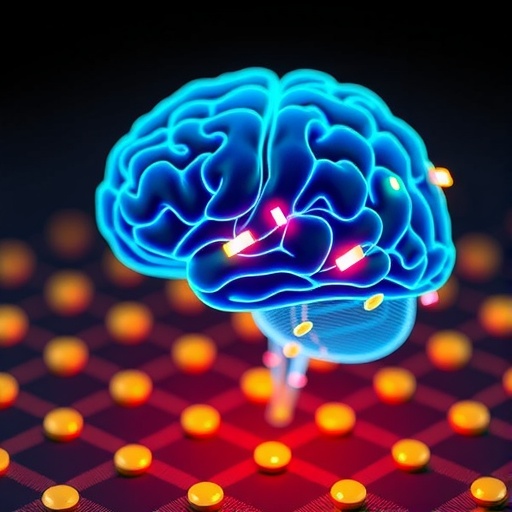
In a remarkable stride towards personalized medicine and neurotechnology, researchers at Penn State have harnessed advanced 3D printing techniques to develop soft, honeycomb-inspired bioelectrodes crafted to conform precisely to individual human brain geometries. The breakthrough promises to transform neural interfaces, facilitating improved monitoring and treatment of neurodegenerative diseases by addressing the long-standing mismatch between rigid bioelectrodes and the soft, complex topology of the cerebral cortex.
Conventional neural electrodes, central to recording and modulating brain activity, are generally fabricated from stiff materials in uniform shapes, an approach that fails to accommodate the unique gyrification patterns inherent in every brain. The cerebral cortex’s highly folded surface—comprising gyri (ridges) and sulci (grooves)—varies subtly across individuals, presenting a formidable anatomical challenge to one-size-fits-all sensor technology. Deviations in electrode fit can compromise signal quality and pose risks of tissue damage, limiting the effectiveness and biocompatibility of existing devices.
The Penn State team, led by Professor Tao Zhou, has innovated a patient-specific electrode fabrication process by integrating MRI-based finite element analysis with high-fidelity 3D modeling and direct ink writing of hydrogels. By creating detailed simulations of brain surfaces from MRI data of 21 human subjects, they generated bespoke 3D models of the cerebral cortex. This computational framework enabled customized electrode designs contoured intricately to each brain’s unique fold patterns, enabling unparalleled anatomical conformity.
The electrodes are primarily composed of a hydrogel matrix, a water-rich polymeric material renowned for its remarkable softness and tissue-like mechanical properties. This deliberate material choice ensures mechanical compliance with the delicate brain tissue, minimizing inflammation and damage that often result from stiff electrode interfaces. The innovative honeycomb-inspired architectural design further reduces the stiffness of the hydrogel electrodes while preserving necessary mechanical strength, providing a flexible yet durable structure that efficiently interacts with the brain’s convoluted surface.
Adopting the honeycomb pattern contributes to a significant decrease in material usage, expediting printing times and reducing costs and environmental impact. The modular design facilitates rapid production of patient-specific electrodes without the need for expensive clean room manufacturing processes, democratizing access to personalized neural interfaces and accelerating fabrication workflows.
Extensive mechanical and electrical testing confirmed the hydrogel electrodes’ superior ability to maintain close, stable contact with the brain surface. This improved contact is essential to capturing high-resolution bioelectrical signals, as the electrodes can intimately follow the intricate gyri and sulci contours, enhancing signal fidelity dramatically compared to traditional planar devices. Importantly, these soft electrodes do not disrupt cerebral fluid dynamics, preserving critical physiological functions that are often impaired by rigid implants.
To evaluate longevity and biocompatibility, the researchers implanted the electrodes in rat brain models for a continuous period of 28 days. Throughout the trial, the bioelectrodes exhibited no adverse immune responses, demonstrating excellent tissue compatibility. Their functional integrity remained intact, with consistent sensitivity and accuracy in detecting physiologically relevant electrical signals, underscoring their potential for chronic neural interfacing applications.
Beyond monitoring neural activity, the team envisions these customizable bioelectrodes as versatile platforms for targeted neurological therapies. By leveraging patient-specific anatomical mapping and tailored electrode fabrication, these devices could be refined to detect and potentially modulate disease-specific neural patterns, paving the way for precision medicine approaches in treating conditions such as Parkinson’s disease, epilepsy, and Alzheimer’s disease.
This pioneering work, published in Advanced Materials, represents a confluence of biomedical engineering, materials science, and additive manufacturing, epitomizing the future of brain-machine interfaces. By meticulously marrying computational neuroanatomy with hydrogel-based soft materials and innovative 3D printing methods, the study lays a foundation for next-generation neural implants that are safer, more effective, and intimately compatible with individual brain morphology.
The impact of this technology extends beyond clinical neuroscience. The cost-effective, scalable fabrication process has implications for broader biomedical device manufacturing, potentially catalyzing personalized healthcare tools ranging from prosthetics to wearable sensors. It also exemplifies how integrating patient-specific data with advanced materials engineering can surmount longstanding biomedical challenges, translating into tangible healthcare improvements.
Furthermore, the environmental benefits of reduced material consumption highlighted by the honeycomb-inspired design reflect growing priorities in sustainable engineering. This approach aligns with the increasing imperative to develop eco-friendly technologies that do not compromise performance or safety, demonstrating responsible innovation in neurotechnology development.
Supported by grants from the U.S. National Science Foundation and the National Institutes of Health, this multidisciplinary research brings together expertise from biomedical engineering, materials science, and neural engineering. The collaborative effort underscores how concerted academic research can address complex healthcare needs through innovative technological solutions.
Looking ahead, Zhou and his team aim to extend their research by collaborating with clinical partners to refine these electrodes for patient use and explore their efficacy in disease diagnosis and therapy. Their vision is for these personalized bioelectrodes to become integral components of routine neurological care, enhancing diagnostic precision and enabling targeted interventions that adapt seamlessly to the patient’s individual neuroanatomy.
This landmark advance marks a pivotal step towards truly personalized neural interfaces, where technology no longer merely interacts with the brain but seamlessly integrates with its complex architecture—ushering in a new era of neurotechnology that is as unique as the brains it aims to serve.
Subject of Research: Animals
Article Title: 3D-Printable, Honeycomb-Inspired Tissue-Like Bioelectrodes for Patient-Specific Neural Interface
News Publication Date: 14-Mar-2026
Web References: https://doi.org/10.1002/adma.202516291
References: Advanced Materials Journal, DOI: 10.1002/adma.202516291
Image Credits: Provided by Tao Zhou
Keywords
Biotechnology, Neuroscience, Biomedical Engineering, Materials Science, Materials Engineering, Hydrogels, Fabrication, Additive Manufacturing
Tags: 3D-printed brain sensorsadvanced neural interface fabricationbrain signal quality improvementcerebral cortex conformal sensorsfinite element analysis in neurosciencehoneycomb-inspired neural interfaceshydrogel-based neural implantsMRI-based brain modelingneurotechnology for neurodegenerative diseasespatient-specific brain electrodespersonalized neural monitoring technologysoft bioelectrodes for brain