For millions of people living with limb amputation, the socket that connects flesh to prosthetic limb remains the weakest link in an otherwise remarkable chain of engineering. Straps, liners and vacuum systems transmit forces through soft tissue that was never designed to bear load, producing pain, skin breakdown and a prosthesis many patients simply abandon. Osseointegration — anchoring the artificial limb directly into the bone of the residual limb — promises a fundamentally different interface, one that restores proprioceptive feedback, improves range of motion and allows all-day wear. Yet the technique has been held back by real clinical concerns: infection at the skin-implant junction, implant fracture, bone loss around the stem and loosening under the enormous repetitive loads of walking. A new preclinical study from Peking University People’s Hospital, published in the Annals of Biomedical Engineering, describes a 3D-printed osseointegration prosthesis system engineered specifically to attack those failure modes, and reports encouraging early results from computational modeling and a large-animal model.
The research team, led by corresponding author Jun Wang of the Department of Musculoskeletal Tumor, designed their osseointegration prosthesis, or OIP, as a family of configurations rather than a single device. The system was categorized into four types distinguished by fixation strategy and rotational control. Type I implants rely solely on intramedullary press-fit fixation, in which a stem is wedged tightly into the reamed canal of the femur. Type II adds an extramedullary sleeve that sits outside the bone, reinforcing the construct from the cortical surface inward. Within each of those categories, a suffix distinguishes devices with no auxiliary anti-rotation screws (Type a) from those that add such screws (Type b) to resist torsional loads. This modular taxonomy allowed the investigators to isolate, in silico, exactly how much each design feature contributes to mechanical stability — a level of design transparency that is rare in the implant literature.
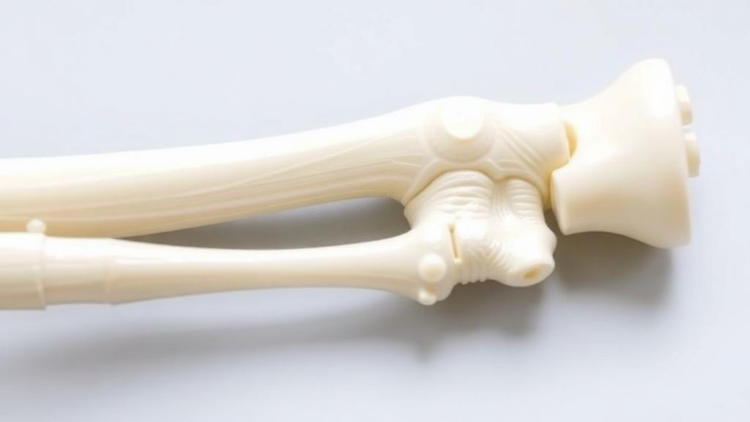
The defining hardware innovation is the extramedullary cloverleaf sleeve, whose inner wall and the surface of the intramedullary stem are coated with 3D-printed metal porous structures. Porous titanium lattices of this kind serve two purposes simultaneously. Mechanically, they create a frictional, interlocking surface that grips bone during the critical early period before biological fixation matures. Biologically, their interconnected pores invite bone to grow into the implant, converting a press-fit mechanical wedge into a living, load-sharing composite of metal and bone. Additive manufacturing is what makes this feasible: conventional machining cannot produce the intricate, graded porosity that 3D printing lays down layer by layer, and the same digital workflow means a patient-specific implant can in principle be printed from computed tomography data of the individual’s residual femur.
Before any animal was operated on, the team subjected the four design variants to rigorous finite element analysis. Finite element analysis, or FEA, is a computational technique that divides a complex structure into thousands of small elements and solves the equations of elasticity for each, producing maps of stress and displacement that would be impossible to measure directly inside a living limb. The researchers built their models from adult femoral CT data, ensuring that the geometry and material distribution of the bone reflected real anatomy rather than an idealized cylinder. They then simulated two clinically meaningful loading scenarios: vertical compressive loads of 600 and 900 newtons, approximating the forces transmitted through the femur during stance phase and more demanding activities, and torsional moments of 15,000 and 20,000 newton-millimeters, representing the twisting loads generated when the foot pivots or the patient stumbles.
The computational results delivered a clear verdict on the cloverleaf sleeve. Prostheses equipped with the extramedullary sleeve exhibited lower peak stresses under high vertical loading and a more dispersed stress distribution across the bone-implant interface compared with intramedullary fixation alone. They also demonstrated superior resistance to displacement, meaning the construct was less likely to subside or rotate under load. This matters because stress concentration is the silent killer of orthopedic implants: where stress piles up at a single point on the bone-implant interface, bone resorbs, micromotion increases, and the fixation spirals toward aseptic loosening. By spreading load over a broader area and shielding the cortical bone with the sleeve, the Type II design mimics the way a healthy femur distributes the forces of gait — a principle biomechanists call favorable load transfer. The FEA contour plots gave the team the quantitative evidence needed to select the optimal configuration for the animal phase.
That animal phase was the study’s most ambitious component. The researchers constructed a mid-femoral amputation model in Small-tailed Han sheep, using three animals, and implanted the Type IIa prosthesis — the combined intramedullary press-fit and extramedullary sleeve design without auxiliary anti-rotation screws. The surgical protocol mirrored what would eventually be proposed for human patients: the intramedullary cavity was reamed to accept the stem, and the cortical bone was decorticated, a technique that removes the dense outer layer to stimulate bleeding and activate the bone-healing response at the implant surface. Sheep are a demanding test bed for orthopedic implants because their bone remodeling rates and loading patterns approximate the human situation better than smaller rodents, and because a transcutaneous implant in a quadruped endures constant, uncontrolled loading.
The outcomes reported from the sheep model were strikingly positive. The implants achieved stable fixation, with no obvious infection developing around the transcutaneous components — historically the single most feared complication of osseointegration, since a permanent opening through the skin provides a potential highway for bacteria to reach the bone. Blood parameters monitored in the study, including white blood cell count, platelet count and hemoglobin, served as systemic indicators of inflammatory response and overall biocompatibility. Most importantly, histological and mechanical evaluation demonstrated favorable osseointegration between the prosthesis and the femur, confirming that the 3D-printed porous surfaces had done their biological job: bone had grown into and bonded with the implant’s lattice architecture, transforming a mechanical press-fit into durable biological fixation.
The significance of this work lies in its methodological completeness. Rather than presenting either a purely computational study or an isolated animal experiment, the team built a preclinical pipeline in which finite element analysis guided design selection, and the selected design was then validated in a large-animal model assessing functional reconstruction, biocompatibility and osseointegration together. The authors state explicitly that the newly designed OIP possesses good biocompatibility and osseointegration capacity, and that the extramedullary cloverleaf sleeve enhances the mechanical properties of the construct — laying what they describe as a theoretical foundation for future clinical application. The work was funded by the National Natural Science Foundation of China, the Beijing Natural Science Foundation Innovation Joint Fund and the Research and Development Fund of Peking University People’s Hospital, and all animal procedures were approved by the institutional animal care and ethics committees at Peking University People’s Hospital.
Caution is still warranted before celebrating a clinical breakthrough. Three sheep constitute a small sample, and the study is explicitly preclinical: no human data exist yet for this specific device, and the long-term behavior of the implant — years of cyclic loading, the durability of the skin seal, the response to accidental overload — remains untested. Existing osseointegration systems such as the OPRA implant and the OPL have already demonstrated in human trials that bone-anchored prostheses can dramatically improve mobility and quality of life, but systematic reviews have catalogued complication rates that include soft-tissue infections, implant fractures and revisions. What the Peking University study contributes is a rational, computationally verified design intended to reduce precisely those complications, with animal data suggesting the strategy works as intended.
Nevertheless, the trajectory is compelling. The convergence of additive manufacturing, patient-specific imaging and rigorous biomechanical simulation is reshaping how implants are conceived: no longer off-the-shelf rods, but engineered structures whose porosity, stiffness and geometry are tuned to the individual patient’s bone and loading demands. If subsequent large-animal studies with longer follow-up and, eventually, carefully controlled clinical trials confirm what this preclinical work suggests, the cloverleaf-sleeved, 3D-printed osseointegration prosthesis could move amputee rehabilitation closer to its long-promised goal — a prosthesis that feels less like an appliance strapped to the body and more like a genuine extension of the skeleton itself. For the millions who struggle daily with socket discomfort and instability, that future cannot come soon enough.
Subject of Research: Preclinical development of a 3D-printed osseointegration prosthesis for residual limb reconstruction after amputation
Article Title: A Preclinical Approach to 3D-Printed Osseointegration Prosthesis: Improving Functional Outcomes and Reducing Complications in Residual Limb Reconstruction
Article References: A Preclinical Approach to 3D-Printed Osseointegration Prosthesis: Improving Functional Outcomes and Reducing Complications in Residual Limb Reconstruction. (n.d.). https://doi.org/10.1007/s10439-026-04401-5
Image Credits: AI Generated
DOI: 10.1007/s10439-026-04401-5
Keywords: osseointegration, 3D printing, prosthesis, finite element analysis, amputation, biomechanics, titanium implant, bone anchoring, residual limb, preclinical study, biocompatibility, cloverleaf sleeve
Cite Scienmag News
APA MLA Chicago
Denise Maddox. (October 1, 2026). 3D-Printed Bone-Anchored Prosthesis Shows Promise in Preclinical Tests. Scienmag. https://scienmag.com/3d-printed-bone-anchored-prosthesis-shows-promise-in-preclinical-tests/
Denise Maddox. “3D-Printed Bone-Anchored Prosthesis Shows Promise in Preclinical Tests.” Scienmag, 1 October 2026, https://scienmag.com/3d-printed-bone-anchored-prosthesis-shows-promise-in-preclinical-tests/. Accessed 1 October 2026.
Denise Maddox. “3D-Printed Bone-Anchored Prosthesis Shows Promise in Preclinical Tests.” Scienmag. October 1, 2026. https://scienmag.com/3d-printed-bone-anchored-prosthesis-shows-promise-in-preclinical-tests/
Copy citation Download RIS
Tags: 3D printing3D printing in prosthetic engineering3D-printed bone-anchored prosthesisamputationbiocompatibilitybiomechanical analysis of bone-anchored prosthesesbiomechanicsbone anchoringclinical challenges in limb prostheticscloverleaf sleeveenhancing prosthetic limb stability and comfortfinite element analysisinfection prevention in prosthetic implantsinnovative designs for osseointegration systemslarge-animal model for prosthesis developmentosseointegrationosseointegration limb prosthesisovercoming prosthesis implant failure modespreclinical studypreclinical testing of osseointegration implantsprosthesisregenerative engineering for limbresidual limbtitanium implant