• HOME
  • NEWS
  • EXPLORE
    • CAREER
      • Companies
      • Jobs
    • EVENTS
    • iGEM
      • News
      • Team
    • PHOTOS
    • VIDEO
    • WIKI
  • BLOG
  • COMMUNITY
    • FACEBOOK
    • INSTAGRAM
    • TWITTER
Wednesday, June 17, 2026
BIOENGINEER.ORG
No Result
View All Result
  • Login
  • HOME
  • NEWS
  • EXPLORE
    • CAREER
      • Companies
      • Jobs
        • Lecturer
        • PhD Studentship
        • Postdoc
        • Research Assistant
    • EVENTS
    • iGEM
      • News
      • Team
    • PHOTOS
    • VIDEO
    • WIKI
  • BLOG
  • COMMUNITY
    • FACEBOOK
    • INSTAGRAM
    • TWITTER
  • HOME
  • NEWS
  • EXPLORE
    • CAREER
      • Companies
      • Jobs
        • Lecturer
        • PhD Studentship
        • Postdoc
        • Research Assistant
    • EVENTS
    • iGEM
      • News
      • Team
    • PHOTOS
    • VIDEO
    • WIKI
  • BLOG
  • COMMUNITY
    • FACEBOOK
    • INSTAGRAM
    • TWITTER
No Result
View All Result
Bioengineer.org
No Result
View All Result
Home NEWS Science News

3-D reconstruction of skull suggests a small crocodile is a new species

Bioengineer by Bioengineer
February 15, 2017
in Science News
Reading Time: 2 mins read
0
Share on FacebookShare on TwitterShare on LinkedinShare on RedditShare on Telegram
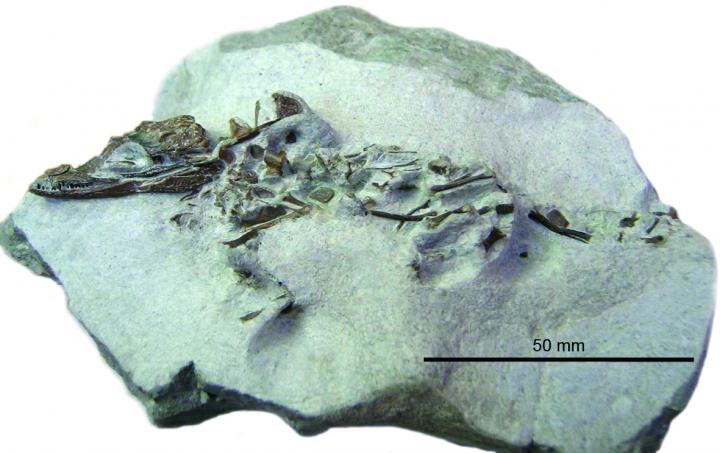
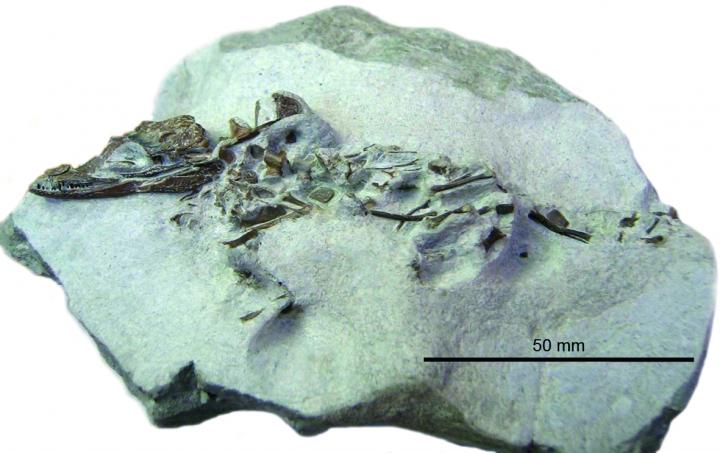
IMAGE

Credit: Schwarz et al (2017)

A small crocodile discovered in Germany's Langenberg Quarry may be a new species, according to a study published February 15, 2017 in the open-access journal PLOS ONE by Daniela Schwarz from Leibniz Institute for Evolutionary and Biodiversity Research, Germany, and colleagues.

The Langenberg Quarry has proven to be a rich source of marine-related fossils, including small crocodile-like atoposaurid species. The fossilized remains of this crocodile were exceptionally well-preserved but were still partly in sediment, making it difficult to examine the fossils fully. After initial analysis, the crocodile was assigned to the Theriosuchus genus. To study this atopasaurid in more detail, Schwarz and colleagues did a 3-D reconstruction of one of the fossil skulls based on micro-computed tomography.

The researchers concluded that the atoposaurid they studied is actually a new species, which they call Knoetschkesuchus. This conclusion is based on unique features of the skull, such as openings in the jaw bone and in front of the eye, as well as of tooth morphology. The latter may have reflected dietary specialization, and diversity of tooth morphology is thought to have been a driver of atoposaurid evolution during the Jurassic.

"The study describes a new diminutive crocodile Knoetschkesuchus langenbergensis that lived around 154 Million years ago in Northwestern Germany," says Schwarz. "Knoetschkesuchus belongs to the evolutionary lineage that leads to modern crocodiles and preserves ­ for the first time in this group ­ two skulls in 3D, allowing us detailed anatomical studies via micro-CT images. Our research is part of the Europasaurus-Project which studies the remains of a unique Jurassic island ecosystem in Northern Germany."

###

In your coverage please use this URL to provide access to the freely available paper: http://dx.plos.org/10.1371/journal.pone.0160617

Citation: Schwarz D, Raddatz M, Wings O (2017) Knoetschkesuchus langenbergensis gen. nov. sp. nov., a new atoposaurid crocodyliform from the Upper Jurassic Langenberg Quarry (Lower Saxony, northwestern Germany), and its relationships to Theriosuchus. PLoS ONE 12(2): e0160617. doi:10.1371/journal.pone.0160617

Funding: The Volkswagen Foundation generously funded the Europasaurus-Project (grant no. 85 882) and OW in the grant initiative "Research in Museums."

Competing Interests: The authors have declared that no competing interests exist.

Media Contact

Beth Jones
[email protected]

Home

############

Story Source: Materials provided by Scienmag

Share12Tweet8Share2ShareShareShare2

Related Posts

Loss of Smell as Devastating as Parkinson’s and Stroke, New Study Reveals — Biology

Loss of Smell as Devastating as Parkinson’s and Stroke, New Study Reveals

June 17, 2026
KAIST Enhances Humanoid Robot Vision Using Minimal Memory — Technology and Engineering

KAIST Enhances Humanoid Robot Vision Using Minimal Memory

June 17, 2026

New Research Reinforces Alcohol’s Role in Fatal Pancreatic Cancer

June 16, 2026

Rice Husk Biochar Catalyst Rapidly Decomposes Antibiotic Pollutants in Minutes

June 16, 2026
Please login to join discussion

POPULAR NEWS

  • ESMO 2025: mRNA COVID Vaccines Enhance Efficacy of Cancer Immunotherapy

    326 shares
    Share 130 Tweet 82
  • Saying Goodbye to PGY-6: Pediatric Fellowship Realities

    101 shares
    Share 40 Tweet 25
  • Multi-Hospital Study Reveals Long Covid Burden Is Twice as High as Current Estimates

    91 shares
    Share 36 Tweet 23
  • Detection of EDCs in Breast Milk and Infant Urine Up to Six Months Highlights Early Exposure Risks

    75 shares
    Share 30 Tweet 19

About

We bring you the latest biotechnology news from best research centers and universities around the world. Check our website.

Follow us

Recent News

Loss of Smell as Devastating as Parkinson’s and Stroke, New Study Reveals

KAIST Enhances Humanoid Robot Vision Using Minimal Memory

New Research Reinforces Alcohol’s Role in Fatal Pancreatic Cancer

Subscribe to Blog via Email

Enter your email address to subscribe to this blog and receive notifications of new posts by email.

Join 82 other subscribers
  • Contact Us

Bioengineer.org © Copyright 2023 All Rights Reserved.

Welcome Back!

Login to your account below

Forgotten Password?

Retrieve your password

Please enter your username or email address to reset your password.

Log In
No Result
View All Result
  • Homepages
    • Home Page 1
    • Home Page 2
  • News
  • National
  • Business
  • Health
  • Lifestyle
  • Science

Bioengineer.org © Copyright 2023 All Rights Reserved.