Credit: @Science China Press
Calcium ions are presented in rocks, bones, shells, biominerals, geological deposits, ocean sediments, and many other important materials. Calcium ions also play major roles in the retention of carbon dioxide in natural waters, water hardness, signal transduction and tissue generation. As one of the alkaline earth metals, the calcium atom has two valence electrons according to the octet rule. Up to now, the only known valence state of calcium ions under ambient conditions is +2, and the corresponding crystals with calcium ions are insulating.
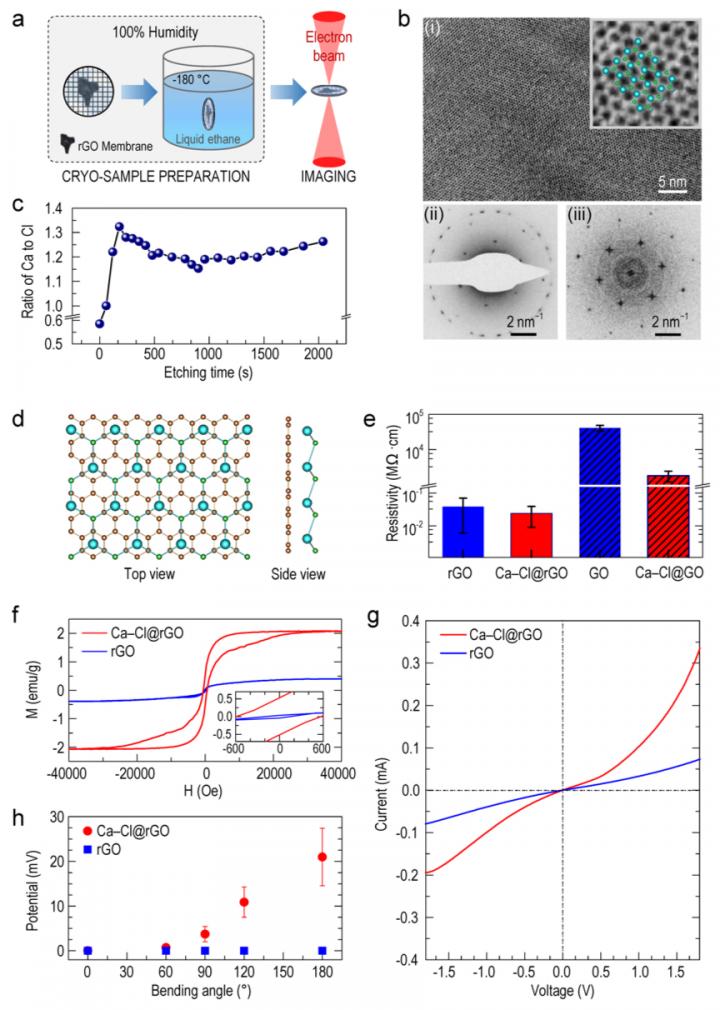
By using cryo-electron microscopy, scientists reported the direct observation of two-dimensional (2D) CaCl crystals on reduced graphene oxide (rGO) membranes under ambient conditions, which exhibit only monovalent (i.e. +1) calcium ions. Remarkably, metallic rather than insulating properties are displayed by those 2D CaCl crystals, and more interestingly, room-temperature ferromagnetism, resulted graphene-CaCl heterojunction, coexistence of piezoelectricity and metallicity, together with the distinct hydrogen storage and release capability under ambient conditions are experimentally demonstrated.
It should be noted that conventionally, metallic materials generally do not show a piezoelectricity. Such unexpected piezoelectricity-like behavior of the metallic CaCl crystals is induced by the abnormal 2D CaCl structure that the structure is metallic due to the monovalent behavior of the Ca ions on the one hand, and on the other hand the structure has two elements (Ca and Cl) with different electric effects under compressive or tensile strain. Therefore, the 2D CaCl crystals are a novel material that has both metallic character and piezoelectric property, and will have great novel applications as transistors down to the atomic scale and nanotransistor devices.
So far as we know, room-temperature ferromagnetism has never been observed for a main group metal element. Theoretical study reveals that the possible origin of such room-temperature ferromagnetism is the edge or defect effects of the CaCl crystals, where there is an unpaired valence electron in Ca+, then it is expected that every metal element has room-temperature ferromagnetism via forming the correspondingly abnormal 2D crystals.
Theoretical studies show that the formation of such abnormal crystal is attributed to the strong cation-π interactions of the Ca cations with the aromatic rings in the graphene surfaces. Since strong cation-π interactions also exist between other metal cations (such as Mg2+, Fe2+, Co2+, Cu2+, Cd2+, Cr2+ and Pb2+) and graphitic surfaces, similar crystals with abnormal valence of other metal cations are expected.
These findings not only present a breakthrough on the 2D crystals with abnormal cation-anion ratio, novel valence of cations, and unexpected conductivity, but also provide seminal works in material, biological, chemical and physical applications. The properties and behaviors of 2D crystals break the general knowledge about this widely distributed element in daily life, and they will definitely attract attention and prompt thought about its exciting applications in various fields.
These properties and behaviors of the 2D crystals will also highly expand the applications for the functionalized graphene. Further, considering the wide distribution of metallic cations and carbon on earth, such nanoscale “special” compounds with previously unrecognized properties may be ubiquitous in nature.
###
This research received funding from the National Natural Science Foundation of China, the Chinese Academy of Sciences, and the Ministry of Education of China.
See the article:
Lei Zhang, Guosheng Shi, Bingquan Peng, Pengfei Gao, Liang Chen, Ni Zhong, Liuhua Mu, Lijuan Zhang, Peng Zhang, Lu Gou, Yimin Zhao, Shanshan Liang, Jie Jiang, Zejun Zhang, Hongtao Ren, Xiaoling Lei, Ruobing Yi, Yinwei Qiu, Yufeng Zhang, Xing Liu, Minghong Wu, Long Yan, Chungang Duan, Shengli Zhang, and Haiping Fang
Novel 2D CaCl crystals with metallicity, room-temperature ferromagnetism, heterojunction, piezoelectricity-like property, and monovalent calcium ions
Natl Sci Rev, 2020, doi: 10.1093/nsr/nwaa274
https:/
Media Contact
Haiping Fang
[email protected]
Original Source
http://doi.
Related Journal Article
http://dx.