Credit: Cancer Research UK
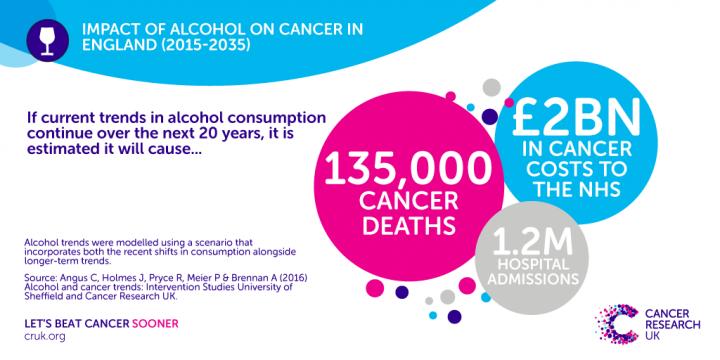
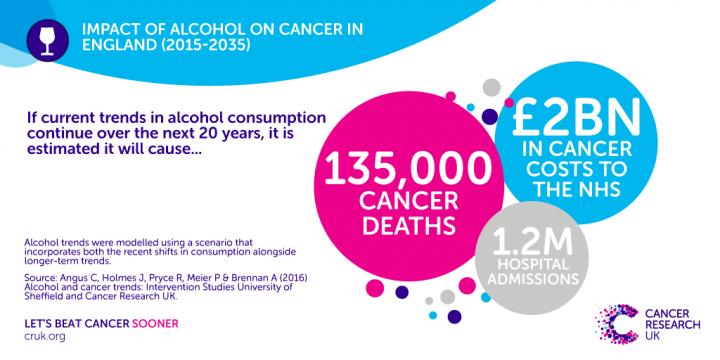
ALCOHOL will cause around 135,000 cancer deaths over the next 20 years and will cost the NHS an estimated £2 billion in treatments, according to estimates from a new report* by Sheffield University, commissioned by Cancer Research UK**.
The new figures, published today (Friday), reveal that by 2035 the UK could see around 7,100 cancer deaths every year that are associated with alcohol. Of the cancer types included in the report, oesophageal cancer is set to see the largest increase, followed by bowel cancer, mouth and throat cancer, breast cancer and liver cancer***.
The report also forecasts that there will be over 1.2 million hospital admissions for cancer over the 20 year period, which will cost the NHS £100 million, on average, every year.
The results were based on analyses that assume alcohol drinking trends will follow those seen over the last 40 years, and takes recent falls in alcohol consumption, including among young people, into account****.
Evidence suggests that the more alcohol you drink, the higher the risk of cancer. UK government guidelines, published earlier this year, advise that both men and women drink no more than 14 units of alcohol a week.
The latest figures follow a Cancer Research UK study published earlier in the year that showed 9 in 10 people are unaware of the link between alcohol and cancer *****.
The report also examined the impact of introducing a minimum unit price for alcohol in England. It found that over 20 years a 50p minimum price per units of alcohol could reduce deaths linked to alcohol by around 7,200, including around 670 cancer deaths. It would also reduce healthcare costs by £1.3 billion. This follows a recent court decision in Scotland which found that a minimum unit price would not break European law.
Alison Cox, the Director of Prevention at Cancer Research UK, said: "These new figures reveal the devastating impact alcohol will have over the coming years. That's why it's hugely important the public are aware of the link between alcohol and cancer, and what they can do to improve their risk.
"If we are to change the nation's drinking habits and try to mitigate the impact alcohol will have then national health campaigns are needed to provide clear information about the health risks of drinking alcohol."
Professor Sir Ian Gilmore, chair of the Alcohol Health Alliance, said: "These latest figures show the serious consequences for individuals, the NHS and society if the UK government continues to ignore the consequences of the nation's drinking. In particular they reinforce the need for a minimum unit price (MUP) for alcohol. It is clear from the report that MUP will save lives, including those lost to cancer, and ease the burden on our health service. Importantly, MUP will do this while leaving moderate drinkers and prices in pubs and bars unaffected.
In addition, we need mandatory health information on the labels of all alcoholic products, informing the public of the link between alcohol and cancer, and the new low-risk drinking guidelines.
The public have the right to know about how their drinking impacts their health, so that they are empowered to make informed choices."
###
For media enquiries contact Sarah Cowen-Rivers in the Cancer Research UK press office on 020 3469 6189 or, out of hours, on 07050 264 059.
Notes to editor:
* Angus C, Holmes J, Pryce R, Meier P & Brennan A (2016) Alcohol and cancer trends: Intervention Studies University of Sheffield and Cancer Research UK. https://www.cancerresearchuk.org/sites/default/files/alcohol_and_cancer_trends_report_cruk.pdf
** Alcohol trends were estimated across the whole population for England in 2015-2035. Using a scenario that incorporates both the recent shifts in consumption alongside longer-term trends, the average consumption is estimated to be 14.6 units/week and the abstention rate 20.7%.
Scenario In 20 years with no change (baseline)
Health outcomes: mortality
All deaths from alcohol-related conditions 12,778
All deaths from alcohol-related cancers 7,097
of which: Oesophageal cancer 3,674
Other mouth and throat cancer 887
Colorectal cancer 1,369
Liver cancer 333
Breast cancer 835
**** Smoking drinking and drug use among young people in England in 2014: Health and Social Care Information Centre, 2015. http://content.digital.nhs.uk/catalogue/PUB17879
*****Based on figures from a Cancer Research UK commissioned report 'An investigation of public knowledge of the link between alcohol and cancer', 2016.
Media Contact
Sarah Cowen-Rivers
[email protected]
44-203-469-6189
@CR_UK
http://www.cancerresearchuk.org
############
Story Source: Materials provided by Scienmag