Credit: Eindhoven University of Technology
The electronic data connections within and between microchips are increasingly becoming a bottleneck in the exponential growth of data traffic worldwide. Optical connections are the obvious successors but optical data transmission requires an adequate nanoscale light source, and this has been lacking. Scientists at Eindhoven University of Technology (TU/e) now have created a light source that has the right characteristics: a nano-LED that is 1000 times more efficient than its predecessors, and is capable of handling gigabits per second data speeds. They have published their findings in the online journal Nature Communications.
With electrical cables reaching their limits, optical connections like fiberglass are increasingly becoming the standard for data traffic. Over longer distances almost all data transmission is optical. Within computer systems and microchips, too, the growth of data traffic is exponential, but that traffic is still electronic, and this is increasingly becoming a bottleneck. Since these connections ('interconnects') account for the majority of the energy consumed by chips, many scientists around the world are working on enabling optical (photonic) interconnects. Crucial to this is the light source that converts the data into light signals which must be small enough to fit into the microscopic structures of microchips. At the same time, the output capacity and efficiency have to be good. Especially the efficiency is a challenge, as small light sources, powered by nano- or microwatts, have always performed very inefficiently to date.
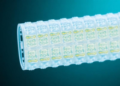
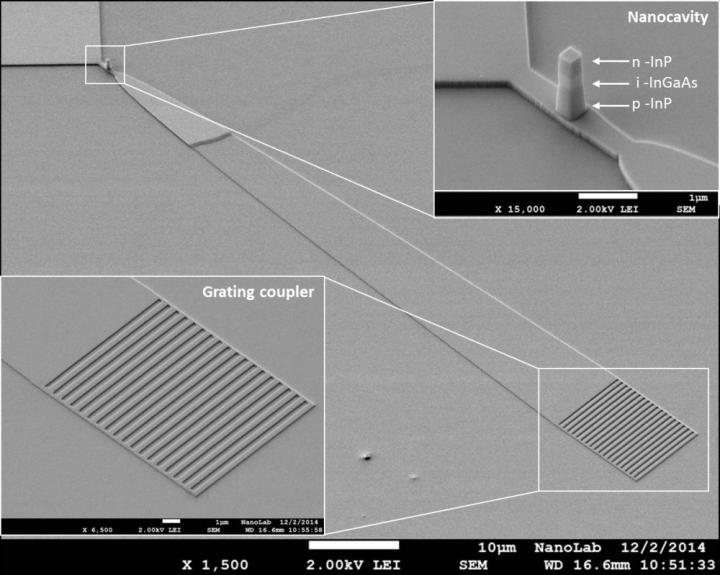
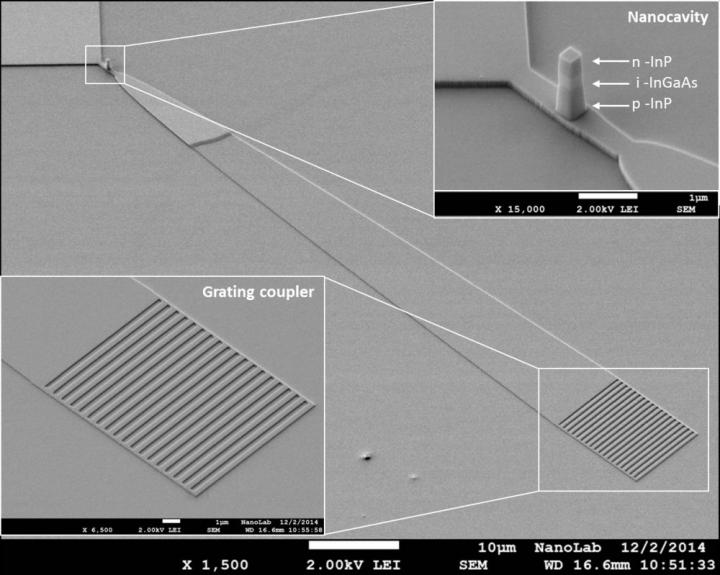
Researchers at TU Eindhoven have now developed a light-emitting diode (LED) of some hundred nanometers with an integrated light channel (waveguide) to transport the light signal. This integrated nano-LED is a 1000 times more efficient than the best variants developed elsewhere. The Eindhoven-based researchers have especially made progress in the quality of the integrated coupling of the light source and the waveguide whereby much less light is lost and therefore far more light enters the waveguide. The efficiency of the new nano-LED currently lies between 0.01 and 1 percent, but the researchers expect to be well above that figure soon thanks to a new production method.
Another key characteristic of the new nano-LED is that it is integrated into a silicon substrate on a membrane of indium phosphide. Silicon is the basic material for microchips but is not suitable for light sources whereas indium phosphide is. Furthermore, tests reveal that the new element converts electrical signals rapidly into optical signals and can handle data speeds of several gigabits per second.
The researchers in Eindhoven believe that their nano-LED is a viable solution that will take the brake off the growth of data traffic on chips. However, they are cautious about the prospects. The development is not yet at the stage where it can be exploited by the industry and the production technology that is needed still has to get off the ground.
###
The paper 'Waveguide-coupled nanopillar metal-cavity light-emitting diodes on silicon' appeared on 2 February 2017 in Nature Communications, and can be found under reference number DOI 10.1038/ncomms14323. The authors are V. Dolores-Calzadilla, B. Romeira, F. Pagliano, S. Birindelli, A. Higuera-Rodriguez, P.J. van Veldhoven, M.K. Smit, A. Fiore and D. Heiss.
The study is part of the Dutch Gravitation Programme 'Research Centre for Integrated Nanophotonics' being performed at TU/e. The Institute for Photonic Integration of TU/e is one of the world's leading research institutes for integrated photonics.
Media Contact
Andrea Fiore
[email protected]
31-630-239-122
@TUEindhoven
http://www.tue.nl/en
############
Story Source: Materials provided by Scienmag