After cancer spreads, finding and destroying malignant cells that circulate in the body is usually critical to patient survival. Now, researchers reporting in the Cell Press journal Chemistry & Biology have developed a new method that allows investigators to label and track single tumor cells circulating in the blood. This advance could help investigators develop a better understanding of cancer spread and how to stop it.
University of Arkansas at Little Rock
Cancer spread, or metastasis, leads to up to 90% of cancer deaths. Investigators currently do not have the clinical capability to intervene and stop the dissemination of tumor cells through metastasis because many steps of this process remain unclear. It is known that cancer cells undergo multiple steps, including invasion into nearby normal tissue, movement into the lymphatic system or the bloodstream, circulation to other parts of the body, invasion of new tissues, and growth at distant locations. Now, a new approach developed by Dr. Ekaterina Galanzha of the University of Arkansas for Medical Sciences in Little Rock and her colleagues allows for labeling and tracking of individual circulating cancer cells throughout the body, thereby helping researchers elucidate the pathways of single cells from start to finish.
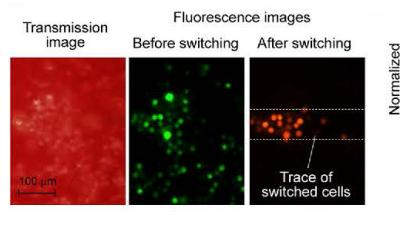
These are images of cancer cells moving with a velocity of 1 mm/s across a linear laser beam having a power of 30mW. Photo Credit: Chemistry & Biology, Nedosekin et al.
The advance uses photoswitchable fluorescent proteins that change their color in response to light. When the first laser of light hits the circulating tumor cells, they appear to be fluorescent green. A second laser, using a different wavelength, makes the cells appear to be fluorescent red. To label individual cells, researchers use a very thin violet laser beam aimed at small blood vessels.
The fluorescence from each cell is collected, detected, and reproduced on a computer monitor as real-time signal traces, allowing the investigators to count and track individual cells in the bloodstream
“This technology allows for the labeling of just one circulating pathological cell among billions of other normal blood cells by ultrafast changing color of photosensitive proteins inside the cell in response to laser light,” explains Dr. Galanzha.
In tumor-bearing mice, the researchers could monitor the real-time dynamics of circulating cancer cells released from a primary tumor. They could also image the various final destinations of individual circulating cells and observe how these cells travel through circulation and colonize healthy tissue, existing sites of metastasis, or the site of the primary tumor. “Therefore, the approach may give oncologists knowledge on how to intervene and stop circulating cancer cell dissemination that might prevent the development of metastasis,” she says.
The approach might also prove useful for other areas of medicine — for example, tracking bacteria during infections or immune-related cells during the development of autoimmune disease.
Story Source:
The above story is based on materials provided by Cell Press.