When babies learn to talk or birds learn to sing, the same principle applies: listen and then imitate. This is how the first babble becomes the first word or vocalization. Male zebra finch chicks initially memorize the song of an adult bird. Later, they refine their own vocalization until they resemble the learned song. Researchers at the Max Planck Institute for Biological Intelligence have now shown that the first vocalizations of zebra finches play a role even before they practice to sing on their own. The initial babbling is necessary to memorize songs in the first place. This is in line with findings in human infants, where the babbling of babies also plays a crucial role in language acquisition.
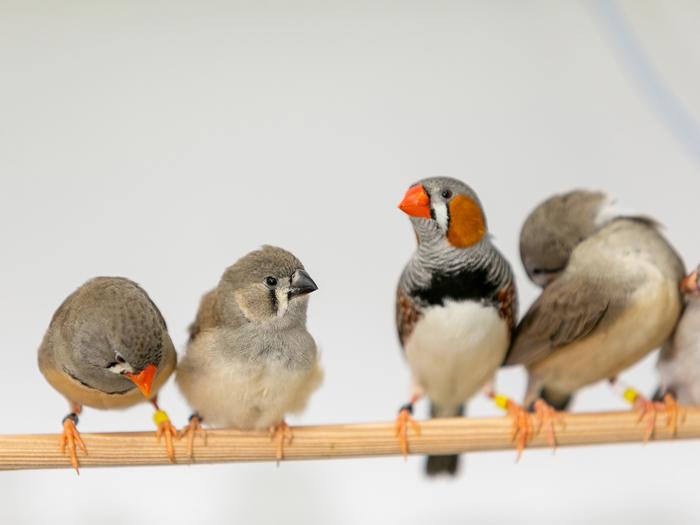
Credit: MPI for Biological Intelligence/ Axel Griesch
When babies learn to talk or birds learn to sing, the same principle applies: listen and then imitate. This is how the first babble becomes the first word or vocalization. Male zebra finch chicks initially memorize the song of an adult bird. Later, they refine their own vocalization until they resemble the learned song. Researchers at the Max Planck Institute for Biological Intelligence have now shown that the first vocalizations of zebra finches play a role even before they practice to sing on their own. The initial babbling is necessary to memorize songs in the first place. This is in line with findings in human infants, where the babbling of babies also plays a crucial role in language acquisition.
A male zebra finch chick hatches from its egg. Around 3-4 weeks later, it begins to make its first croaking sounds – these do not have much in common with its later song. But by the time it is three months old, the zebra finch has finished practicing its vocalizations: The song is now fully developed. And this is exactly what it will be singing for the rest of his life, to find a mate or to defend its territory.
Learning to sing in zebra finches is similar to learning to speak in humans: Chicks or babies imitate what they hear – for zebra finches it is usually the father`s song. The chicks go through two learning phases. Around 25 days after hatching, they begin to memorize the song of their tutor and store it as a template (sensory phase). The sensorimotor phase, which runs in parallel, begins a little later: In this phase, the chicks refine their own calls until they resemble the memorized template song.
Babbling triggers memorizing songs
It was previously assumed that the initial babblings initiate the sensorimotor phase, the time at which the chicks begin to imitate the memorized song. The mechanisms that trigger the previous, sensory phase of song learning remained unclear. Albertine Leitão and Manfred Gahr from the Max Planck Institute for Biological Intelligence have now shown that the babbling already initiates the first, sensory phase – thereby challenging the previous concept of song learning in zebra finches.
For their investigations, the researchers gave male zebra finch chicks the sex hormone testosterone. This caused the chicks to start babbling earlier than usual. Interestingly, the sensory phase also started earlier in these cases. To show that these two observations are linked, the researchers studied chicks that were temporarily unable to babble: They were unable to memorize their tutor`s song.
The researchers thus show that the role of babbling starts earlier than previously thought: The chicks have to babble in order to learn the song they intend to imitate. This probably creates connections in the brain that enable the zebra finches to memorize and store the song in the first place. This is consistent with findings in humans: The pre-linguistic babbling of babies plays a decisive role in their learning success during language acquisition.
Journal
Proceedings of the National Academy of Sciences
DOI
10.1073/pnas.2312323121
Subject of Research
Animals
Article Title
Babbling opens the sensory phase for imitative vocal learning
Article Publication Date
15-Apr-2024