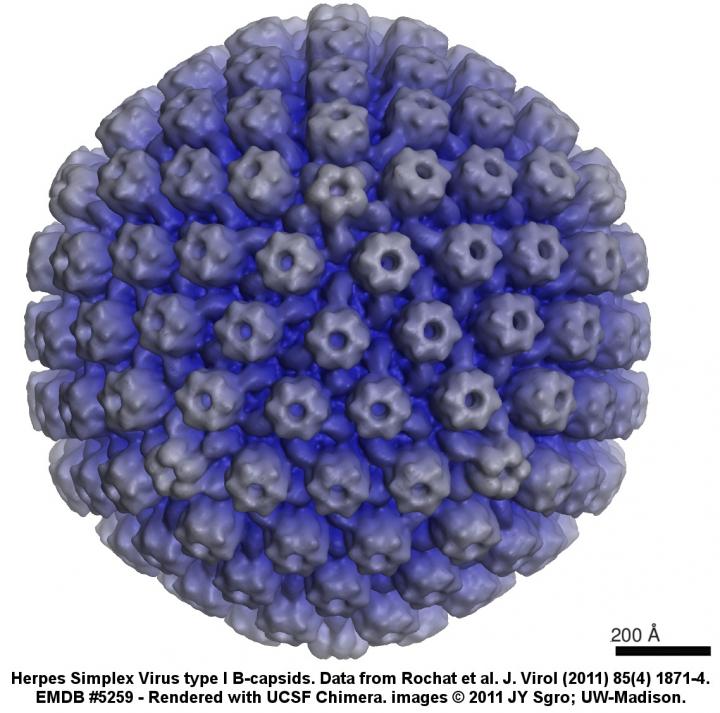
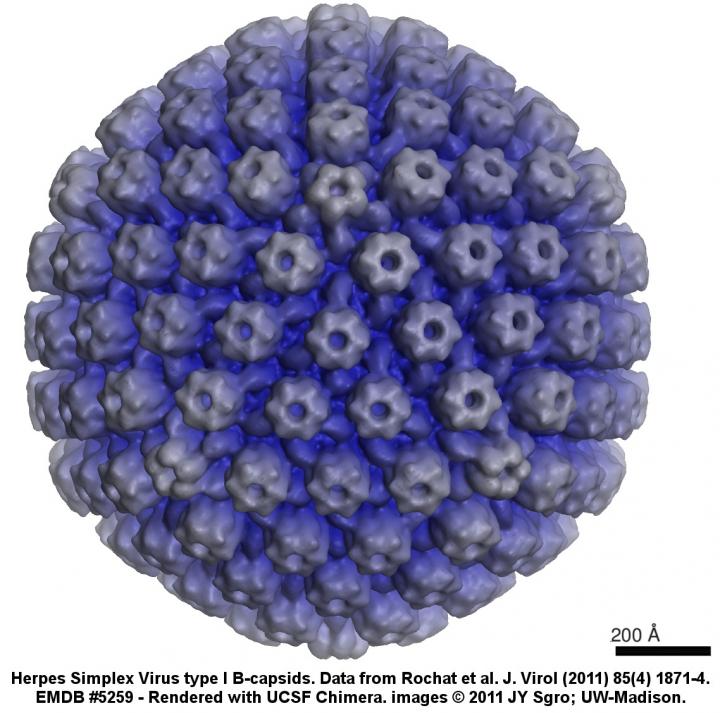
The genomes of two distinct strains of the virus that causes the common lip cold sore, herpes simplex virus type 1 (HSV-1), have been identified within an individual person — an achievement that could be useful to forensic scientists for tracing a person's history. The research also opens the door to understanding how a patient's viruses influence the course of disease. The research by an international team led by Moriah L. Szpara, assistant professor of biochemistry and molecular biology at Penn State University, will be published in the May 2016 issue of the journal Virology.
Most people harbor HSV-1, frequently as a strain acquired from their mothers shortly after birth and carried for the rest of their lives. The new discovery was made with the help of a volunteer from the United States. The research revealed that one strain of the HSV-1 virus harbored by this individual is of a European/North American variety and the other is an Asian variety — likely acquired during the volunteer's military service in the Korean War in the 1950s.
"It's possible that more people have their life history documented at the molecular level in the HSV-1 strains they carry," said Derek Gatherer, a lecturer in the Division of Biomedical and Life Sciences at Lancaster University in the United Kingdom and a member of the research team, which also includes scientists at Georgia State University, the University of Pittsburgh, and Princeton University.
Earlier research by the same team has demonstrated that the geographical origin of HSV-1 can be predicted, as well. Since Asian, African, and European/North American varieties of the virus exist, and the virus is often acquired early in life, the research implies that a personal strain of HSV-1 can reflect a person's origin. Another implication is that two individuals who have identical strains of HSV-1 are more likely to be related than those who have different strains.
"Using similar genetic fingerprinting of HSV-1 could help flesh out a person's life story, adding an extra layer of genetic information not provided by our genomes alone. Forensic virology could be on the way in the same way in which we use genetic fingerprinting of our human DNA to locate perpetrators at the scene of a crime and to help trace the relatives of unidentified bodies," Gatherer said.
"We're working on better ways to sequence viral genomes from ever-smaller amounts of starting material, to allow identification and comparison of samples from diverse sources," said Szpara, who also is affiliated with Penn State's Huck Institutes of the Life Sciences. "Deep sequencing of viruses like HSV-1 will provide a better view of the viral genetic diversity that individuals harbor, and will provide valuable information about how that influences the course of disease."
In addition to Szpara and Gatherer, other members of the research team include Christopher D. Bowen, Daniel W. Renner, and Jacob T. Shreve at Penn State (Eberly College of Science and Huck Institutes of the Life Sciences), Yolanda Tafuri at Princeton University, Kimberly M. Payne and Paul Kinchington at the University of Pittsburgh, and Richard D. Dix at Georgia State University and Emory University.
This research was supported by startup funds from Penn State University, along with funding from the National Institutes of Health, the Eye & Ear Institute of Pittsburgh, and Research to Prevent Blindness, Inc.
###
CONTACTS
Moriah Szpara: [email protected], (+1) 814-867-0008
Barbara Kennedy (PIO): [email protected], (+1) 814-863-4682
IMAGES and ARCHIVE
Images and and archive of this information are at http://science.psu.edu/news-and-events/2016-news/Szpara4-2016.
Media Contact
Barbara K. Kennedy
[email protected]
814-863-4682
@penn_state
http://live.psu.edu