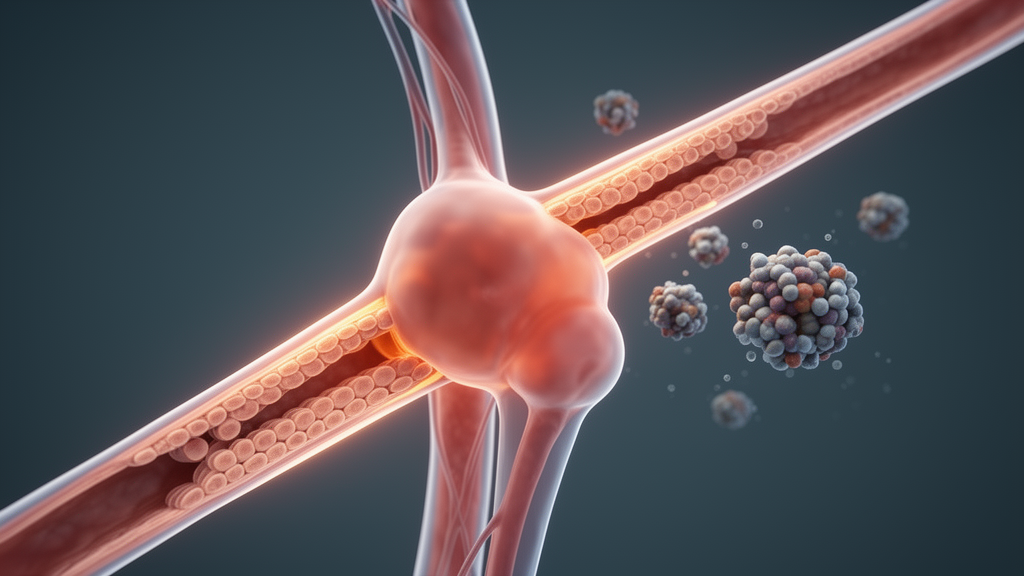
Contrast-enhanced computed tomography revealed appendicitis, but the imaging also detected a rare vascular anomaly: a 20-mm saccular aneurysm at the origin of the left common iliac artery. This incidental finding, alongside an 8-mm gastric varix, prompted a referral to a specialized institution for further management of the aneurysm, which was considered unusual for a patient of his age and health status.
The patient was previously healthy, with no history of lifestyle diseases, smoking habits, or known connective tissue disorders. His physical examination showed no specific signs of eye, skin, oral mucosal, or skeletal abnormalities that might suggest a systemic inflammatory condition. However, a detailed medical history revealed that his mother had a history of uveitis and ankylosing spondylitis, which had been treated with steroids two decades prior. This family history suggested a potential genetic link, specifically the possible inheritance of HLA-B27, a human leukocyte antigen allele associated with ankylosing spondylitis.
Tests for anti-nuclear antibodies, anti-Sjögren’s syndrome type A antibody, and immunoglobulin G4 were also unremarkable, and syphilis antibodies were negative. Vertebral radiography did not reveal specific signs of ankylosing spondylitis, such as marginal sclerosis of the sacroiliac joint or bamboo spine.
The surgical team performed an endovascular aortic repair under general anesthesia to address the aneurysm. Angiography confirmed symmetrical common iliac arteries and the saccular aneurysm at the terminal aorta bifurcation. To prevent a type II endoleak, the surgeons occluded the left fourth lumbar artery using two DELTAFILL devices and the median sacral artery using a DELTAFILL and a Nester device. A bifurcated stent graft, specifically an AFX2 BEA 22–70/I16-30, was delivered to the terminal aorta. The operation lasted 2 hours and 8 minutes, with minimal blood loss of only 5 mL.
The choice of the AFX2 stent graft was driven by the patient’s specific anatomy. The abdominal aorta just above the terminal aorta was narrow, measuring 15 mm in diameter, which posed a risk of compression for other stent graft models. The AFX2, a bifurcated unibody stent graft with an endoskeletal structure, is preferred in cases with a narrow terminal aorta. Postoperative imaging revealed no stent-graft stenosis or migration, and the patient was discharged on postoperative day three with an uncomplicated course. Six months after the procedure, follow-up CT scans showed shrinkage of the common iliac artery aneurysm.
Postoperative HLA typing revealed that the patient was positive for HLA-A11, HLA-A26, HLA-B27, and HLA-B35. The presence of HLA-B27 is notable because it is strongly associated with ankylosing spondylitis, a chronic progressive rheumatoid disease that primarily affects the axial skeleton. In the Japanese population, the prevalence of HLA-B27 is low, at 0.3–0.4%, but 74.8% of Japanese patients with ankylosing spondylitis carry this allele. However, the patient did not present with ankylosing spondylitis, aortic valve regurgitation, or heart conduction disturbances, suggesting that the iliac aneurysm may have developed independently of the HLA-B27 association.
In contrast, HLA-A26 is associated with Behçet’s disease, a chronic relapsing condition that can affect the oral mucosa, skin, eyes, and major organs, including the vascular system. The prevalence of HLA-A26 in the Japanese population is 10.9%, and among Japanese patients with Behçet’s disease, 29.2–30% have this allele. Vascular Behçet’s disease involves arterial and venous inflammation, which can lead to aneurysm formation and vascular occlusion. The presence of a saccular aneurysm and a gastric varix in this patient raised the possibility that he might develop vascular Behçet’s disease in the future, which could manifest with eye, skin, oral mucosal, and joint lesions.
A literature review conducted by the authors searched the Ichushi-Web of Japan Medical Abstract Society, PubMed, and Google Scholar databases. They found seven reports describing eight cases of HLA-B27–positive aortic aneurysms, including thoracic and abdominal aortic aneurysms. In these cases, the average age at discovery was 45 years, and men were affected three times more often than women. In all reported cases, ankylosing spondylitis preceded the aortic dilation and aneurysm diagnosis, and all patients were symptomatic due to aortitis and aortic valve regurgitation.
The review also identified two reports of HLA-A26–positive peripheral arterial aneurysms. Including the current case, the average age at discovery for HLA-A26–positive arterial aneurysms was 34 years, and all three patients were men. The two previously reported cases involved pain at the large aneurysm site, and the aneurysms were pseudoaneurysms. One of these cases was diagnosed with vascular Behçet’s disease. Based on this epidemiological review, the authors suggested that the patient’s iliac artery aneurysm, a type of peripheral arterial aneurysm, may be more strongly associated with HLA-A26 than with HLA-B27.
Treatments for HLA-associated inflammatory aneurysms vary depending on the specific condition and aneurysm location. Surgeries for HLA-B27–positive aortic aneurysms have included aortic valve and root replacement, grafting, and stent grafting. For HLA-A26–positive arterial aneurysms, treatments have included direct ligation and endovascular treatment using a covered stent. In cases of inflammatory abdominal aortic aneurysms, endovascular repair is often considered over open surgery if the anatomy is suitable, as it is less invasive and may reduce the risk of complications such as pseudoaneurysm formation after graft anastomosis.
The decision to perform a minimally invasive endovascular repair in this case was also influenced by the patient’s desire to return to work soon and his concern about potential sexual dysfunction caused by pelvic splanchnic nerve damage during open surgery. The case highlights the importance of careful cardiovascular follow-up for patients with a medical or family history of collagen disease–related vasculitis and specific HLA types.
This case report underscores the rarity of saccular common iliac artery aneurysms in young adults and the potential role of HLA markers in their development. While the patient did not exhibit symptoms of ankylosing spondylitis or Behçet’s disease, the presence of HLA-B27 and HLA-A26 suggests a genetic predisposition to inflammatory vascular conditions. The authors recommend that when aortic aneurysms are incidentally found in young patients, HLA typing should be considered in addition to specific antibodies for collagen diseases.
Common iliac artery aneurysms are typically associated with arteriosclerosis in elderly patients with a history of smoking or lifestyle diseases. In younger individuals, the etiology is often distinct, involving heritable thoracic aortic disease, vasculitis, or trauma. Heritable conditions such as Marfan, vascular Ehlers-Danlos, Loeys-Dietz, and Turner syndromes present with characteristic stature, skin, and skeletal findings linked to well-known genes. This patient had no family history of these heritable conditions or prior abdominal trauma. The probability of abdominal aortic aneurysms being diagnosed in people younger than 40 years is 1.3%, making cases in the twenties exceptionally rare. The aneurysm in this case was located at the origin of the left common iliac artery or the terminal aorta bifurcation, a site where saccular aneurysms are less common than in the descending thoracic and abdominal aortas.
Outpatient ultrasonography performed after the initial appendectomy measured the aneurysm at 13.1 by 19.8 mm at the origin of the left common iliac artery. The imaging showed no to-and-fro streams, which supported the classification of the lesion as a true aneurysm rather than a pseudoaneurysm. The median sacral and left fourth lumbar arteries originated directly from the aneurysm, a vascular configuration that necessitated specific intraoperative management to prevent postoperative complications. The absence of mural thrombi or a mantle on the initial contrast-enhanced computed tomography further characterized the aneurysm’s morphology before surgical intervention.
Surgical guidelines indicate that patients with fusiform common iliac artery aneurysms larger than 35 mm in diameter are considered surgical candidates. In contrast, saccular common iliac artery aneurysms are considered surgical candidates regardless of their size or the patient’s age. For inflammatory abdominal aortic aneurysms, endovascular repair is often preferred over open surgery when the anatomy is suitable, based on Class IIa evidence with level C certainty. This preference is partly due to reports of pseudoaneurysm formation after graft anastomosis in vasculitis-related aneurysms. The minimally invasive approach also addressed the patient’s specific concerns regarding rapid return to work and the risk of sexual dysfunction from pelvic splanchnic nerve damage during open procedures.
Postoperative management in this case involved observation without anti-inflammatory medications, as the patient exhibited no symptoms or specific laboratory findings indicative of active inflammation. In other cases of HLA-associated inflammatory aneurysms, postoperative therapies have included steroids, nonsteroidal anti-inflammatory drugs, coumarins, and colchicine. Preoperative positron emission tomography can be used to diagnose aortic inflammation in stent grafting cases where pathology is indeterminate, though it was not performed in this instance due to cost.
The literature review highlighted that in HLA-B27–positive aortic aneurysms, ankylosing spondylitis consistently preceded the aortic dilation and aneurysm diagnosis. All patients in those reports were symptomatic due to aortitis and aortic valve regurgitation, with aortic aneurysms developing from the sinus of Valsalva to the abdominal aorta. C-reactive protein levels in those cases were not always proportional to aneurysm size. In contrast, the HLA-A26–positive arterial aneurysms reviewed included pseudoaneurysms and multiple lesions, particularly in cases of vascular Behçet’s disease. This distinction helps contextualize the current case, where the aneurysm was a true saccular lesion in a patient without prior symptoms of the associated systemic diseases.
Subject of Research: Surgical case report of a saccular common iliac artery aneurysm in a young adult associated with HLA-A26 and HLA-B27.
Article Title: Saccular common iliac artery aneurysm associated with HLA-A26 and HLA-B27 in a young adult patient: a surgical case report and literature review
Article References: Yasumura, H., Arata, K., Shimoishi, K., Ogata, Y., Matsuba, T., Fukumoto, Y., Yotsumoto, G., & Soga, Y. (2026). Saccular common iliac artery aneurysm associated with HLA-A26 and HLA-B27 in a young adult patient: a surgical case report and literature review. General Thoracic and Cardiovascular Surgery Cases, 5(1), Article 21. https://doi.org/10.1186/s44215-026-00250-9
Image Credits: AI Generated
DOI: 10.1186/s44215-026-00250-9
Keywords: iliac artery aneurysm, HLA-B27, HLA-A26, endovascular repair, young adult, genetic markers, vascular disease, case report, Saccular, common, iliac, artery
News Source: Ophelia Keating. (November 12, 2026). Young Man’s Iliac Aneurysm Linked to HLA Markers. Scienmag.