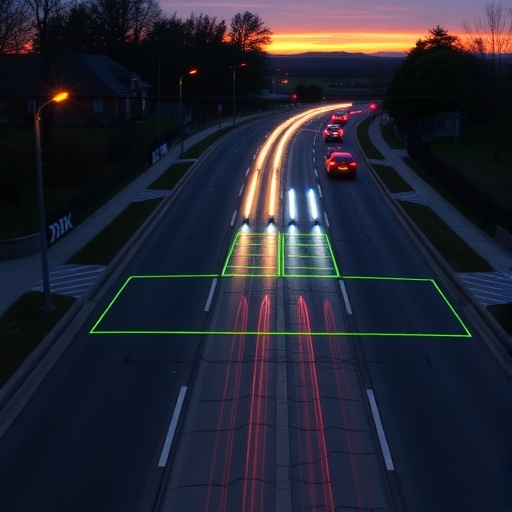
In the realm of autonomous driving and intelligent transport systems, adaptive object detection has emerged as a central theme for enhancing safety and efficiency on our roads. A groundbreaking study conducted by Byenkya, N.L., Rose, N., and Nixson, O. presents a novel approach to this critical topic by utilizing YOLOv11 (You Only Look Once version 11), an advanced deep learning model specifically designed for real-time object detection. The paper, published in 2026 in Discov Artif Intell, delves deep into the intricacies of implementing continuous learning mechanisms that enable these systems to adapt dynamically to the ever-changing road environments they navigate.
Understanding the importance of accurate and timely obstacle detection is essential for vehicle systems that rely on such technologies. In recent years, the integration of AI in transportation has prompted researchers to explore how these systems can not only identify static obstacles but also respond swiftly to dynamic challenges. Traditional approaches often struggle with this adaptability, leading to potential safety hazards. The research conducted by Byenkya et al. showcases a paradigm shift in how autonomous vehicles can perceive their surroundings and make split-second decisions that enhance both safety and performance.
At the core of the study is the YOLOv11 model, an evolution in the YOLO family, known for its high efficiency and accuracy in detecting objects from images or video frames in real-time. This model represents a significant improvement over its predecessors, incorporating advanced neural network architectures that refine its object detection capabilities. Leveraging the robustness of YOLOv11, the authors conduct experiments in a variety of dynamic road environments, ranging from urban settings with heavy traffic to rural landscapes with sporadic obstacles.
One of the flagship features of this research is the continuous learning mechanism integrated into the YOLOv11 framework. Continuous learning allows the model to evolve and improve its detection prowess as it encounters new data from real-world scenarios. This approach contrasts sharply with static models, which often require retraining from scratch when applied to new environments. Therefore, the adaptive nature of this system is a game-changer, allowing it to refine its performance through gradual learning rather than relying solely on pre-trained data sets.
The experiments conducted in the research highlight the effectiveness of continuous learning in enhancing object detection metrics such as accuracy, recall, and precision. As the YOLOv11 model engages with new obstacles and varied conditions, it assimilates information and adjusts its detection algorithms accordingly. The results of these experiments reveal not just improved detection rates but also a reduction in false positives, a critical aspect of ensuring that autonomous vehicles can operate safely amidst the unpredictability of road users and conditions.
Furthermore, the study does not shy away from discussing the challenges faced during the implementation of YOLOv11 in dynamic environments. The authors detail the complexities involved in training the model, particularly in ensuring it can differentiate between moving and stationary objects with high fidelity. This differentiation is vital for applications in autonomous driving, where misidentifying a moving pedestrian as an inert object could lead to catastrophic consequences. By employing a diverse dataset that encapsulates various dynamic scenarios, the researchers ensure that the model is not only robust but also versatile.
The research also dives into the comparative analysis of YOLOv11 against other existing models used for object detection. While many alternatives exist, the study emphasizes how YOLOv11 stands apart due to its multi-scale prediction approach, which enhances recognition at different levels of resolution. This adaptability to scale is imperative when dealing with objects that vary significantly in size or are partially occluded, a common challenge in real-world traffic scenarios.
Moreover, the implications of deploying such an advanced object detection system extend beyond mere road safety. The authors speculate on its potential applications across various sectors, such as smart city infrastructure, where real-time obstacle detection can pave the way for better traffic management systems. The research argues that integrating these systems could facilitate smoother transportation flows, reduce congestion, and, ultimately, lead to greener urban environments.
With the ongoing evolution of transportation technology, the importance of robust, accurate, and adaptive systems cannot be overstated. The findings presented by Byenkya et al. underscore the potential of machine learning to drive innovation in autonomous driving. As these systems become more prevalent, establishing protocols based on adaptive learning will be crucial for their ultimate success in navigating the complexities of human-dominated environments.
In the future, the research hints at the need for collaborative efforts among technologists, policymakers, and transportation agencies. Such partnerships would ensure that as this technology matures, it is woven seamlessly into existing road networks and adheres to safety standards. Such measures not only promise to safeguard lives but also to enhance public trust in autonomous systems.
In conclusion, the study sheds light on a significant leap forward in the pursuit of safer, more efficient roads through the integration of adaptive learning mechanisms in object detection systems. With the implementation of YOLOv11, the possibilities for revolutionizing transportation through intelligent systems are vast. By nurturing this domain, researchers can pave the way for a future where autonomous vehicles don’t merely navigate our roads but do so with the intelligence and adaptability necessary to meet the demands of an ever-evolving world.
As researchers like Byenkya, Rose, and Nixson continue to push the boundaries of what’s possible, the potential for breakthroughs in autonomous vehicle technology stands promising. Achieving a balance between advanced technological capabilities and practical applications will ultimately determine how soon we can realize fully autonomous driving and create the safer, smarter roads of tomorrow.
Subject of Research: Adaptive object detection in dynamic road environments using YOLOv11 with continuous learning.
Article Title: Adaptive object detection in dynamic road environments using YOLOv11 with continuous learning for Real-Time obstacle detection.
Article References:
Byenkya, N.L., Rose, N. & Nixson, O. Adaptive object detection in dynamic road environments using YOLOv11 with continuous learning for Real-Time obstacle detection.
Discov Artif Intell (2026). https://doi.org/10.1007/s44163-025-00828-2
Image Credits: AI Generated
DOI: 10.1007/s44163-025-00828-2
Keywords: adaptive object detection, YOLOv11, continuous learning, real-time detection, autonomous driving
Tags: adaptive object detection for vehiclesadvanced deep learning for transportationAI integration in road safetyautonomous driving safety technologiescontinuous learning in AI systemsdynamic road environment challengesenhancing efficiency in autonomous vehiclesintelligent transport systems innovationsmachine learning in dynamic environmentsnovel approaches to obstacle identificationsplit-second decision making in vehiclesYOLOv11 real-time obstacle detection